Erectile Dysfunction: What Causes It and What Actually Works
Erectile Dysfunction: What Causes It and What Actually Works
Erectile dysfunction is one of the most searched health topics for men — and still one of the most under-explained. Most guys get a quick pill prescription and zero context. Some get told it's "just stress." Very few get a real answer about what's happening in their body and why.
The short answer: Erectile dysfunction means consistently being unable to get or maintain an erection firm enough for sex. It affects an estimated 30 million men in the United States (Heidelbaugh, 2010) and is almost always a signal of something happening elsewhere — in your cardiovascular system, hormones, nervous system, or mental health. The treatments that work do so because they address the underlying mechanism, not just the symptom.
This is the breakdown your doctor should have given you.
Reviewed by the HEXIS Health Medical Team — licensed providers with clinical experience in men's health, hormone optimization, and sexual medicine. Updated June 2026.
What Is Actually Happening When You Have Erectile Dysfunction?
Erectile dysfunction occurs when the physiological cascade that produces an erection fails at one or more points — most commonly a breakdown in blood vessel signaling driven by an enzyme called phosphodiesterase type 5 (PDE5). Understanding this mechanism explains why some treatments work, and why others don't.
An erection requires four things working together: adequate blood flow into the penis, proper nerve signaling, the right hormone levels, and psychological readiness. If any one of those breaks down, the whole system can fail.
The process starts with sexual stimulation triggering the release of nitric oxide (NO) in penile tissue. Nitric oxide activates an enzyme that produces cyclic GMP (cGMP) — a signaling molecule that tells the smooth muscle in penile blood vessels to relax. When those muscles relax, blood rushes in, filling two spongy chambers called the corpora cavernosa, and an erection occurs.
Here's where things go wrong in most men with ED: an enzyme called phosphodiesterase type 5 (PDE5) breaks down cGMP before it can do its job. The blood vessels don't relax enough. Blood flow stays insufficient (Setter et al., 2005).
This is exactly why PDE5 inhibitors — the class of drugs that includes sildenafil (Viagra) and tadalafil (Cialis) — work. They block PDE5 from destroying cGMP, which lets the whole cascade run properly. Understanding this also explains why these drugs don't work as standalone fixes for men whose problem isn't the PDE5 enzyme but something upstream — like low testosterone, severe arterial disease, or nerve damage.
What Causes Erectile Dysfunction?
Erectile dysfunction is caused by impaired blood flow (vascular), nerve damage (neurogenic), hormone deficiency (endocrine), psychological factors, or — most commonly — a combination of all of these. In men over 40, vascular disease accounts for the majority of cases (Montorsi et al., 2003).
Vascular and Cardiovascular Causes
The most common cause of ED is reduced blood flow — specifically, early-stage atherosclerosis in the small arteries feeding the penis. This often shows up years before cardiovascular disease is diagnosed elsewhere.
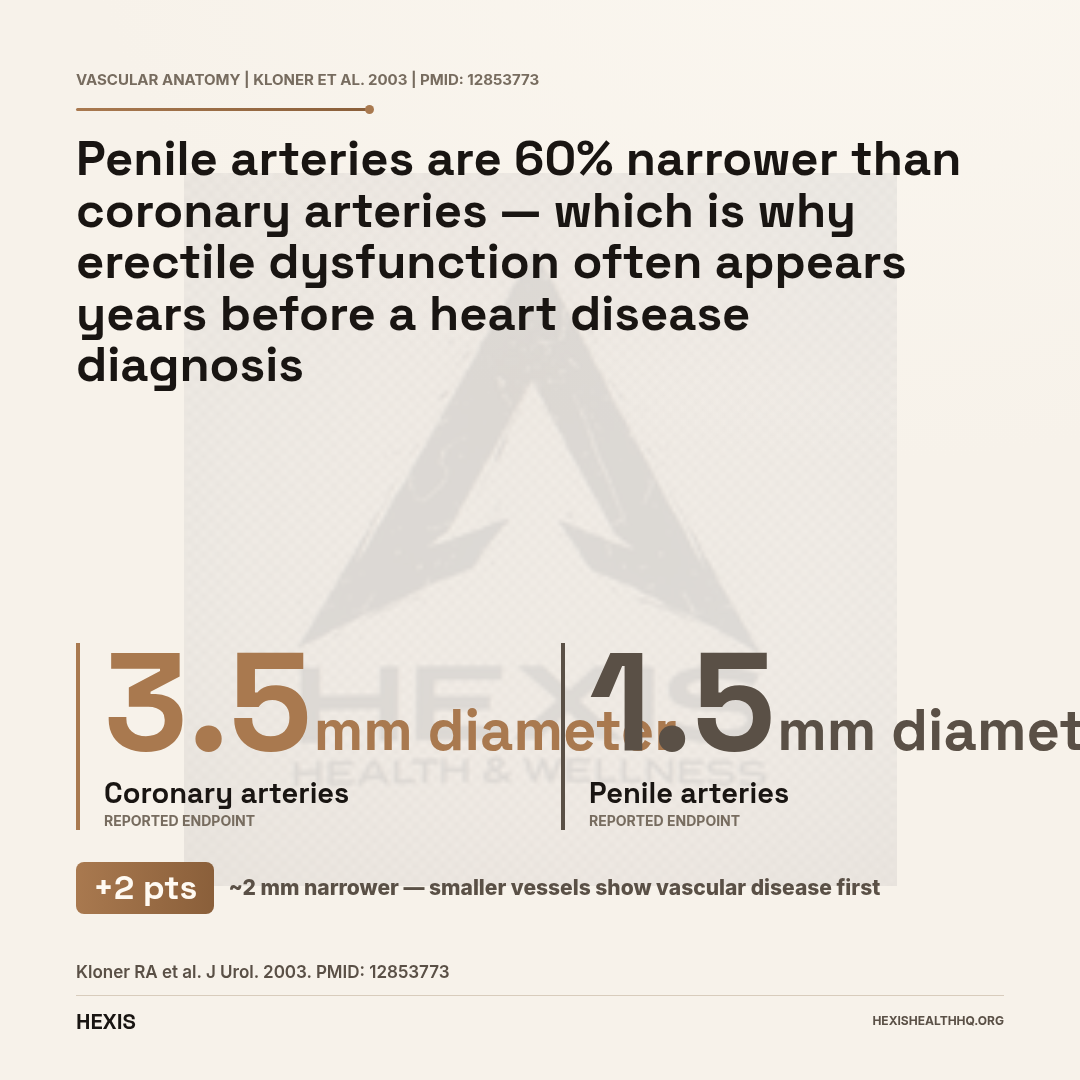
That's not a coincidence. The penile arteries are smaller than coronary arteries, so the same level of arterial plaque that doesn't yet cause chest pain can already be restricting enough blood flow to impair erections. Kloner et al. (2003) described this relationship extensively — erectile dysfunction in a man over 40 should prompt a cardiovascular risk assessment, not just a prescription refill.
Risk factors for vascular ED include hypertension, high cholesterol, smoking, obesity, and type 2 diabetes. Diabetes deserves special mention: it damages both the small blood vessels and the autonomic nerves that regulate penile smooth muscle — a double hit (Basu and Ryder, 2004).
Hormonal Causes
Low testosterone doesn't directly cause erections, but it sets the baseline for libido and for the neural pathways that initiate the erection process. Men with low testosterone frequently report reduced sexual desire first, then difficulty with erections.
Testosterone also plays a role in maintaining the structural integrity of penile smooth muscle tissue. When testosterone drops chronically, the tissue can undergo changes that reduce its responsiveness — one reason why restoring testosterone alone sometimes improves ED, and why it's often used alongside PDE5 inhibitors in men with documented low T.
Neurogenic Causes
Nerve damage is the primary driver of ED in men who've had radical prostatectomy for prostate cancer — the nerves that run along the prostate and control erections are at risk during surgery (Nandipati et al., 2006). The same nerve disruption can result from pelvic radiation, spinal cord injury, multiple sclerosis, or peripheral neuropathy from diabetes.
Neurogenic ED tends to be more treatment-resistant than vascular ED because you can maximize blood flow all you want, but if the signal to trigger relaxation never arrives, the mechanism stalls.
Psychological and Relationship Factors
Performance anxiety, depression, and relationship stress are real drivers of ED — not excuses. The brain is genuinely part of the erection pathway. Anxiety triggers the sympathetic nervous system, which actively inhibits erection. One bad experience creates anticipatory anxiety, which creates another bad experience, and the cycle becomes self-reinforcing.
Psychological ED is more common in younger men. Older men more often present with vascular or hormonal contributors layered underneath psychological factors.
How Is Erectile Dysfunction Diagnosed?
The diagnosis itself is clinical — your history is usually enough. But what matters for treatment is identifying the contributing causes, because treatment varies dramatically based on what's actually driving the problem.
A thorough evaluation includes:
- Medical history and medications — Many common drugs impair erectile function, including beta-blockers, SSRIs, diuretics, and certain antihypertensives (Fazio and Brock, 2004)
- Hormone panel — Total and free testosterone, LH, FSH, prolactin, and thyroid function
- Metabolic labs — Fasting glucose, HbA1c, lipids, and blood pressure
- Penile blood flow assessment — A Doppler ultrasound can measure whether arterial insufficiency or venous leak is present (Katz, 2010)
Skipping the workup and going straight to a pill is the single biggest mistake in ED management. It treats the symptom while the actual problem progresses underneath. Clinically, we find that a significant portion of men presenting with ED have undiagnosed low testosterone, pre-diabetes, or both — conditions that directly drive the dysfunction and are fully addressable. A full hormone panel gives you and your provider the complete picture before any prescription is written.
Critical Drug Interaction
PDE5 inhibitors (Viagra, Cialis, Levitra, Stendra) are absolutely contraindicated with nitrate medications — nitroglycerin, isosorbide, and related compounds. The combination can cause severe, potentially fatal hypotension. If you take nitrates for heart disease, you need cardiology clearance before any ED medication.
Source: Kloner et al., 2003 (PMID: 12853773)
What Are the Treatment Options for Erectile Dysfunction?
PDE5 Inhibitors: First-Line Treatment
PDE5 inhibitors are the gold standard first-line treatment for most men with ED. There are currently four approved in the United States: sildenafil, tadalafil, vardenafil, and avanafil. They all work through the same mechanism — blocking PDE5 to allow cGMP to accumulate — but their pharmacokinetics differ considerably (Gupta et al., 2005).
Sildenafil (Viagra) works within 30-60 minutes and lasts 4-6 hours. It's the original and most studied. Food, especially fatty meals, delays absorption and reduces peak effect — a practical consideration most men aren't told about (Goldstein et al., 2019).
Tadalafil (Cialis) has a half-life of 17.5 hours, giving it an effective window of up to 36 hours. A daily low-dose regimen (5 mg/day) can restore more spontaneous erection capacity than on-demand dosing — relevant for men who prefer not to plan around a pill. Cui et al. (2015) found that combining daily tadalafil with on-demand sildenafil at treatment initiation improved outcomes in difficult cases.
Vardenafil (Levitra) has similar kinetics to sildenafil with slightly higher potency at equivalent doses. Clinical comparisons by Keating and Scott (2003) showed comparable efficacy with a marginally more favorable side effect profile in some patients.
Avanafil (Stendra) is the newest, with the fastest onset — 15-30 minutes — and the lowest rate of visual side effects. Phase 3 data from the REVIVE-D trial (NCT00809471, n=390) in diabetic men showed significant improvement in erectile function scores versus placebo.
The common side effects across this class — headache, flushing, nasal congestion, dyspepsia — result from PDE5 inhibition in tissues outside the penis. These are generally mild and dose-dependent (Rosen and Kostis, 2003).
PDE5 inhibitors are absolutely contraindicated with nitrate medications (nitroglycerin, isosorbide). The combination can cause severe, potentially fatal hypotension. Men on nitrates for heart disease need to discuss alternatives with their cardiologist before pursuing any ED treatment (Kloner et al., 2003).
Testosterone Therapy in Men with Low T
When ED is driven by hypogonadism — clinically low testosterone — PDE5 inhibitors alone often underperform. Restoring testosterone to a normal physiologic range can improve libido, erection quality, and PDE5 inhibitor responsiveness simultaneously. Low testosterone symptoms often show up before ED does — low libido and fatigue come first in most men.
The AUA considers TRT a reasonable first approach when testosterone is confirmed low and the patient has symptoms of hypogonadism alongside ED. This requires actual lab documentation — not a guess (Heidelbaugh, 2010).
Vacuum Erection Devices and Intracavernosal Injections
For men who don't respond to oral medications — or who can't use them — second-line options include:
Vacuum erection devices (VEDs): A mechanical pump that draws blood into the penis, then a constriction band maintains the erection. Awkward, but effective and without systemic side effects. Often used as part of penile rehabilitation after radical prostatectomy (Porst et al., 2013).
Intracavernosal injections (ICI): Alprostadil (a synthetic prostaglandin E1) injected directly into the penis causes smooth muscle relaxation and erection within 5-20 minutes. Hamzehnejadi et al. (2022) reviewed prostaglandin therapies and found them highly effective even when oral agents have failed, with the main barrier being patient acceptance of self-injection.
Intraurethral alprostadil (MUSE): A pellet inserted into the urethra. Less effective than ICI but avoids needles.
Low-Intensity Shockwave Therapy
Low-intensity extracorporeal shockwave therapy (Li-ESWT) is one of the more promising newer approaches for vasculogenic ED. The theory is that low-energy acoustic waves stimulate angiogenesis — the formation of new blood vessels — in penile tissue, addressing the underlying vascular problem rather than just patching the downstream signaling.
A randomized controlled trial (NCT03006536, n=100) was completed for Li-ESWT in ED, and a larger combination trial pairing Li-ESWT with tadalafil 5 mg (NCT03642366, n=51) examined additive effects in severe ED. Protocols are still being standardized — this is not yet a standard-of-care option, but it's generating legitimate interest.
Penile Implant Surgery
Inflatable penile prostheses are the most effective treatment for ED — satisfaction rates above 90% in properly selected patients — but they're irreversible and reserved for men who have failed all other treatments. The PROPPER registry (NCT01383018, n=1,457) has documented long-term outcomes for AMS penile prosthesis devices (Porst et al., 2013).
This is a last-resort option, not a first call.
Psychological and Behavioral Treatment
Cognitive behavioral therapy and sex therapy address the psychological contributors to ED. For younger men with primarily performance-anxiety driven ED, this can be highly effective without any medication. An Acceptance and Commitment Therapy (ACT) protocol for erectile rehabilitation was evaluated in a randomized trial (NCT01275404, n=99) — the data showed improved adherence to rehabilitation programs when psychological support was paired with medical treatment.
Exercise also has documented evidence: aerobic exercise specifically, not just general activity, has been shown to improve erectile function in men with vasculogenic ED by improving endothelial function and nitric oxide availability. A combination of tadalafil plus aerobic and interval exercise is currently being studied (NCT04623840, n=60).
PDE5 Inhibitor Pharmacokinetics Comparison
| Drug | Onset (Min) | Duration (Hr) | Half-Life (Hr) | Food Effect |
|---|---|---|---|---|
| Sildenafil (Viagra) | 30-60 | 4-6 | 3-5 | Yes — fatty meals reduce peak effect |
| Tadalafil (Cialis) | 30-60 | up to 36 | 17.5 | No significant effect |
| Vardenafil (Levitra) | 30-60 | 4-6 | 4-5 | High-fat meals reduce absorption |
| Avanafil (Stendra) | 15-30 | 6-12 | 5-10 | Minimal effect |
Source: Gupta M, Kovar A, Meibohm B. J Clin Pharmacol. 2005. PMID: 16100293
Is Erectile Dysfunction a Warning Sign for Heart Disease?
Yes.
The arteries supplying the penis are 1-2 mm in diameter. Coronary arteries are 3-4 mm. The same process of endothelial dysfunction and atherosclerosis affects smaller vessels first. A man who develops ED in his 40s without an obvious psychological cause is showing a cardiovascular risk signal several years before he'd typically show cardiac symptoms.
Kloner et al. (2003) documented this link in cardiac patients, finding that ED frequently preceded coronary artery disease diagnosis. Ioakeimidis and Kostis (2003) further described how PDE5 inhibitors may themselves have cardiovascular benefits through their effects on smooth muscle relaxation — though the data are still accumulating.
Treat ED as a metabolic and cardiovascular signal, not just a sexual function problem. Addressing the upstream risk factors — blood pressure, lipids, blood sugar, weight, smoking — often improves ED directly, and always reduces the cardiovascular risk that ED is flagging.
“Treat ED as a metabolic and cardiovascular signal, not just a sexual function problem.”
Why Don't the Pills Work for Some Men?
PDE5 inhibitors fail for two distinct reasons: incorrect use (the most common cause) and genuine non-response due to severe vascular disease, neurogenic ED, or untreated low testosterone. Vitezic and Pelcic (2002) documented that many apparent treatment failures resolve entirely with proper counseling on administration — no medication change needed.
The most frequent administration errors are taking sildenafil after a fatty meal (which delays absorption and cuts peak effect), not waiting long enough for absorption, and not being adequately sexually stimulated. These drugs require sexual arousal to work — they amplify the signal, they don't generate it independently.
Beyond that, genuine non-response occurs when:
- The underlying vascular disease is too severe for PDE5 amplification to overcome
- The problem is primarily neurogenic rather than vascular
- Testosterone is low enough that the arousal pathway is suppressed at the start
- Psychological anxiety is interrupting the signal before it reaches the smooth muscle
A good evaluation catches these before the first prescription is written.
What About Medications That Cause Erectile Dysfunction?
Several prescription drug classes cause or worsen erectile dysfunction as a direct pharmacological side effect — and this is among the most underdiagnosed contributors to ED. Identified culprits include beta-blockers (metoprolol, atenolol), SSRIs and SNRIs, thiazide diuretics, and antipsychotics that elevate prolactin and thereby suppress testosterone (Fazio and Brock, 2004).
Beta-blockers reduce sympathetic tone and blunt the arousal response. SSRIs and SNRIs delay or impair ejaculation and can reduce erectile quality even when libido is preserved. Some antipsychotics significantly elevate prolactin, which suppresses testosterone — a hormonal chain reaction that ends in ED.
If your ED started or worsened when you began a new medication, that correlation deserves a conversation with your prescriber. Often there are alternatives within the same drug class with lower sexual side effect profiles.
Frequently Asked Questions About Erectile Dysfunction
Do I need a blood test to treat erectile dysfunction?
The pill-only approach misses the underlying cause. Bloodwork isn't always required for a brief on-demand trial of a PDE5 inhibitor, but any man with persistent ED should get testosterone, metabolic, and cardiovascular labs. The real goal is treating the cause, not just the symptom. If something treatable is driving your ED, you want to know about it.
Can erectile dysfunction be reversed permanently?
For men whose ED is primarily driven by reversible factors — obesity, sedentary lifestyle, hypertension, early-stage metabolic dysfunction — yes. Sustained weight loss, regular aerobic exercise, and cardiovascular risk factor management have been shown to improve erectile function without medication. For men with established vascular disease or nerve damage, treatment typically manages rather than reverses the condition.
Is it safe to take ED medications if I have heart disease?
PDE5 inhibitors are generally considered safe in men with stable cardiovascular disease who can tolerate the mild exertion of sexual activity. The contraindication is specifically with nitrate medications. Any man with unstable angina, recent heart attack, severe heart failure, or who takes nitrates should get cardiology clearance before starting ED medication (Ravipati et al., 2007).
At what age does erectile dysfunction typically start?
ED prevalence increases steadily with age, but it is not an inevitable consequence of aging. Age-related changes in vascular function, testosterone levels, and nerve sensitivity all contribute — but the primary drivers in most men are the comorbidities that tend to accumulate with age (diabetes, hypertension, obesity), not age itself. ED in a man under 40 warrants investigation for treatable causes.
Does psychological erectile dysfunction respond to medication?
Yes, often. PDE5 inhibitors can break the anxiety cycle by reliably producing erections, which restores confidence and interrupts the anticipatory anxiety pattern. This can allow medication to be gradually reduced or stopped once the psychological reinforcement is rebuilt. Psychological treatment and medication together typically produce better outcomes than either alone (Porst et al., 2013).
What HEXIS Does Differently
Most ED treatment starts with a pill and ends there. At HEXIS, we start with bloodwork — because in our clinical experience, the men who do best long-term are the ones whose underlying contributors get addressed alongside the symptom.
The reason is simple: if you're 45, have ED, and also have low testosterone, borderline blood pressure, and a fasting glucose creeping toward pre-diabetes — those are three separate drivers of your symptoms, and treating only the downstream problem means the upstream issues keep progressing.
Your HEXIS provider will review your full hormone panel and metabolic labs before recommending any protocol. Some men do well with a PDE5 inhibitor alone. Others need testosterone replacement therapy, metabolic support, and a medication adjustment with their primary care provider to get real traction.
We don't prescribe without bloodwork. That's not a policy — it's what the evidence supports, and it's what our patients consistently tell us made the difference.
- 1
ED is almost always a signal from your cardiovascular, hormonal, or nervous system — not just a bedroom problem.
- 2
PDE5 inhibitors (sildenafil, tadalafil) are the first-line treatment, but they work best when the underlying cause is identified.
- 3
Men on nitrate medications cannot safely use PDE5 inhibitors — cardiology clearance is required.
- 4
Low testosterone frequently contributes to ED and should be tested before or alongside any treatment plan.
- 5
Treating the cause — not just the symptom — is the difference between a pill that works and one that doesn't.