Gynecomastia: Why It Happens
Gynecomastia: Why It Happens
Reviewed by the HEXIS Health Medical Team — physicians specializing in men's hormonal health, endocrinology, and hormone replacement therapy.
You felt a firm lump behind your nipple — or maybe both nipples — and your first thought was dread. Then your doctor said "gynecomastia" and told you it's benign. That's accurate. But "benign" doesn't explain why it happened, whether it will get worse, or what you can actually do about it. This article does.
Gynecomastia — the actual enlargement of male glandular breast tissue — affects 30–50% of healthy men at some point in their lives (Gikas & Mokbel, 2007). It's not a character flaw and it's not chest fat. It's a hormonal signal, and once you understand what's driving it, the path forward gets a lot clearer.
The short answer: Gynecomastia happens when the ratio of estrogen activity to androgen activity in breast tissue tips too far toward estrogen. That imbalance can come from puberty, aging, obesity, medications, liver disease, hypogonadism, or rare tumors — but the final mechanism is always the same: breast glandular tissue grows in response to excess estrogen stimulation relative to testosterone. Early-stage disease can respond to medication. Established, fibrotic gynecomastia typically requires surgery.
50.0% relative scale
of healthy men develop gynecomastia at some point — making it one of the most common endocrine findings in male medicine
Gynecomastia vs. Pseudogynecomastia: The Difference That Changes Everything
True gynecomastia is the growth of glandular breast tissue behind the nipple — not fat, not muscle. Pseudogynecomastia is chest fat with no glandular component at all. The two conditions look similar but require completely different treatment, and most men — and some clinicians — confuse them.
True gynecomastia feels like a firm or rubbery disc of tissue directly behind the nipple-areolar complex. It's usually symmetric, freely movable, and — especially in early stages — tender or even painful. Pseudogynecomastia, by contrast, is soft, non-tender fullness that shifts when you press it and typically affects the whole chest rather than concentrating behind the nipple.
The clinical test is simple: pinch the tissue behind the nipple between your thumb and forefinger. A firm, disk-like ridge that doesn't slip away? That's glandular tissue — true gynecomastia. Soft, diffuse, non-tender fat that shifts? That's pseudogynecomastia (Mathur & Braunstein, 1997).
Why does this distinction matter so much? Because the management is completely different. Pseudogynecomastia resolves with weight loss. Anti-estrogen medications do nothing for it. Surgery in the form of liposuction alone may address it. True gynecomastia — depending on when you catch it — can respond to tamoxifen, or may require glandular excision.
Getting this wrong at step one wastes months and creates real distress. Up to 65% of patients with true gynecomastia report significant psychosocial impact, including social withdrawal, avoidance of sports, and body image disruption (Vaile et al., 2025).
Why Does Gynecomastia Happen? The Estrogen-Androgen Ratio
Every case of gynecomastia — regardless of what triggered it — runs through a single pathway: more estrogen effect relative to androgen effect at breast tissue level (Braunstein, 1993).
Breast glandular tissue has both estrogen receptors (which drive growth) and androgen receptors (which inhibit it). When that balance tips — because estrogen rises, testosterone falls, or both — the tissue grows.
That imbalance can occur in three ways:
- Increased estrogen production or exposure — aromatase converts androgens to estrogens; more body fat means more aromatase; some tumors overproduce estrogen; exogenous estrogens (including from some medications) add directly to the pool.
- Decreased androgen action — low testosterone, androgen receptor blockade from medications like bicalutamide or spironolactone, or 5-alpha reductase inhibition that shifts the androgen pool.
- Increased sensitivity of breast tissue to estrogen — even normal estrogen levels can drive growth if the tissue is hypersensitive.
This is why gynecomastia is a symptom, not a disease. It tells you something about the hormonal environment. Identifying which of the three mechanisms is operating tells you what to do about it (Leung & Leung, 2017).
The aromatase pathway — why adipose tissue drives estrogen elevation and what aromatase inhibitors do about it — is covered in depth in our article on elevated estrogen in men.
Who Is Most Likely to Develop Gynecomastia?
Gynecomastia clusters at three predictable points — puberty (49% of boys), middle age, and the newborn window — each driven by a distinct hormonal shift. Outside those windows, a new diagnosis warrants evaluation for a correctable cause.
Puberty: The Most Common, and Usually the Least Concerning
Pubertal gynecomastia is far more common than most teenage boys — or their parents — realize. In a longitudinal cohort of 106 Danish boys followed through puberty, 52 (49%) developed gynecomastia (Mieritz et al., 2015). Nearly 1 in 2.
The mechanism isn't fully understood. The estrogen-to-testosterone ratio fluctuates unpredictably during early puberty as both hormones surge at slightly different rates. IGF-1 levels, which are markedly elevated during the pubertal growth spurt, may also play a role — boys who developed gynecomastia had significantly higher IGF-1 and estradiol during the transition compared to those who didn't (Mieritz et al., 2015).
Most pubertal cases are self-limiting. The majority resolve within 6–24 months as testosterone production matures and stabilizes (Ma & Geffner, 2008). Reassurance and watchful waiting are first-line. The main clinical judgment call: when has it persisted long enough, or become symptomatic enough, to justify treatment?
Aging Men: The Testosterone Decline and Aromatase Problem
The second peak hits in middle age and beyond. As men age, total and free testosterone decline, sex hormone-binding globulin (SHBG) rises (binding more free testosterone), and body fat — which carries aromatase — tends to increase. The net effect is a falling androgen-to-estrogen ratio (Barros & Sampaio, 2012).
This is why gynecomastia in a man in his 50s or 60s is common and not automatically alarming. But new-onset gynecomastia in an older adult still warrants evaluation to rule out medication causes, liver disease, or — rarely — an estrogen-secreting or hCG-producing tumor.
Neonatal: The Brief Window After Birth
Maternal estrogens cross the placenta in the third trimester. Most newborn males have palpable breast tissue at birth that disappears within a few weeks. It's physiologic, it requires no workup, and it doesn't predict anything about the child's hormonal future (Leung & Leung, 2017).
What Causes Gynecomastia? The Full Picture
Outside the three physiologic peaks, gynecomastia develops from identifiable causes — most commonly obesity, hypogonadism, medications, liver disease, or (rarely) a hormone-secreting tumor. Each works through the same final pathway: tipping the estrogen-to-androgen balance at the breast tissue level.
Obesity and Body Composition
Excess adipose tissue does two things: it increases aromatase activity (converting more androgens to estrogens) and it tends to lower SHBG, which can alter the free hormone balance. Weight loss can improve or resolve gynecomastia in obese men — but only if there's no fibrotic component and no concurrent medication cause (Barros & Sampaio, 2012). Pseudogynecomastia (fat) resolves; fibrotic true gynecomastia usually doesn't, even with significant weight loss.
Hypogonadism and Testicular Disorders
Low testosterone from any cause — primary hypogonadism (testicular failure), secondary hypogonadism (pituitary/hypothalamic dysfunction), Klinefelter syndrome (47,XXY), or testicular trauma — reduces the androgen side of the ratio. Klinefelter syndrome is particularly notable: overexpression of aromatase CYP19A1 combined with deficient testosterone creates a dual hit, and gynecomastia is nearly universal in untreated cases (Wosnitzer & Paduch, 2013).
Testosterone replacement therapy (TRT) can paradoxically cause gynecomastia in some men by providing substrate for aromatization. In a cohort of 95 young hypogonadal patients on TRT, 43.1% developed mild-to-moderate gynecomastia (De Sanctis et al., 2019). The TRT-to-gynecomastia relationship — and how aromatase inhibitors fit in — is covered in our article on TRT side effects.
Liver Disease and Renal Failure
The liver metabolizes estrogens. When liver function is impaired — cirrhosis, hepatitis, alcohol-related liver disease — estrogen clearance drops and levels rise. Chronic renal failure has a similar effect via reduced testosterone production and altered gonadotropin regulation (Braunstein, 1993).
Hyperthyroidism
Excess thyroid hormone increases SHBG and enhances peripheral aromatization, raising estradiol. Gynecomastia in a patient with hyperthyroidism typically resolves once the thyroid is treated (Mathur & Braunstein, 1997).
Tumors (Rare, but Important to Exclude)
Estrogen-secreting adrenocortical carcinomas and testicular tumors (Leydig cell tumors, Sertoli cell tumors, germ cell tumors producing hCG) can drive gynecomastia through direct hormone production. Large cell calcifying Sertoli cell tumors, in particular, overexpress aromatase CYP19A1 and cause prepubertal gynecomastia with growth acceleration and advanced bone age (Crocker et al., 2014). Any prepubertal gynecomastia — or new-onset gynecomastia with a palpable testicular mass — requires urgent workup.
Antiandrogens carry the highest drug-induced gynecomastia risk
A meta-analysis of 32 randomized controlled trials found antiandrogens (bicalutamide, flutamide) produce gynecomastia in up to 70% of prostate cancer patients. The OR of 17.38 (95% CI: 11.26–26.82) dwarfs every other drug class. Spironolactone carries an OR of 8.39; 5-alpha reductase inhibitors, 1.77.
If you're starting an antiandrogen, spironolactone, or finasteride, discuss prophylactic tamoxifen with your provider — the evidence supports early intervention.
Source: Trinchieri et al., Arch Ital Urol Androl, 2021. PMID 34933535
Drug-Induced Gynecomastia: The Most Common Preventable Cause
Medications are estimated to cause 10–25% of all gynecomastia cases (Deepinder & Braunstein, 2012). This is also the most actionable category: identify the drug, stop it if possible, and the gynecomastia may resolve — provided it hasn't fibrosed.
The High-Risk Drug Classes
Antiandrogens are the highest-risk class by a large margin. A systematic review and meta-analysis of 32 randomized controlled trials found that men taking antiandrogens had an odds ratio of 17.38 (95% CI: 11.26–26.82) for developing gynecomastia compared to controls (Trinchieri et al., 2021). Bicalutamide and flutamide (used in prostate cancer treatment) produce gynecomastia in up to 70% of patients. The mechanism: blocking androgen receptors removes the inhibitory signal on breast tissue.
Spironolactone, a mineralocorticoid antagonist used in heart failure, hypertension, and hyperaldosteronism, has weak antiandrogenic properties. The same meta-analysis found an OR of 8.39 (95% CI: 5.03–13.99) in mixed-gender populations (Trinchieri et al., 2021). The gynecomastia from spironolactone is dose-dependent and usually reversible on discontinuation.
5-Alpha reductase inhibitors (finasteride, dutasteride) prevent conversion of testosterone to DHT. DHT is a potent androgen; lowering it shifts the breast tissue balance toward estrogen stimulation. The meta-analysis OR was 1.77 (95% CI: 1.53–2.06) versus controls (Trinchieri et al., 2021).
Anabolic-androgenic steroids (AAS) cause gynecomastia primarily through aromatization: supraphysiologic androgen levels drive excess estradiol production. In the HAARLEM study — a prospective 1-year cohort of 100 men who started an AAS cycle — gynecomastia was observed in 19% by the end of the cycle (Smit et al., 2021). Post-cycle, as endogenous testosterone suppression persists while exogenous AAS clear, the estrogen-to-androgen ratio can worsen transiently.
Other notable agents: ketoconazole and other azole antifungals (reduce testosterone synthesis), digoxin (estrogen-like receptor activity), GnRH analogs, certain antipsychotics (via hyperprolactinemia — risperidone had an OR of 4.32 vs. quetiapine in the meta-analysis), omeprazole and other PPIs, calcium channel blockers, and certain antiretrovirals (Batteux et al., 2020; Benitez & Carver, 2019; Trinchieri et al., 2021).
When you see a patient with new gynecomastia, the drug list is often the diagnosis.
When Does Gynecomastia Need a Hormonal Workup?
Most gynecomastia does not require extensive workup. The clinical evaluation guides how far to go.
Start with history and physical exam. When did it start? Is it tender? Is it growing? What medications, supplements, or substances are you taking? Any recent weight gain? Symptoms of hypogonadism, liver disease, or hyperthyroidism? Family history of testicular cancer?
On exam, confirm it's true glandular tissue (firm, subareolar ridge) rather than adipose. Note size, symmetry, and tenderness. Examine the testes carefully. Check for hepatosplenomegaly and lymphadenopathy.
When history and exam alone suffice:
- Pubertal gynecomastia in an otherwise healthy adolescent without rapid progression, without a testicular mass, and without signs of an underlying endocrine disorder.
- Incidentally discovered, asymptomatic gynecomastia in a man on a drug known to cause it.
When to work up hormonally and/or with imaging:
- New-onset gynecomastia with no clear medication cause.
- Breast diameter greater than 4 cm.
- Rapid progression or progressive enlargement over weeks.
- Unilateral gynecomastia (warrants imaging to exclude cancer).
- Associated symptoms: testicular mass, hepatomegaly, signs of hypogonadism, symptoms of hyperthyroidism.
- Persistent gynecomastia beyond 3–6 months of watchful waiting (Gikas & Mokbel, 2007).
Lab workup when indicated: Total testosterone, LH, FSH, estradiol, hCG, DHEA-S, prolactin, liver function tests, thyroid function. The pattern distinguishes primary hypogonadism (low T, high LH/FSH) from secondary (low T, low/normal LH/FSH) from an hCG-producing tumor (low T or normal T, low LH/FSH, elevated hCG).
If the evaluation points toward low testosterone rather than a primary gynecomastia etiology, addressing the hypogonadism is the first step.
Red flags that require urgent biopsy or surgical referral:
- Hard, fixed, eccentric (off-center from nipple), or rapidly growing mass.
- Nipple discharge or skin dimpling.
- Axillary lymphadenopathy.
- Age over 50 with new-onset unilateral breast enlargement.
Male breast cancer is uncommon — less than 1% of all breast cancers — but gynecomastia is associated with a higher background risk of atypical ductal hyperplasia, which was found incidentally in 85% of male breast cases presenting for gynecomastia workup in one pathology review (Al-Refai et al., 2025). Any mass that doesn't fit the classic picture of soft, symmetric, bilateral, subareolar gynecomastia needs tissue evaluation.
Medical Therapy Outcomes in Gynecomastia
Response rates — early/tender disease only. Fibrotic cases require surgery regardless.
| Tamoxifen | Raloxifene | Danazol | |
|---|---|---|---|
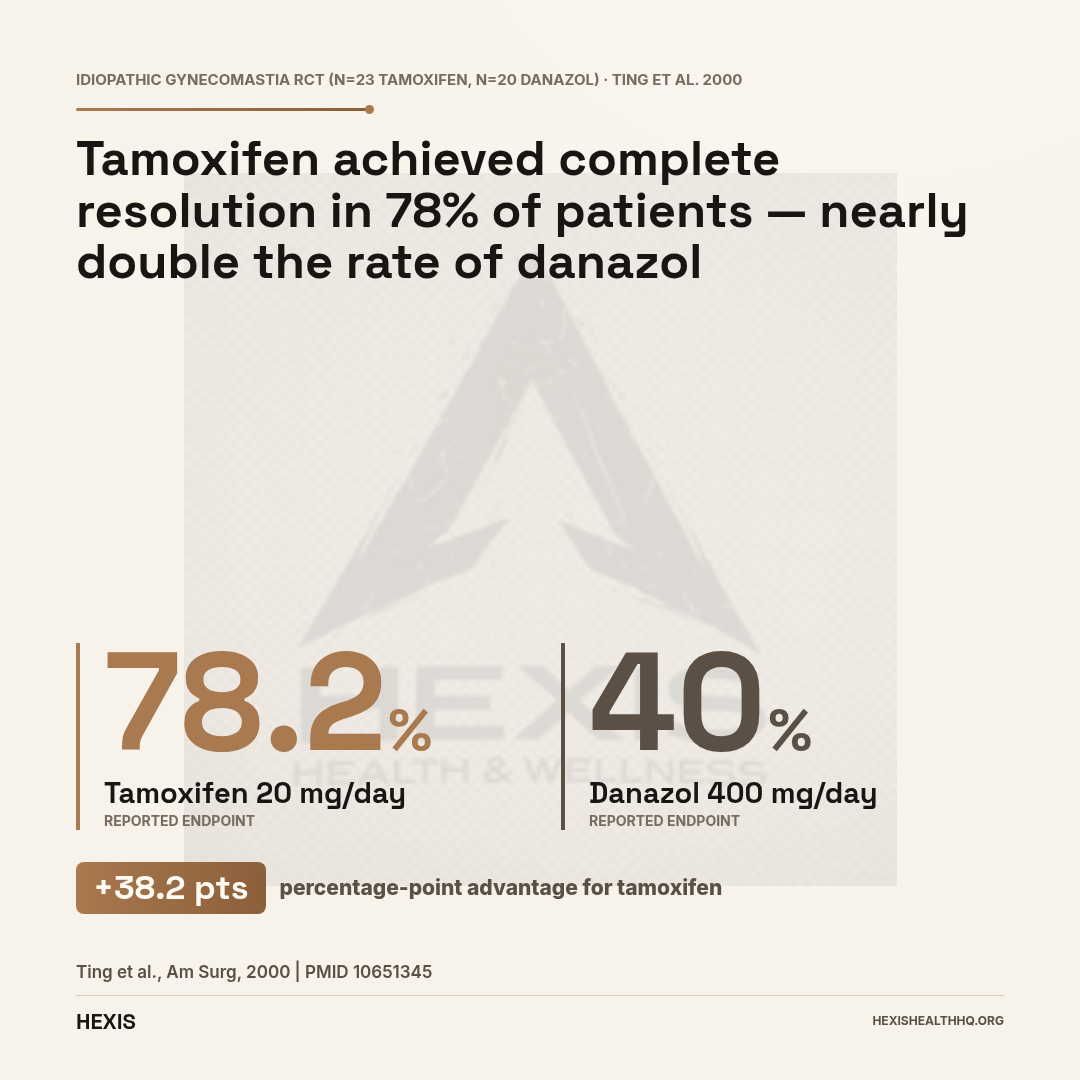
| Complete resolution (idiopathic) | 78.2% | — | 40% |
| Improvement (pubertal RCT) | 86% | 91% | — |
| FDA approved for gynecomastia | No (off-label) | No (off-label) | No (off-label) |
| Typical dose | 10–20 mg/day | 60 mg/day | 400 mg/day |
| Works on fibrotic gynecomastia | No | No | No |
Source: Ting et al., Am Surg, 2000 (PMID 10651345); Lawrence et al., J Pediatr, 2004 (PMID 15238910)
Management: Watchful Waiting, the Medical Therapy Window, and Surgery
Treatment depends entirely on how long gynecomastia has been present and what's driving it.
Step 1: Remove the Cause If There Is One
Before any medical or surgical intervention, address the underlying cause. Stop or switch the offending medication if possible. Treat the hypogonadism, the liver disease, the hyperthyroidism. Optimizing body composition in obese men can reduce aromatization. These steps alone can produce regression in early-onset cases (Braunstein, 1993).
The Medical Therapy Window: It Has a Closing Door
Anti-estrogen medications work only during the active, proliferative phase — while the glandular tissue is still responding to estrogen stimulation and hasn't yet become fibrotic. Miss that window and you're looking at surgery regardless of what medication you try.
Once the tissue has been present for more than approximately 12 months, fibrous stromal tissue predominates. Tamoxifen, raloxifene, and other SERMs cannot reverse fibrosis. Surgery becomes the only effective option (Mathur & Braunstein, 1997).
Tamoxifen is the most studied medical option. In a prospective comparison of 68 patients with idiopathic gynecomastia, complete resolution occurred in 78.2% of those treated with tamoxifen (20 mg/day) versus only 40% in the danazol group (Ting et al., 2000). Tamoxifen outperforms the next available option by nearly double.
In an RCT specifically enrolling adolescents with pubertal gynecomastia, some improvement was seen in 86% of patients receiving tamoxifen (Lawrence et al., 2004).
Raloxifene — a selective estrogen receptor modulator with a different receptor-binding profile — showed slightly superior results in the same RCT: improvement in 91% of patients receiving raloxifene versus 86% with tamoxifen (Lawrence et al., 2004). Neither drug is FDA-approved specifically for gynecomastia, but both are used off-label in clinical practice.
Tamoxifen in drug-induced gynecomastia: When gynecomastia is caused by bicalutamide or other non-steroidal antiandrogens and cannot be discontinued, tamoxifen provides effective prophylaxis and treatment. A systematic review found tamoxifen significantly reduced the risk of gynecomastia with a risk ratio of 0.10 (95% CI: 0.05–0.22) versus untreated controls at 6 months, and outperformed anastrozole and radiotherapy in head-to-head comparisons (Kunath et al., 2012).
If the gynecomastia has been present for over a year, is non-tender, and isn't growing, it has likely fibrosed. Medical therapy won't budge it at that point.
Surgery: When It's the Only Remaining Option
For established, fibrotic gynecomastia, surgery is definitive. The standard approach is subcutaneous mastectomy combined with liposuction via a periareolar incision — this removes the glandular tissue while addressing any associated adiposity and minimizing visible scarring (Gikas & Mokbel, 2007).
A retrospective study comparing isolated mastectomy to the combined mastectomy-plus-liposuction technique found significantly shorter operative time with the combined approach (82 vs. 123 minutes; p<0.005), without any difference in complication rates or patient satisfaction — both groups reported 92–96% satisfaction at 2-year follow-up (Saenz-Molina et al., 2026).
Surgery is also the right choice for patients with Simon grade III–IV gynecomastia (marked enlargement with skin redundancy) regardless of duration, and for any patient for whom the psychosocial burden is significant and medical therapy has failed.
65.0% relative scale
of gynecomastia patients report significant quality-of-life burden — yet most wait over 2 years before seeking evaluation
The Psychosocial Reality: Don't Minimize It
Gynecomastia has a lifetime prevalence of 65% (Vaile et al., 2025) and a real, documented impact on quality of life. Studies of adolescents with gynecomastia show significantly elevated social appearance anxiety, avoidance of physical activity, social withdrawal, and in some cases bullying.
The problem: the average time from symptom onset to first clinical evaluation often exceeds 2 years. Boys and men feel embarrassed to bring it up. Clinicians can be dismissive because they know it's usually benign.
But "benign" in the pathology sense doesn't mean "benign" in the experience of wearing a shirt to the pool because you're ashamed of your chest at 15. Taking the concern seriously — validating it, explaining the mechanism, discussing options — is part of the clinical job. The research on patient-reported outcomes confirms that body image concerns can persist even after clinical resolution if the treatment window is missed (Vaile et al., 2025).
Frequently Asked Questions
Will gynecomastia go away on its own?
Often, yes — but it depends on the cause and timing. Pubertal gynecomastia resolves on its own in most boys within 6–24 months. Drug-induced gynecomastia can resolve after stopping the offending agent. Gynecomastia that has been present for more than 12 months and is non-tender has likely fibrosed and will not resolve without intervention.
How do I know if it's gynecomastia or chest fat?
The clinical test: press the tissue directly behind the nipple. A firm or rubbery disc-like ridge that doesn't move away from the nipple = glandular tissue (true gynecomastia). Soft, diffuse, non-tender fullness that shifts = fat (pseudogynecomastia). Pseudogynecomastia responds to weight loss; true gynecomastia does not.
Can tamoxifen get rid of gynecomastia without surgery?
Yes — but only during the active, proliferative phase (roughly the first 6–12 months, when the tissue is tender). In trials, tamoxifen produced complete resolution in 78.2% of idiopathic cases (Ting et al., 2000). Once fibrosis has set in — the tissue is non-tender, firm, and has been present for more than a year — tamoxifen is unlikely to work and surgery becomes the definitive option.
Does TRT cause gynecomastia?
It can. Testosterone provides substrate for aromatase, and in some men — especially those who are aromatase-sensitive or already have elevated estradiol — TRT drives estrogen elevation that triggers gynecomastia. One study found a 43.1% rate of mild-to-moderate gynecomastia in young hypogonadal men on TRT (De Sanctis et al., 2019). This is one reason TRT protocols should include baseline and follow-up estradiol monitoring.
When is surgery the only option?
When gynecomastia has been present for more than approximately 12 months, is non-tender, and has become fibrotic — medical therapy won't reverse it. Surgery (subcutaneous mastectomy with or without liposuction) is also indicated for severe grades with skin excess, and for patients with persistent symptoms after a failed medical trial.
Work With a Provider Who Looks at the Whole Picture
Gynecomastia is almost always a hormonal story. Identifying which chapter of that story you're in — puberty, aging, medication effect, hypogonadism — determines what can actually be done.
At HEXIS, we start with labs, not guesses. A full hormone panel — testosterone, estradiol, LH, FSH, and thyroid — tells the story. If the evaluation points toward hypogonadism, a medication-induced cause, or an imbalance worth correcting, your provider builds a protocol around your numbers and your timeline.
Schedule a consultation and we'll figure out what's actually driving it.
Gynecomastia: The Bottom Line
- 1
True gynecomastia is glandular, not fat — the two conditions require completely different management, and confusing them wastes months of treatment window.
- 2
The medical therapy window closes at approximately 12 months: tamoxifen achieves 78.2% complete resolution in early idiopathic cases, but cannot reverse fibrosis — act early or plan for surgery.
- 3
Every case has a cause — puberty, aging, obesity, medications, or hypogonadism. A full hormone panel (testosterone, estradiol, LH, FSH) narrows the field and tells you what's actually driving it.