DHEA: What It Does & Who Benefits
DHEA: What It Does & Who Benefits
Your body makes more DHEA than almost any other hormone. By the time most people hit their 40s and 50s, they're making half of what they once did — and most doctors never mention it.
DHEA (dehydroepiandrosterone) is the raw material your body uses to build both testosterone and estrogen. It doesn't do one thing. It does many things, and how it gets used depends on your sex, your age, and the tissue doing the converting. That's what makes it interesting — and what makes blanket supplementation advice nearly useless.
What the actual research shows, who it's most likely to help, and what you need to know before adding it to your protocol.
The short answer: DHEA is a steroid hormone produced primarily by the adrenal glands. It declines roughly 2% per year after age 30. The FDA has approved one DHEA-based product — Intrarosa (prasterone, 6.5 mg vaginal insert) — specifically for menopausal dyspareunia. Oral DHEA supplements (25–100 mg) are legal OTC under DSHEA but are not FDA-approved for any systemic use. Evidence is strongest for vaginal atrophy and adrenal insufficiency; anti-aging results in otherwise healthy adults are more mixed.
2.0% relative scale
per year — the rate at which DHEA-S declines after age 30, leaving most people at 20–30% of their peak by age 70 (Nair et al., 2006)
What Is DHEA and Why Does It Decline?
Your adrenal glands — two walnut-sized glands that sit on top of your kidneys — are responsible for making about 90% of the DHEA in your bloodstream. Your ovaries and testes produce the rest.
DHEA doesn't act directly on tissues the way testosterone or estrogen does. It acts as a prohormone — a biological raw material. Your body converts it into androgens (like testosterone) or estrogens, depending on what each tissue needs at a given moment. The direction of that conversion differs between men and women, and even between different tissues in the same person.
DHEA-S (DHEA sulfate) is the storage form that circulates in your blood. When your doctor runs a "DHEA" test, they're almost always measuring DHEA-S. It's stable, reliable, and easy to quantify.
DHEA-S levels peak somewhere in your mid-20s and then fall about 2% per year for the rest of your life (Nair et al., 2006). By the time most people hit 70, they have roughly 20–30% of the DHEA they had at their peak. That's not a subtle change. It's a dramatic, decades-long decline in one of your body's most abundant hormone precursors — and it happens in everyone, regardless of lifestyle.
Whether that decline causes problems on its own, or whether it's just a marker that something else is happening, is still debated. But the physiological rationale for studying DHEA replacement is real.
The One FDA-Approved DHEA Product (And What It's Actually For)
This distinction matters. There is exactly one FDA-approved DHEA product.
It's called Intrarosa. It contains 6.5 mg of prasterone (the pharmaceutical name for DHEA) delivered as a vaginal insert, once daily. The FDA approved it in November 2016 specifically for moderate-to-severe dyspareunia — pain during sexual intercourse — due to vulvovaginal atrophy of menopause (NDA 208470).
Intrarosa is not a systemic hormone therapy. It works locally. The prasterone is converted directly within vaginal tissue into estrogens and androgens, restoring tissue integrity without significantly raising systemic hormone levels. That's why it doesn't require progestin co-administration (as oral estrogen does), and why it's considered an option even for some women who want to avoid systemic HRT.
In clinical trials, intravaginal prasterone improved vaginal pH, increased superficial cell percentages, and significantly reduced dyspareunia compared to placebo (Labrie et al., 2011; Portman et al., 2015). A 52-week open-label study showed sustained improvement across all vulvovaginal atrophy symptoms with consistent daily use (Labrie et al., 2015).
A separate RCT specifically studied its effects on sexual dysfunction — not just pain — and found meaningful improvements in desire, arousal, lubrication, and orgasm in postmenopausal women (Labrie et al., 2015 JSM).
A separate trial confirmed that intravaginal prasterone at this dose does not affect the endometrium — meaning it doesn't stimulate uterine lining growth the way systemic estrogens can (Portman et al., 2015).
What this is not: Intrarosa is not an anti-aging supplement. It's not a systemic hormone boost. And it's definitely not the same as taking a 50 mg DHEA capsule from your local supplement store.
What Oral DHEA Trials Have Found
Key RCT results across major outcome domains — evidence quality varies
| Outcome | Finding | Source |
|---|---|---|
| Hormone levels | DHEA-S, testosterone, androstenedione all increased at 6 months | Stomati et al., 2000 |
| Endothelial function | Improved in men with coronary artery disease | Kawano et al., 2003 |
| Body composition | No significant improvement vs placebo at 2 years (75 mg/day) | Nair et al., 2006 — NEJM |
| Cognition | No significant improvement in 12-week RCT | Parsons et al., 2006 |
| Bone turnover | Markers influenced — not a fracture-prevention trial | Kahn et al., 2002 |
Source: All trials peer-reviewed; doses 50–75 mg/day oral unless noted
Oral DHEA Supplements: What the Research Actually Shows
OTC oral DHEA supplements are legal in the United States under the Dietary Supplement Health and Education Act (DSHEA) of 1994. You can buy 25 mg, 50 mg, or 100 mg capsules without a prescription. They're not FDA-approved for any systemic indication — not anti-aging, not adrenal support, not HRT.
That legal reality doesn't mean oral DHEA does nothing. It means the bar for approved claims is higher than what existing data currently clears. The actual trial data is more nuanced.
What trials have actually found:
Hormonal effects: A six-month study of oral DHEA supplementation in postmenopausal women documented significant increases in DHEA-S, testosterone, and androstenedione, along with some estrogen-related effects (Stomati et al., 2000). The conversion direction and magnitude varied by individual.
Endothelial function and insulin sensitivity in men: A randomized trial found that DHEA supplementation improved endothelial function and insulin sensitivity in men with coronary artery disease (Kawano et al., 2003). Not dramatic effects, but measurable and biologically meaningful.
Body composition and metabolism: In a well-designed NEJM trial, men and women over 60 received 75 mg/day of DHEA or placebo for two years. There were no significant improvements in body composition, physical performance, or insulin sensitivity compared to placebo (Nair et al., 2006). That was a high-quality null result from a credible institution — worth taking seriously.
Cognitive effects: A 12-week RCT in postmenopausal women found no significant cognitive improvement with DHEA supplementation versus placebo (Parsons et al., 2006). Memory, attention, and executive function were unchanged.
Bone turnover: A small trial in middle-aged to elderly men found that DHEA supplementation influenced bone turnover markers (Kahn et al., 2002). Not a fracture-prevention trial, but suggestive data worth following.
The honest read on oral DHEA for otherwise-healthy aging adults: effects exist but are modest, inconsistent, and highly individual. The people who show the most benefit tend to have genuinely low DHEA-S levels to start with — not people who are supplementing because they think their levels could be higher.
Who Is Most Likely to Benefit from DHEA?
Three populations have the clearest clinical case for DHEA: postmenopausal women with vulvovaginal atrophy or dyspareunia (FDA-approved intravaginal prasterone), people with adrenal insufficiency, and individuals with documented low DHEA-S on blood testing. Outside these groups, the evidence for routine supplementation is substantially thinner.
The strongest evidence clusters around these three specific populations. If you're not in one of them, the case for supplementing is weaker.
1. Postmenopausal Women with Vulvovaginal Atrophy or Dyspareunia
This is where the evidence is clearest and the FDA approval exists. Intravaginal prasterone (Intrarosa) has multiple well-designed RCTs behind it, showing real improvements in vaginal tissue health, pain during intercourse, and sexual function (Labrie et al., 2009, 2011, 2015). If this is your situation, this is a conversation worth having with a provider who knows how to prescribe it — not an OTC supplement question.
2. People with Adrenal Insufficiency
When your adrenal glands don't produce adequate cortisol (Addison's disease, or secondary adrenal insufficiency), DHEA production also falls dramatically. The clinical question is whether DHEA replacement improves quality of life for these patients.
The evidence is genuinely mixed. Some trials have shown modest improvements in well-being, mood, and sexual function in women with adrenal insufficiency who received DHEA replacement. Others have shown little effect. A pilot trial in Sjögren's syndrome patients (an autoimmune condition affecting glandular function) showed some QoL signal but not strong enough to change practice guidelines (Pillemer et al., 2004).
For adrenal insufficiency specifically, DHEA replacement is worth discussing with your endocrinologist — it's not standard of care everywhere, but it's not unreasonable either.
3. Individuals with Documented Low DHEA-S Levels
If your blood work shows DHEA-S genuinely below the reference range for your age and sex, and you're experiencing symptoms consistent with hormonal deficiency (fatigue, low libido, mood issues), that's a different clinical picture than supplementing hoping to feel better.
A low DHEA-S without an obvious cause — not just age-related decline — is worth investigating. Adrenal function testing, thyroid evaluation, and a full hormone panel put that number in context.
Dosing: What the Trials Used
Oral DHEA dosing ranges in clinical research from 25 mg to 100 mg per day. No dose has been FDA-approved for systemic use.
The doses used across the clinical literature:
| Form | Dose | Population Studied |
|---|---|---|
| Oral | 25 mg/day | General aging, mild deficiency |
| Oral | 50 mg/day | Postmenopausal women, men over 60 |
| Oral | 75–100 mg/day | Higher-risk populations; more androgenic side effects |
| Intravaginal (Intrarosa) | 6.5 mg/day | Postmenopausal dyspareunia (FDA-approved) |
Higher doses produce more androgenic effects — which means more acne, more hair thinning in women with sensitivity, and more risk of pushing testosterone or estrogen into ranges you didn't intend. Most practitioners working with oral DHEA start at 25–50 mg and adjust based on DHEA-S response.
The trial in postmenopausal women using six months of oral supplementation documented measurable hormonal shifts at these doses, but individual response varied substantially (Stomati et al., 2000).
Before starting anything: test your baseline DHEA-S. Supplementing without knowing your starting point is like filling a gas tank without knowing how much is already in it.
Hormone-Sensitive Cancer History: Get Physician Oversight First
DHEA converts to sex hormones in peripheral tissues. Most clinical trials exclude anyone with a history of hormone-sensitive cancers (breast, prostate) specifically because the safety data in that population does not exist. The gap is real — not a formality.
If you have a history of hormone-sensitive cancer, do not self-supplement with DHEA. This is a physician conversation, not an OTC decision.
Source: Brief writerGuidance.concernsToAddress; regulatory brief
Side Effects: What to Actually Watch For
DHEA is a hormone precursor. That means side effects are largely androgenic in women and estrogenic in both sexes if levels climb too high.
Most commonly reported:
- Acne and oily skin (most common in women at higher doses)
- Hair thinning in women with androgenic sensitivity
- Mood changes, irritability
- Breast tenderness
These are dose-dependent. They're also more common when people supplement without testing baseline levels — because they may already be in a normal range and are pushing past it.
The cancer question: Most DHEA trials exclude people with a history of hormone-sensitive cancers (breast cancer, prostate cancer). That exclusion exists for a reason. DHEA converts to sex hormones, and the safety data in cancer survivors is thin. This is not a supplement to take casually if you have that history — it's a physician conversation first.
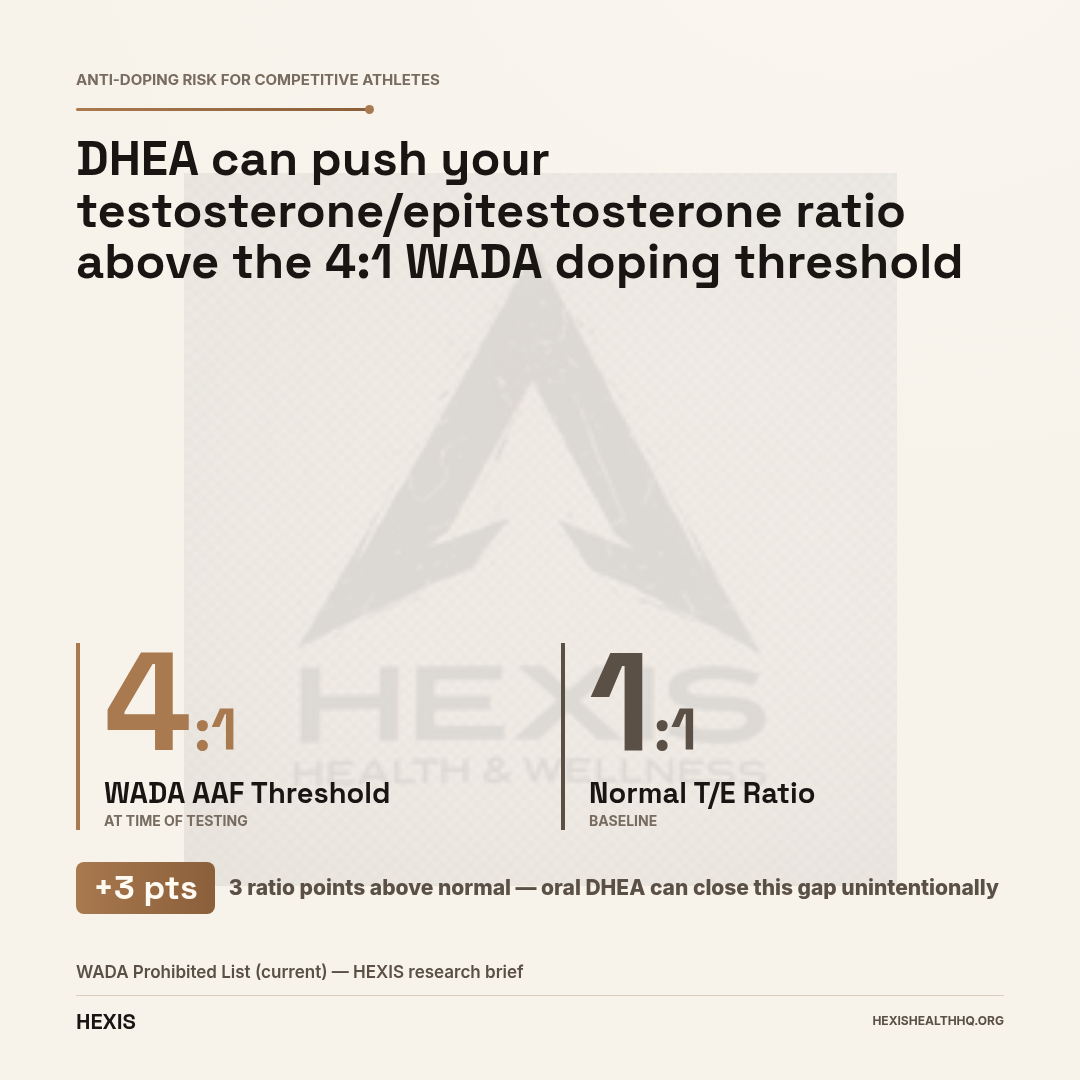
The doping issue: DHEA itself is not on the current WADA prohibited list. But it converts to testosterone, and oral supplementation can raise your testosterone/epitestosterone (T/E) ratio above the 4:1 threshold that triggers an Adverse Analytical Finding. Competitive athletes should know this before taking any DHEA supplement.
Psychiatric risk: There are case reports of DHEA triggering hypomanic or manic episodes in people with underlying mood disorders (Dean, 2000). If you have a history of bipolar disorder or similar conditions, this warrants caution and physician oversight.
DHEA vs. 7-Keto DHEA: They Are Not the Same Thing
7-Keto DHEA is a downstream metabolite of DHEA that does not convert to testosterone or estrogen — which means it carries neither the androgenic side effects nor the hormone-raising benefits of regular DHEA. It is a chemically distinct compound with a different mechanism and a separate (much thinner) evidence base.
You'll see 7-Keto DHEA marketed as a "safer" alternative. The key difference is exactly that: 7-Keto DHEA is a metabolite that does not convert back to sex hormones. It won't raise your testosterone or estrogen.
That means 7-Keto DHEA does not have the same risks — but it also doesn't have the same potential benefits. If the goal is influencing androgen or estrogen levels, 7-Keto DHEA won't do it. They're chemically distinct compounds with different mechanisms and different evidence bases.
Most of the clinical research on DHEA uses regular DHEA, not the 7-keto form. Don't assume they're interchangeable.
Sheehan Syndrome and Hypopituitarism: A Specific Use Case
One area where DHEA replacement has specific and compelling rationale: Sheehan syndrome, which is pituitary damage (usually from postpartum hemorrhage) that leaves women deficient in multiple hormones including DHEA.
A 2022 randomized double-blind crossover trial found that DHEA replacement improved sexual function in women with Sheehan syndrome compared to placebo (Mandal et al., 2022). This is a narrow population but a clean trial — and it illustrates the broader principle that documented deficiency, not hopeful optimization, is where DHEA replacement earns its keep.
“If your DHEA-S is mid-range or normal for your age, you're not correcting a deficiency — you're stacking on top of what's already there, and the evidence for that is much thinner.”
Should You Test Before You Supplement?
Yes. There's no serious argument against checking your baseline DHEA-S before starting a supplement that directly influences your hormone levels.
DHEA-S is a standard blood test. It's inexpensive, widely available, and gives you an actual number instead of a guess. The reference range is age-adjusted, so "low" looks different at 35 versus 65.
If your DHEA-S is genuinely low, that changes the clinical picture. If it's mid-range or normal for your age, you're not correcting a deficiency — you're stacking on top of what's already there, and the evidence for that is much thinner.
The DAWN (Dehydroepiandrosterone And WellNess) study examined DHEA supplementation methodically in a community-based population and provided important design and measurement data for understanding who actually responds (von Mühlen et al., 2007). The takeaway: population-level responses are inconsistent. Individual baseline matters.
Frequently Asked Questions
Does DHEA actually raise testosterone levels?
It can, but not reliably or predictably. DHEA converts to testosterone through enzymatic pathways in your tissues, but the amount of conversion depends on your sex, your enzyme activity, your age, and your baseline hormone levels. In men, oral DHEA at typical doses (50 mg) produces modest testosterone increases. In women, the effect is more pronounced because their starting testosterone is lower. Whether that translates to any clinical benefit depends on what symptoms you're addressing.
Is oral DHEA the same as prescription Intrarosa?
No. Intrarosa (prasterone 6.5 mg vaginal insert) is the only FDA-approved DHEA product, cleared specifically for menopausal dyspareunia. It works locally within vaginal tissue. OTC oral DHEA capsules (25–100 mg) are dietary supplements — legal but not FDA-approved for any systemic condition. Different delivery, different dose, different evidence, different regulatory status.
Can men take DHEA supplements?
Men can, but the evidence in otherwise-healthy men is thin. The NEJM trial (Nair et al., 2006) found no significant body composition or metabolic benefits in men over 60 at 75 mg/day versus placebo over two years. If a man has documented low DHEA-S, the case for supplementation is more reasonable. In men with normal-range DHEA-S, the data doesn't support routine supplementation for anti-aging or performance.
Will DHEA affect hormone-sensitive cancer risk?
This is the right question to ask and the honest answer is: we don't fully know. Most DHEA trials exclude people with breast cancer or prostate cancer histories. DHEA converts to sex hormones, and hormone-sensitive cancers can theoretically be influenced by that. This is not a supplement to take without physician oversight if you have that history. For otherwise-healthy people, the existing evidence does not establish a causal link — but the gap in the safety data is real.
How long before you notice effects from DHEA?
In the intravaginal trials, meaningful improvements in vaginal tissue took 6–12 weeks of consistent daily use. For oral supplementation, hormonal shifts are measurable within weeks, but symptom-level changes (if they occur) typically take 1–3 months. The longest trials ran 12–24 months; that's the timeframe over which bone and metabolic effects were assessed.
The Bottom Line on DHEA
DHEA is not a magic anti-aging hormone. It's not nothing either.
The evidence is clear and strong for one specific indication: intravaginal prasterone (Intrarosa) for menopausal dyspareunia and vulvovaginal atrophy. Multiple phase-3 trials back it up, and the FDA agreed.
For oral DHEA in otherwise-healthy aging adults: effects exist but are modest and highly individual. The people who benefit most have genuinely low DHEA-S levels to begin with — not people supplementing optimistically. The NEJM trial that found no effect at 75 mg/day for two years is not easy to dismiss.
If you're considering DHEA — in any form — the starting point is a blood test. Know your DHEA-S. Know where you're starting. Know whether you're correcting a deficiency or adding to something that doesn't need adding to. Then have that conversation with a provider who actually looks at your full hormone picture.
At HEXIS, that's exactly how we approach it. We run labs first — DHEA-S, testosterone, estradiol, cortisol, the full picture. In practice, the patients who feel a meaningful difference from DHEA are almost always people who had genuinely low levels to correct, not people in the mid-range looking for an edge. If DHEA replacement or intravaginal prasterone makes sense for your situation, we can help you access it correctly. If it doesn't, we'll tell you that too.
Schedule a consultation and we'll start with your actual numbers.
If you're exploring the broader context of hormone optimization, our articles on testosterone replacement therapy and HRT for women cover the related hormone picture in more depth. For the role of adrenal health in overall hormone function, see our overview of adrenal hormones and fatigue.
This article is for educational purposes and does not constitute medical advice. DHEA is a hormone precursor that influences sex hormone levels; any supplementation decisions should involve a qualified healthcare provider who can evaluate your individual hormone panel and health history.
DHEA: The Bottom Line
- 1
The only FDA-approved DHEA product is Intrarosa (6.5 mg intravaginal prasterone) for menopausal dyspareunia — multiple phase-3 RCTs back it up. OTC oral DHEA is legal but not FDA-approved for any systemic use.
- 2
Oral DHEA shows inconsistent results in otherwise-healthy adults. The NEJM trial (Nair et al., 2006) found no significant body composition or metabolic benefit at 75 mg/day over two years — a result worth taking seriously.
- 3
Test your DHEA-S before supplementing. People with documented low levels have the clearest clinical case. Without baseline labs, you don't know whether you're correcting a deficiency or overshooting a normal range.