Perimenopause Symptoms & Treatment: What the Research Actually Says
Perimenopause Symptoms and Treatment: What the Research Actually Says
Your sleep is wrecked. Your cycles are unpredictable. Your mood swings in ways that feel completely foreign. And yet every lab result comes back "normal." If you're in your early-to-mid forties and you recognize that picture, there's a good chance you're in perimenopause — and the reason nobody's given you clear answers is that most clinicians underestimate how disruptive this transition actually is.
The short answer: Perimenopause is a distinct clinical phase — typically lasting 4 to 10 years before your final menstrual period — driven by irregular, declining estrogen and progesterone. Hot flashes, sleep disruption, mood changes, and irregular cycles are the hallmark symptoms. Effective, evidence-backed treatments exist: hormone therapy, low-dose contraceptives, and two FDA-approved non-hormonal options (paroxetine mesylate and fezolinetant). The right one depends on your symptom profile, your health history, and timing.
Here's what the evidence actually shows.
What Hormonal Changes Drive Perimenopause Symptoms?
Perimenopause is not a single hormone crash. It's a years-long fluctuation — estrogen and progesterone rise and fall erratically before eventually declining for good. FSH (follicle-stimulating hormone) rises as the ovaries respond less predictably, but FSH levels alone are unreliable for diagnosis during the transition because they can swing dramatically cycle to cycle (Santoro et al., 2021).
That erratic pattern explains a lot. The same woman can have perfectly normal cycles for two months, then skip one, then bleed unexpectedly. Estrogen surges can cause breast tenderness and bloating; crashes drive hot flashes and mood instability. This is not "just getting older" — it's a genuine physiological shift that deserves clinical attention.
The most widely referenced staging system, STRAW+10, classifies the menopausal transition into early and late stages based on cycle irregularity. Perimenopause begins when cycles become variable by 7 or more days. It ends with the final menstrual period — after which 12 consecutive period-free months officially mark menopause (Santoro et al., 2021).
Here's the practical takeaway: because FSH fluctuates so much during perimenopause, a single elevated result doesn't confirm the diagnosis and a normal result doesn't rule it out. Perimenopause is primarily a clinical diagnosis — irregular cycles plus symptoms, in the right age range.
Hot Flashes and Night Sweats: The Vasomotor Symptom Problem
Hot flashes — clinically called vasomotor symptoms (VMS) — affect roughly 75% of women during the menopausal transition. For many, they're disruptive enough to interrupt sleep every night. For some, they persist a decade or more past the final menstrual period.
The mechanism: fluctuating estrogen narrows the thermoregulatory zone in the hypothalamus. Small changes in body temperature trigger a heat-dissipation response — flushing, sweating, rapid heart rate — that in a non-perimenopausal person would require a much larger thermal provocation (Hira et al., 2026).
Hot flashes aren't just uncomfortable. The research shows they're tightly coupled with sleep disruption and mood — not just because waking up sweating is unpleasant, but because there's a bidirectional relationship between VMS and depression risk during the transition (Natari et al., 2017). Women who have more severe vasomotor symptoms are more likely to develop depressive symptoms, and depression can amplify the subjective experience of VMS. Treating one without considering the other misses half the picture.
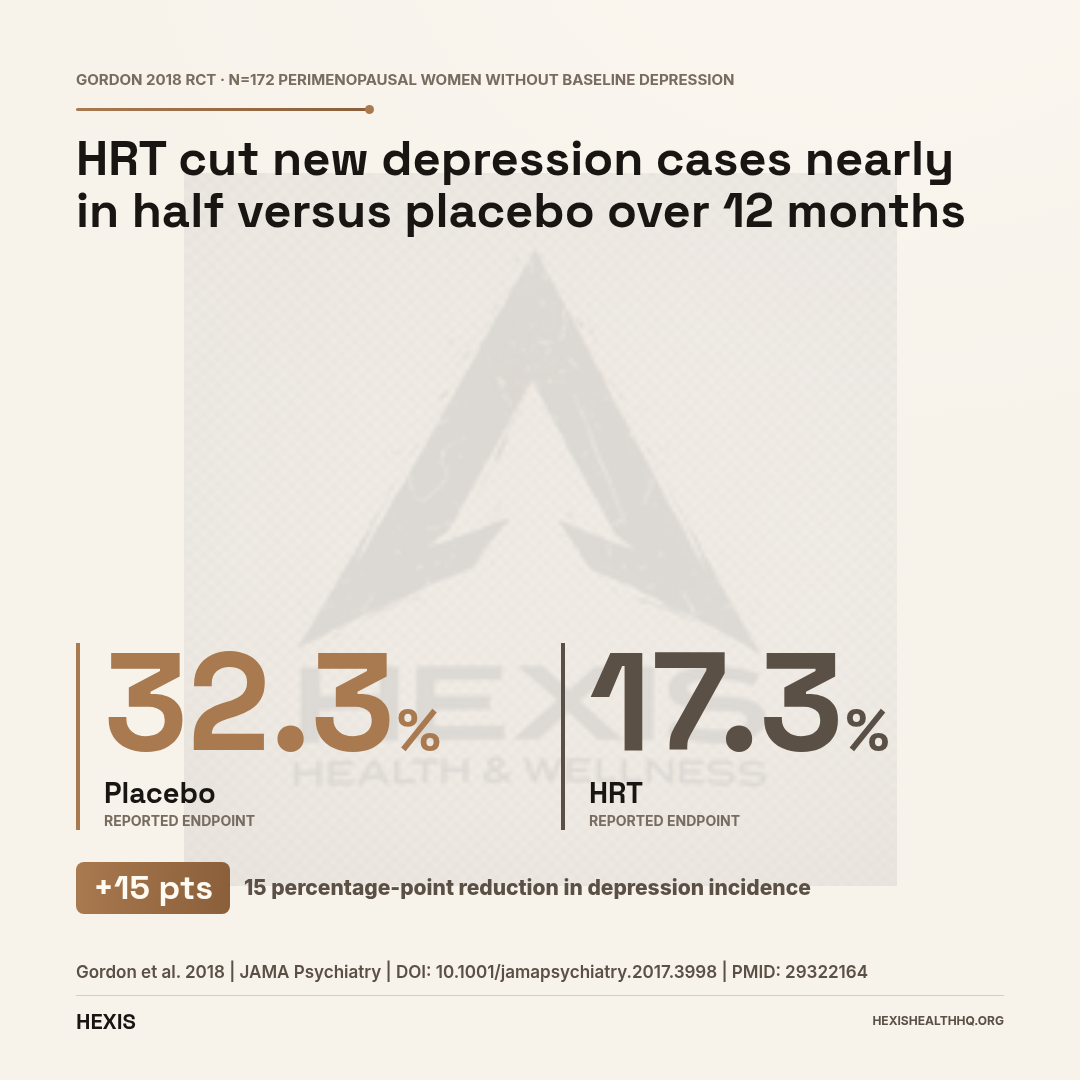
Gordon 2018 RCT: Depression Prevention in Perimenopause
12-month incidence of significant depressive symptoms (JAMA Psychiatry)
| Group | Depression Incidence | Outcome |
|---|---|---|
| Transdermal estradiol + micronized progesterone | 17.3% | Nearly half the risk vs placebo |
| Placebo | 32.3% | — |
Source: Gordon et al., 2018 — JAMA Psychiatry. DOI: 10.1001/jamapsychiatry.2017.3998
Does Perimenopause Cause Depression and Anxiety?
This is one of the most underrecognized aspects of the transition. The risk of depression during perimenopause is 2 to 4 times higher than during the premenopausal years — a finding confirmed by meta-analysis (de Kruif et al., 2016). This isn't just "stress about aging." It's a neurobiological effect of hormone fluctuation on serotonin, dopamine, and GABA signaling.
The key clinical trial here is Gordon et al. 2018, published in JAMA Psychiatry. This was a randomized controlled trial in 172 perimenopausal and early postmenopausal women. The women were not depressed at baseline. Half received transdermal estradiol (0.1 mg/day patch) plus micronized progesterone; the other half received placebo. After 12 months, 17.3% of the estradiol-progesterone group had developed significant depressive symptoms, compared to 32.3% in the placebo group (Gordon et al., 2018). That's a near-halving of depression incidence — in women who started the study without depression.
This is prevention, not just treatment. And it specifically used transdermal estradiol plus micronized progesterone — which matters, because formulation affects both efficacy and risk profile.
A 2026 meta-analysis of 21 studies confirmed that menopausal hormone therapy significantly reduces depressive symptoms in perimenopausal women versus placebo, with the effect strongest in those without prior depressive history (Li et al., 2026).
Sleep disruption compounds this further. When VMS fragment sleep repeatedly, the result is a cumulative cognitive and emotional toll that looks — from the outside — like anxiety, irritability, or depression. Distinguishing VMS-driven sleep disruption from primary insomnia matters because the treatment approach differs (Pavicic et al., 2025).
Breast Cancer Risk: What the Evidence Actually Shows
The 2019 Lancet Collaborative Group meta-analysis (58 studies, 108,647 women with breast cancer) found that combined estrogen-progestogen therapy modestly increases relative breast cancer risk — with the effect varying by duration and progestogen type. The absolute risk increase is modest for most women. HRT is FDA-approved for vasomotor symptoms, vulvovaginal atrophy, and osteoporosis prevention — not for cardiovascular or cognitive benefits.
Source: Collaborative Group on Hormonal Factors in Breast Cancer, 2019 — The Lancet
What Are the Treatment Options for Perimenopause Symptoms?
Several effective treatments exist for perimenopause symptoms — hormone therapy, low-dose contraceptives, and two FDA-approved non-hormonal medications. The right approach depends on which symptoms are most disruptive, your overall health history (particularly breast cancer or clotting history), whether contraception is still needed, and personal preference.
Hormone Therapy (HRT)
Hormone therapy remains the most effective treatment for VMS — reducing hot flash frequency by 75% or more in most trials — and has the added benefit of addressing mood, sleep, and bone protection simultaneously. For a detailed look at how different estrogen formulations compare, see our article on estradiol patches and delivery methods. The evidence supports a "window of opportunity" concept: benefits are most pronounced when therapy is initiated during perimenopause or early postmenopause, rather than years after the final period (Hemachandra et al., 2024).
Formulation matters. A 2025 RCT comparing transdermal estradiol to oral estrogens found that the transdermal route produced superior improvements in menopause-specific quality of life scores, with fewer effects on lipid and coagulation markers (Tang et al., 2025). Oral estrogens undergo first-pass liver metabolism; transdermal estradiol bypasses this, which appears to reduce VTE risk — an important consideration for women with cardiovascular risk factors.
The breast cancer risk question requires honest nuance. The 2019 Collaborative Group analysis in The Lancet — which pooled data from 58 studies covering 108,647 women with breast cancer — found that combined estrogen-progestogen therapy does increase relative breast cancer risk modestly, with the effect varying by duration and progestogen type (Collaborative Group on Hormonal Factors in Breast Cancer, 2019). The absolute risk increase is modest for most women, and must be weighed against the real benefits of symptom control, bone protection, and — as Gordon 2018 showed — depression prevention.
HRT is FDA-approved for VMS, vulvovaginal atrophy, and osteoporosis prevention. It is not FDA-approved for cardiovascular prevention or cognitive benefits — those claims exceed what current evidence supports.
Low-Dose Oral Contraceptives During Perimenopause
For perimenopausal women who also need contraception, low-dose combined oral contraceptives serve double duty: cycle regulation and VMS control. A systematic review confirmed that hormonal contraceptives are effective for managing both irregular bleeding and vasomotor symptoms in perimenopausal women, with safety profiles comparable to younger users in the absence of contraindications (Guerin et al., 2022).
Low-dose oral contraceptives are underutilized for this purpose. Many women in their mid-to-late forties assume they no longer need contraception, but ovulation can occur unpredictably throughout perimenopause — pregnancy is possible until 12 months after the last period.
Non-Hormonal FDA-Approved Options
Two non-hormonal medications have FDA approval specifically for perimenopausal/menopausal VMS:
Paroxetine mesylate (Brisdelle) — a low-dose SSRI (7.5 mg/day, lower than antidepressant doses) approved in 2013. Phase 3 trial data (n=614) demonstrated significant reduction in hot flash frequency versus placebo (NCT01361308). It's a reasonable first-line option for women who cannot or prefer not to use hormones.
Fezolinetant (Veozah) — an NK3 receptor antagonist approved by the FDA in 2023. It works by blocking neurokinin B signaling in the hypothalamus, which is now understood to be a key driver of the menopausal thermoregulatory dysregulation. This is a genuinely new mechanism and avoids any hormonal effects entirely.
Lifestyle and Complementary Approaches
Exercise has consistent evidence for improving sleep quality and psychological well-being during the menopausal transition (Choudhary & Bansal, 2025). Mind-body practices (yoga, tai chi) show meaningful effects on vasomotor symptoms and mood in systematic reviews (Xu et al., 2024). These are best treated as adjuncts, not replacements, for women with moderate-to-severe symptoms.
Phytoestrogens (isoflavones) have modest evidence for VMS reduction — a meta-analysis found small but statistically significant effects versus placebo (Chen et al., 2015). The effect size is substantially smaller than hormone therapy.
“Your FSH is normal so it's not menopause. That's an incomplete answer. The transition is defined by variability, not by a threshold value on a single test.”
How Is Perimenopause Diagnosed?
Perimenopause is diagnosed clinically — not from a blood test. If you're in your forties, have irregular menstrual cycles (varying by 7+ days from your usual length), and are experiencing symptoms like hot flashes, night sweats, sleep disruption, or mood changes, that clinical picture is what matters.
FSH can be checked, but a single value is rarely definitive during perimenopause. The ovaries can still produce plenty of estrogen in some cycles, so FSH may read normal one month and elevated the next. FSH becomes more diagnostically useful after the final menstrual period.
Other conditions that can produce overlapping symptoms — thyroid dysfunction, anemia, premature ovarian insufficiency, pregnancy — should be ruled out with appropriate labs. But the diagnosis of perimenopause itself is a clinical judgment based on age, cycle pattern, and symptom history.
This matters because many women are dismissed at the lab stage: "Your FSH is normal so it's not menopause." That's an incomplete answer. The transition is defined by variability, not by a threshold value on a single test. At HEXIS, the clinicians who work with perimenopausal patients regularly see women whose FSH fell within range on the day of testing — and who were still clearly in perimenopause based on cycle history and symptoms.
Frequently Asked Questions
What is the difference between perimenopause and menopause?
Perimenopause is the transition phase — typically lasting 4 to 10 years — during which your cycles become irregular and hormones fluctuate before declining. Menopause is the endpoint: 12 consecutive months without a menstrual period. Most of the symptoms people associate with "menopause" (hot flashes, sleep disruption, mood changes) actually occur during perimenopause, not after it.
Can HRT prevent depression during perimenopause?
Yes — in women without prior depression, transdermal estradiol with micronized progesterone significantly reduced the incidence of depressive symptoms over 12 months compared to placebo. The Gordon et al. 2018 JAMA Psychiatry RCT found depression incidence of 17.3% in the hormone group versus 32.3% with placebo — that's a prevention effect in women who started the trial without depression, not just symptom management.
Are there non-hormonal options for perimenopause hot flashes?
Two medications are FDA-approved specifically for this: paroxetine mesylate (Brisdelle), a low-dose SSRI at 7.5 mg/day, and fezolinetant (Veozah), an NK3 receptor antagonist approved in 2023. Both reduce hot flash frequency without hormonal effects. They're options for women who can't use or prefer to avoid hormone therapy.
How long does perimenopause last?
On average, 4 to 10 years — though the range is wide. Some women experience significant symptoms for as little as 2 years; others have disruptive VMS for a decade or more past their final period. The duration of symptoms is partly individual and not reliably predictable.
Can I still get pregnant during perimenopause?
Yes. Ovulation continues intermittently throughout perimenopause, and pregnancy remains possible until 12 consecutive period-free months have passed (the clinical definition of menopause). If contraception is a priority, low-dose oral contraceptives are an option that also addresses VMS and cycle irregularity.
What to Do With This Information
If you're experiencing symptoms that fit the perimenopause picture, the next step is a conversation with a clinician who takes this seriously — not one who runs an FSH and tells you everything looks normal. A thorough workup looks at your full symptom history, cycle pattern, relevant labs (thyroid, CBC, to rule out other causes), and health history that would affect treatment choice.
At HEXIS, we approach perimenopause the same way we approach any hormone-related question: with labs, not guesswork. If you want to understand what's actually happening and explore whether hormone therapy or a non-hormonal approach fits your situation, schedule a consultation — we start with a full clinical picture, not a checkbox.
For related context on hormone therapy evidence, see our guide to hormone replacement therapy and our breakdown of HRT for menopause.
- 1
Perimenopause is a clinical diagnosis — irregular cycles plus symptoms in your forties, not a single blood test result.
- 2
Hot flashes, mood disruption, and sleep problems are not separate issues — they're often driven by the same hormonal fluctuations and respond to the same treatments.
- 3
Transdermal estradiol plus micronized progesterone cut depression incidence nearly in half over 12 months in women without prior depression (Gordon et al., 2018).
- 4
Two FDA-approved non-hormonal options exist: paroxetine mesylate (Brisdelle) and fezolinetant (Veozah) — for women who can't or prefer not to use hormones.
- 5
Treatment timing matters: benefits of hormone therapy are strongest when started during perimenopause or early postmenopause, not years later.