Testosterone Therapy for Women: Cream, Benefits & What to Expect
Testosterone Therapy for Women: Cream, Benefits & What to Expect
If you've brought up low libido with your doctor and left feeling dismissed — or handed a pamphlet about "relationship stress" — you're not imagining the gap. Testosterone therapy for women has been backed by serious clinical research for years, endorsed by eleven international medical societies, and is still barely on most physicians' radar. That's frustrating. It's also fixable.
The short answer: Testosterone therapy is an evidence-based, off-label treatment for hypoactive sexual desire disorder (HSDD) in postmenopausal women. Applied as a compounded cream or gel at roughly one-tenth the male dose, it meaningfully improves libido without masculinizing side effects when dosed correctly. No FDA-approved product exists for women in the US — use is off-label via compounded preparations.
Key facts:
- Evidence base: 36 randomized controlled trials (~8,000 women), 11-society Global Consensus Statement (2019)
- Only evidence-backed indication: HSDD in postmenopausal women
- Typical dose: 5–10 mg/day via 0.5–1% compounded cream (approximately one-tenth the male TRT dose)
- Target range: premenopausal serum testosterone (~15–70 ng/dL) — not supraphysiologic
- Long-term safety data beyond 24 months: insufficient — monitoring is required
What Is the Evidence Base for Testosterone in Women?
Testosterone therapy for women is backed by a 2019 Lancet meta-analysis of 36 randomized controlled trials covering approximately 8,000 women, and a Global Consensus Position Statement endorsed by eleven international societies including the Endocrine Society, the North American Menopause Society, and the International Society for the Study of Women's Sexual Health. The evidence is strongest for one specific indication: hypoactive sexual desire disorder (HSDD) in postmenopausal women.
That meta-analysis, led by Islam RM, found consistent improvements in sexual desire, arousal, orgasm, and satisfaction — with women reporting meaningfully more satisfying sexual events per month compared to placebo (Islam et al., 2019).
The Global Consensus Position Statement, co-authored by Davis SR, formalized this finding into clinical practice — identifying HSDD in postmenopausal women as the sole evidence-based indication (Davis et al., 2019). The ISWSH followed in 2021 with a clinical practice guideline specifically recommending testosterone as a first-line option for HSDD in postmenopausal women (Parish et al., 2021).
These are the frameworks that specialists actually follow. This is not fringe medicine.
No testosterone product is currently FDA-approved specifically for women in the United States. All use is off-label via compounded preparations or male-approved products dosed at female-appropriate levels. In Australia, Androfeme 1% cream is TGA-approved — the only approved female testosterone product globally.
Source: Davis et al., 2019 — Global Consensus Position Statement. PMID 31498871.
Who Actually Qualifies for Testosterone Therapy?
The evidence-supported population is postmenopausal women — whether from natural menopause or surgical menopause — who have been diagnosed with HSDD. HSDD is defined as persistently low or absent sexual desire that causes personal distress. It is not simply low libido on its own. For a broader look at the hormonal changes driving this shift, see our guide to hormone replacement therapy for women.
HSDD affects approximately 10% of adult women, making it one of the most prevalent female sexual disorders (Goldstein et al., 2017). Diagnosis is typically made using validated tools like the Decreased Sexual Desire Screener (DSDS) or the Female Sexual Function Index (FSFI). If you're distressed by low desire — not just "not in the mood sometimes" but genuinely bothered by the absence of desire — that's the clinical signal.
For premenopausal women, the picture is different. Evidence for testosterone therapy in women who have not yet reached menopause is limited, and current guidelines do not support it as a standard treatment (Davis et al., 2019). This doesn't mean it's never discussed, but it does mean you're working outside the evidence base if you go that route.
Women with a history of breast cancer are a separate case. Long-term safety data are insufficient, and current consensus recommends against use in this group until more evidence is available (Pinkerton et al., 2021).
Female vs. Male Testosterone Dosing
| Women (physiologic) | Men (standard TRT) | |
|---|---|---|
Source: Davis et al., 2019; Martínez-García & Davis, 2021.
How Does Compounded Testosterone Cream Work?
Testosterone cream for women is applied transdermally — typically to the inner thigh, lower abdomen, or upper arm — using a small measured dose. The active hormone absorbs through the skin and enters circulation. It bypasses first-pass liver metabolism, which is one reason transdermal delivery is preferred over oral forms (Vegunta et al., 2020).
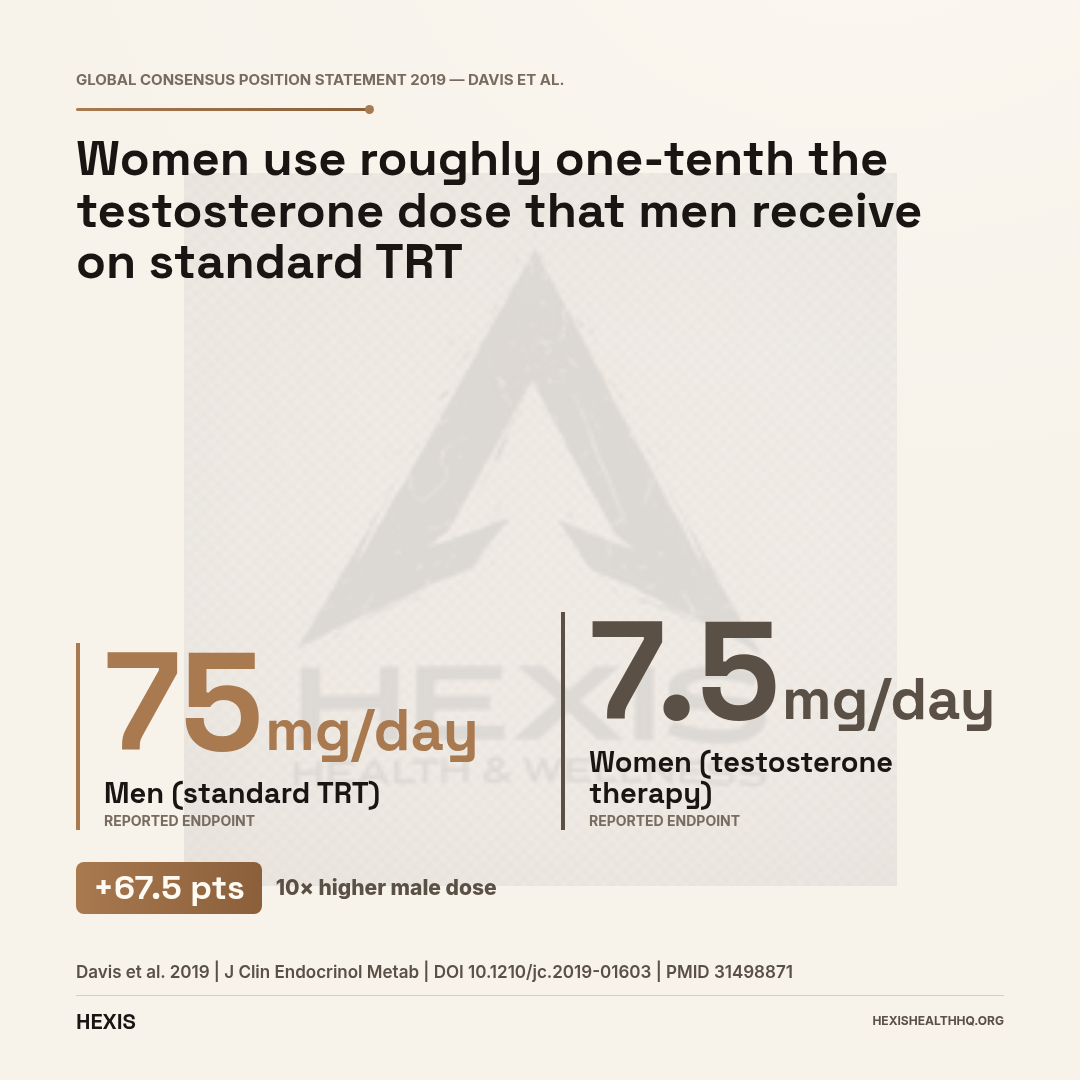
The typical female dose is approximately 5 to 10 mg per day using a 0.5% to 1% compounded cream. Male TRT doses run roughly 50 to 100 mg daily — women use around one-tenth of that. That gap is the primary reason androgenic side effects remain manageable when dosing stays within the physiologic range.
In the ADORE trial, researchers used a transdermal testosterone patch delivering 300 micrograms per day in naturally menopausal women with HSDD. The result was significant improvement in sexual function compared to placebo — with a favorable safety profile (Panay et al., 2010). The patch used in that trial was never FDA-approved, but it demonstrated the efficacy and tolerability of transdermal testosterone at physiologic female doses.
Compounded creams are the most common delivery method in clinical practice today because they allow precise dosing and are prepared by specialty pharmacies. Male-approved gels and solutions (like AndroGel) can also be prescribed at female-appropriate doses, though this requires careful dose calculation to avoid inadvertent over-delivery. If you're weighing cream against other routes, our overview of HRT for menopause covers how different delivery methods compare across hormone therapies.
In Australia, the TGA has approved a 1% testosterone cream called Androfeme specifically for women — the only approved female testosterone product globally as of this writing. The US has not followed suit, leaving compounded preparations as the practical path for American patients (Marko & Simon, 2021).
“The evidence does not support testosterone therapy for energy, mood, bone density, or cognitive function in women. These are popular claims in wellness circles, and they are not backed by the clinical trial data.”
What Benefits Can You Realistically Expect?
The primary benefit of testosterone therapy in women is improvement in sexual desire — this is the only outcome consistently supported by clinical trial data across multiple formulations and populations. Women in the Islam et al. 2019 Lancet meta-analysis reported improvements in sexual desire, arousal, orgasm, and frequency of satisfying sexual encounters (Islam et al., 2019). The effect is real, but it's modest — clinically meaningful improvement, not a dramatic transformation.
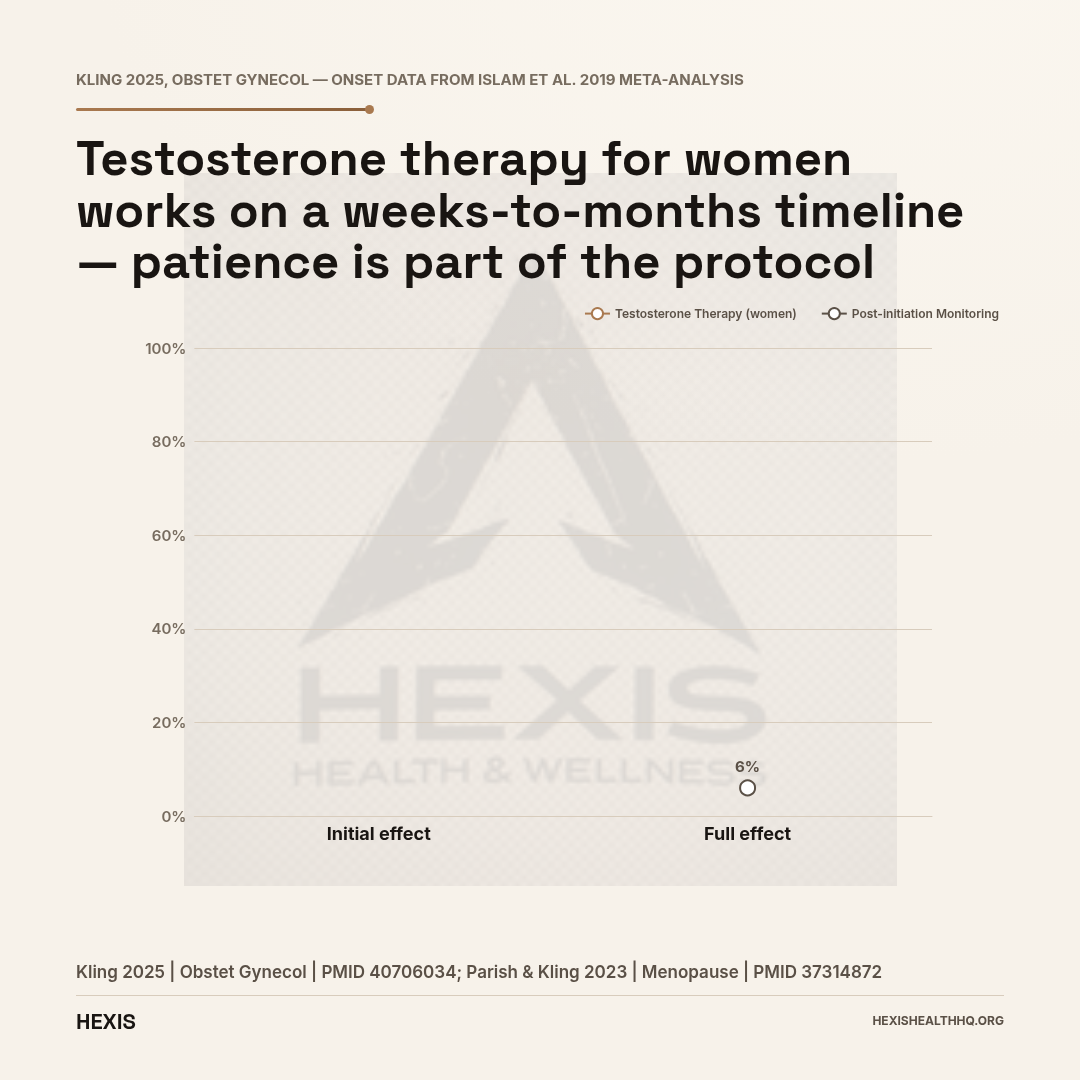
Most women begin noticing changes in desire within four to eight weeks, though the full effect takes three to six months to stabilize. Kling's 2025 review in Obstetrics & Gynecology notes that appropriately selected postmenopausal women with distressing low desire can expect modest but meaningful benefit (Kling, 2025).
The evidence does not support testosterone therapy for energy, mood, bone density, or cognitive function in women (Davis et al., 2019). These are popular claims in wellness circles, and they are not backed by the clinical trial data. Martínez-García & Davis put it plainly — short-term treatment has been shown effective and safe for HSDD, but benefits beyond sexual function remain unproven (Martínez-García & Davis, 2021).
A 2025 Climacteric review by Davis SR examined the emerging evidence for testosterone beyond libido — including preliminary data on mood and cognition — and concluded that while early signals are interesting, none meet the bar for clinical recommendation yet (Davis, 2025).
If you're looking for testosterone to fix your fatigue or lift your mood, the current science doesn't support that application. That doesn't mean those effects won't eventually be demonstrated, but as of now, they're not established.
What Are the Side Effects and Long-Term Risks?
Androgenic side effects are the main concern, and they are dose-dependent. At physiologic female doses — kept within the premenopausal reference range — side effects are uncommon. At supraphysiologic doses, the risk rises substantially (Pinkerton et al., 2021).
The side effects to watch for include:
- Acne (most common)
- Increased body or facial hair (hirsutism)
- Changes to the clitoris (clitoromegaly) — rare at standard doses
- Voice changes — rare and typically reversible on cessation
The Islam et al. 2019 meta-analysis found that androgenic side effects at physiologic doses were present but generally mild and reversed when therapy was stopped (Islam et al., 2019). The key phrase is "stopped" — most androgenic side effects are reversible, but this underscores why dosing precision and monitoring matter.
Long-term safety data beyond 24 months are a genuine gap. The Global Consensus Statement explicitly states that data on cardiovascular outcomes, lipid effects, and breast cancer risk over more than two years are insufficient (Davis et al., 2019). This is not a reason to avoid the treatment — it's a reason to use it with appropriate monitoring and reassess regularly. Whitton & Baber's 2024 review in Best Practice & Research Clinical Endocrinology & Metabolism reinforces this point: off-label and compounded use is widespread, but it comes with the obligation of close follow-up (Whitton & Baber, 2024).
For cardiovascular risk specifically: no signal of harm has emerged from the trial data, but no long-term trial has been powered to detect it (Pinkerton et al., 2021). Breast cancer risk is similarly uncertain — current data do not show increased risk at physiologic doses, but the data are not yet sufficient to rule it out confidently (Davis et al., 2019).
Serum testosterone assays have significant limitations at female concentrations — they were designed for male ranges. Korkidakis & Reid's review makes the case clearly: monitoring in women requires validated high-sensitivity methods, not the same panels used for men (Korkidakis & Reid, 2017).
Monitoring: What Your Numbers Should Look Like
Testosterone therapy in women requires baseline labs before starting and regular monitoring during treatment. The target is to keep serum testosterone within the premenopausal physiologic reference range — not to push it supraphysiologic.
Typical premenopausal total testosterone in women runs roughly 15–70 ng/dL depending on the assay and reference lab. The goal of therapy is to bring a postmenopausal woman's levels back into that window — not above it. Supraphysiologic levels sharply increase the risk of androgenic side effects and have no established additional benefit for sexual function (Martínez-García & Davis, 2021).
Parish & Kling summarize the practical clinical protocol from the ISWSH guidelines: check baseline testosterone, assess at 3 to 6 weeks post-initiation, then every 6 months once stable (Parish & Kling, 2023). If levels are consistently supraphysiologic, the dose should be reduced or the formulation reconsidered.
This monitoring protocol is not bureaucratic box-checking. It's what keeps the side effect profile clean and the therapy safe over time.
Frequently Asked Questions
What dose of testosterone do women take for low libido?
The typical female dose ranges from 5 to 10 mg per day using a 0.5% to 1% compounded cream — roughly one-tenth of what men receive on standard TRT. The goal is to restore testosterone to premenopausal physiologic levels, not to exceed them. Dose is adjusted based on monitoring labs and clinical response after the first 6 weeks.
How long does it take for testosterone cream to work in women?
Most women notice initial changes in sexual desire within 4 to 8 weeks, though the full effect takes 3 to 6 months to develop. The Lancet meta-analysis (Islam et al., 2019) included trials of varying durations — consistent improvement was seen across timepoints, but patience is part of the protocol.
Can testosterone therapy cause facial hair in women?
At physiologic doses — kept within the normal premenopausal range — hirsutism is uncommon. It becomes more likely at supraphysiologic doses. According to the Islam et al. 2019 Lancet meta-analysis, androgenic side effects at physiologic doses were generally mild and reversed when therapy was stopped (Islam et al., 2019). Dosing precision and regular monitoring are the primary safeguards.
Is testosterone cream safe for women long-term?
Short-term safety (up to 24 months) is well-supported by clinical trial data. Beyond that window, cardiovascular and breast cancer safety data are insufficient — not concerning, but incomplete (Davis et al., 2019). The appropriate response is to continue with regular monitoring and reassessment, not to avoid therapy entirely based on uncertainty about data that hasn't been collected yet.
Can premenopausal women use testosterone therapy?
Current guidelines do not recommend testosterone therapy for premenopausal women for HSDD. The evidence base was built almost entirely in postmenopausal women, and the Global Consensus Statement does not extend its recommendation to younger women (Davis et al., 2019). Some clinicians discuss it off-guideline in specific situations, but you're working without strong clinical trial support.
Getting Started: What the Process Looks Like
Getting testosterone therapy as a woman means finding a provider willing to prescribe off-label — a menopause specialist, sexual medicine physician, or a physician-led hormone clinic. No protocol should begin without baseline labs. If you're also navigating broader perimenopause symptoms, our article on perimenopause symptoms and treatment can help frame the full clinical picture.
A baseline testosterone level (using a high-sensitivity assay), plus a full hormone panel including estradiol, FSH, and SHBG, gives your provider what they need to write a sensible protocol. Without that baseline, there's no way to know whether you're a candidate or how to calibrate the dose.
If this is something you want to explore with a provider who will actually take it seriously, HEXIS starts with labs — not assumptions. Schedule a consultation and we'll review your full panel before recommending anything.
The Bottom Line on Testosterone Therapy for Women
- 1
The evidence-based indication is HSDD in postmenopausal women — backed by 36 RCTs and endorsed by 11 international societies.
- 2
No FDA-approved product exists for women in the US. Compounded cream (0.5–1%, ~5–10 mg/day) is the standard clinical path.
- 3
Women use roughly one-tenth the male TRT dose. Androgenic side effects are uncommon at physiologic doses and typically reversible.
- 4
Long-term safety data beyond 24 months are lacking — not alarming, but a reason for regular monitoring.
- 5
Testosterone does not have proven evidence for energy, mood, bone, or cognitive function in women. The sole supported indication is sexual desire.