How Much Does TRT Cost? A Modality-by-Modality Breakdown
How Much Does TRT Cost? A Modality-by-Modality Breakdown
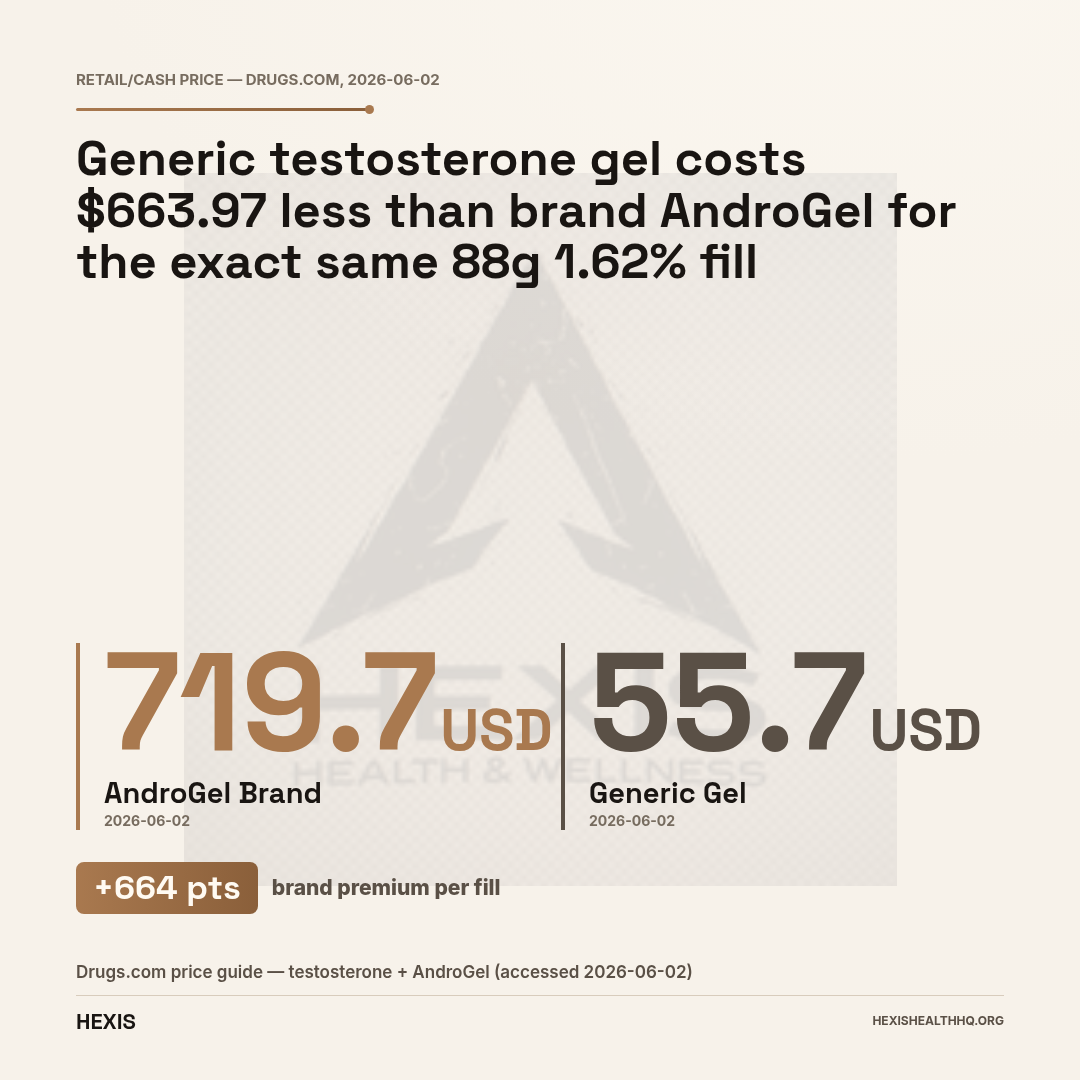
TRT cost depends almost entirely on which form of testosterone you use — and the range is dramatic. Testosterone cypionate injections run about $34 per 10 mL vial at retail. Brand-name AndroGel runs $719.70 for the identical 88-gram fill. Generic gel? $55.73. Knowing which modality fits your situation can save you hundreds of dollars every single month.
The short answer: Without insurance, TRT medication costs range from roughly $34 per month for injectable testosterone cypionate to over $650 per month for Androderm patches or brand-name AndroGel gel. Injections are the lowest-cost modality by far. Generic gel is a middle-ground option. Branded topicals are the most expensive. Lab monitoring and provider visits add $300–$1,200 per year on top.
All prices below are retail/cash prices as of 2026-06-02 from Drugs.com price guide pages and will vary by pharmacy, location, and insurance. Verify current prices at your pharmacy before purchasing.
What Does TRT Actually Cost Without Insurance?
Without insurance, testosterone replacement therapy ranges from roughly $34 per month for injections to over $700 per month for brand-name topicals. If that upper number made you close the tab, don't — the gap is almost entirely brand markup, not a difference in medicine. Generic testosterone is the same molecule as the branded version. The variation is about form factor and who you are writing the check to.
Verified retail pricing from Drugs.com (accessed 2026-06-02):
| Modality | Product | Quantity | Retail Price |
|---|---|---|---|
| Injection | Testosterone cypionate 100 mg/mL | 10 mL vial | $27.26 |
| Injection | Testosterone cypionate 200 mg/mL | 10 mL vial | $34.16 |
| Injection | Testosterone enanthate 200 mg/mL | 5 mL vial | $36.17 |
| Generic gel | Testosterone 1.62% (20.25 mg/pump) | 88 grams | $55.73 |
| Brand gel | AndroGel 1.62% (20.25 mg/pump) | 88 grams | $719.70 |
| Patch | Androderm 2 mg/24hr | 60 films (2-month supply) | $652.50 |
| Patch | Androderm 4 mg/24hr | 30 films (1-month supply) | $652.50 |
The gap between generic gel ($55.73) and brand AndroGel ($719.70) is the single most important price fact in this article. It's the exact same active ingredient, the exact same 1.62% concentration, the exact same 88-gram fill. The brand name costs $664 more per fill. There is no published clinical evidence showing that branded testosterone gel is more effective than the generic equivalent.
Injections remain the lowest-cost option for most people — which is one reason they are the most commonly prescribed modality in clinical practice (Sizar et al., 2024). If you are still deciding whether TRT is appropriate, see our guide on low testosterone symptoms for what a diagnosis actually looks like.
more per month for brand AndroGel vs. generic testosterone gel — same active ingredient, same 1.62% concentration, same 88-gram fill
How Does Each TRT Modality Compare on Monthly Cost?
Most men on testosterone cypionate injections dose every 1-2 weeks, so one 10 mL vial can last a month or two depending on dose. The numbers are better than most people assume.
Injections: The Lowest-Cost Option
Testosterone cypionate 200 mg/mL costs $34.16 for a 10 mL vial at retail (Drugs.com, 2026). A standard clinical dose of 100 mg per week uses 0.5 mL — so one vial covers 20 doses, or roughly 20 weeks at that dose. That works out to well under $10 per month at a weekly injection schedule.
Even at a higher dose of 200 mg every two weeks (a common starting point), one vial covers 10 injections — about 20 weeks of treatment. The medication cost per month stays under $10 in that scenario.
Testosterone enanthate runs slightly higher — $36.17 for a 5 mL vial of the 200 mg/mL formulation (Drugs.com, 2026). Enanthate and cypionate have nearly identical pharmacokinetic profiles; the choice between them is usually prescriber preference and local availability. Both are classified as Schedule III controlled substances under the same legal framework as other testosterone formulations (Magnolini et al., 2025).
The tradeoff with injections: you need supplies (syringes, needles, alcohol swabs) and the willingness to self-inject. Our testosterone cypionate injection guide covers the technique step by step. Many patients learn to self-inject within one or two visits, and supplies add only a few dollars per month.
Gels: Convenience at a Price
Generic testosterone gel (1.62%, 20.25 mg per pump) costs $55.73 for an 88-gram supply (Drugs.com, 2026). That is roughly a one-month supply at a 5-gram per day starting dose — manageable, and a fraction of the brand cost.
Brand AndroGel costs $719.70 for the same 88-gram fill at the same 1.62% concentration (Drugs.com, 2026). Unless your insurance specifically covers only the branded product or your prescriber has a documented clinical reason for it, there is no rationale for paying that premium.
Gels carry one practical consideration worth knowing: transfer risk. The gel must dry fully before skin contact with a partner or child. This is not a reason to avoid them — it is a protocol point your provider will cover in the initial visit.
Clinical evidence supports gel as an effective delivery system. In the TRAVERSE trial — the largest TRT trial ever conducted, with 5,204 men randomized — participants received testosterone gel as the study formulation, and the trial confirmed the clinical effectiveness of TRT for hypogonadal symptoms (Pencina et al., 2024). The fact that the landmark TRT safety trial was built around gel confirms it is a clinically accepted modality.
Patches: Similar Price to Brand Gel
Androderm patches cost $652.50 for either a 30-film or 60-film supply depending on the dose (Drugs.com, 2026). At the 2 mg/24hr dose, the 60-film supply works out to $10.88 per daily patch — roughly $326 per month. At the 4 mg/24hr dose, 30 films cost $652.50, putting the monthly cost at $652.50.
Patches are convenient: once-daily application, no injection, no transfer risk from gel. Skin irritation at the application site is the most commonly reported complaint. Cost-wise, they sit in the same tier as brand-name gel — meaningfully higher than generic gel or injections.
Pellets: Clinic-Variable, No Direct Retail Price
Testosterone pellets are implanted subcutaneously every 3-6 months in an in-office procedure. Because pellets are compounded, their pricing is entirely clinic-dependent. Published ranges for pellet insertion procedures typically run $300-$900 per procedure, which translates to $600-$1,800 per year for two insertions annually. This does not include the initial consultation or follow-up labs.
Pellet pricing was not directly retrieved in this research; the ranges above reflect commonly published clinical estimates. Call the clinic for a specific quote — do not use the range in this article as a firm number. StatPearls lists pellets among the available testosterone formulations for male hypogonadism (Sizar et al., 2024).
Is Testosterone Cypionate Covered by Insurance?
Testosterone cypionate is covered by most commercial insurance plans when a documented hypogonadism diagnosis exists — defined as two morning serum testosterone readings below 300 ng/dL with symptoms (Sizar et al., 2024). Coverage is not automatic, and navigating it takes documentation, the right diagnosis codes, and sometimes a prescriber willing to push back on prior auth denials.
The TRAVERSE trial — the largest randomized controlled trial of TRT to date — enrolled 5,204 men with documented hypogonadism and established that testosterone gel produced no increased risk of major adverse cardiovascular events compared to placebo (Pencina et al., 2024). That safety data has been widely cited in prescribing guideline updates and has supported coverage decisions for appropriately diagnosed patients.
Insurance hurdles to know about:
Prior authorization is common. Most plans require documentation of two confirmed low morning testosterone labs, symptoms consistent with hypogonadism, and sometimes a trial of lifestyle modification before approving TRT.
Step therapy is frequent. Some plans require generic testosterone injections or generic gel before approving branded products — which is actually fine, since generic cypionate and generic gel are clinically equivalent to the branded versions.
"Age-related" exclusion is a real issue. Some plans specifically exclude testosterone therapy attributed to normal aging rather than primary or secondary gonadal failure. Careful diagnostic documentation from your prescriber can sometimes address this, but it is genuinely plan-specific.
For the TRAVERSE trial's JAMA Network Open prostate safety analysis, TRT showed no significantly elevated risk of high-grade prostate cancer compared to placebo over the trial period (Bhasin et al., 2023). That's meaningful reassurance if you're navigating a plan that has concerns about prostate safety.
Hematocrit Monitoring Is Not Optional on TRT
Testosterone stimulates red blood cell production. In some men this causes a clinically significant rise in hematocrit (polycythemia), which increases clotting risk. A standard CBC catches it early — but only if you actually get the blood draw.
Labs required: total testosterone, hematocrit, PSA, and liver function tests. Skipping monitoring is not a cost-savings strategy — it is a risk.
Source: Sizar et al., StatPearls, 2024; Chin-Yee et al., Transfusion, 2017
What Are the Total Ongoing Costs Beyond the Medication?
The total annual cost of TRT includes medication plus mandatory lab monitoring ($300–$1,200/year) plus provider visits — the medication line item is only part of the picture. Most cost discussions stop at the prescription price; monitoring is not optional and adds meaningfully to the annual total.
Lab Monitoring
Clinical guidelines require regular lab work during TRT. A full monitoring panel typically includes total testosterone, hematocrit, PSA, and liver function tests. Frequency is typically every 3-6 months in the first year, then every 6-12 months once stable (Sizar et al., 2024).
At retail/cash rates without insurance, a testosterone level runs $30-$80 at commercial labs. A complete monitoring panel typically runs $150-$300 per draw out of pocket. Over a year with two to four draws, that adds up — and it is worth budgeting for from day one rather than treating it as a surprise.
With insurance, labs are often covered at low or no cost when ordered as medically necessary monitoring for a documented diagnosis.
Hematocrit Monitoring: Why It Matters and What It Costs
One specific monitoring consideration with TRT is polycythemia — elevated red blood cell production. Testosterone stimulates erythropoiesis, and in some men this leads to a clinically significant rise in hematocrit (Chin-Yee et al., 2017). Blood donation is one management option studied in this context, though eligibility rules vary by blood bank. The monitoring cost is included in a standard CBC, typically part of any complete panel — it does not add substantially to lab costs, but it does confirm why ongoing monitoring is not something to skip.
Provider Visits
Initial consultation and follow-up visits add to the total picture. Traditional endocrinology or urology office visits run $150-$400 out of pocket for an established patient visit, more for an initial new-patient consultation.
Telehealth TRT platforms typically structure pricing as monthly subscription models that may bundle consultation access and sometimes medication coordination. Published ranges for telehealth TRT subscriptions vary widely — roughly $100-$350 per month for the consultation and subscription component, separate from medication costs. These are estimates based on published platform information, not directly retrieved pricing; confirm with individual platforms.
Syringes and Supplies (Injections Only)
If you are on injectable testosterone, supplies are minimal: syringes, drawing needles, injection needles, and alcohol swabs. A three-month supply runs $10-$30 at most pharmacies. This is the cheapest part of injectable TRT by a wide margin.
How Can You Reduce TRT Cost?
The biggest lever is modality choice. In clinical practice, men who switch from brand-name topicals to generic injectable cypionate routinely cut their monthly medication cost from $650+ down to under $10. Injections are cheaper than gels or patches by a factor of 5-20x. If you and your provider determine that injections are appropriate, the medication cost becomes almost negligible. Four other moves make a real difference.
Generic always over brand. Generic testosterone cypionate, testosterone enanthate, and generic testosterone gel are therapeutically equivalent to branded products. There is no clinical reason to pay $719.70 for AndroGel when generic gel costs $55.73 for the same fill (Drugs.com, 2026).
GoodRx and discount cards. Programs like GoodRx can reduce retail pharmacy costs substantially — sometimes 50-80% off cash price depending on the drug and pharmacy. The prices cited in this article are retail/cash prices; GoodRx prices at specific pharmacies may be meaningfully lower. Always check before paying retail.
Patient assistance programs. Some branded products offer manufacturer assistance for patients who meet income criteria. AbbVie (AndroGel) and other manufacturers publish patient assistance program details on their product websites.
Lab cost optimization. Services like direct-to-consumer lab ordering can reduce monitoring lab costs significantly versus ordering through a specialist office visit. If labs are the expensive part of your TRT budget, this is worth exploring.
“The cost of untreated hypogonadism — in quality-of-life terms — is real.”
What Does the Clinical Evidence Say About TRT Outcomes?
TRT has strong clinical support for appropriately diagnosed hypogonadism — the largest randomized trial to date (TRAVERSE, n=5,204) confirmed symptom improvement with no increased cardiovascular risk versus placebo (Pencina et al., 2024). Cost matters — but so does understanding the clinical outcomes you are paying for.
The TRAVERSE trial's depression analysis found that men with depressive symptoms at baseline showed significant improvement in depression scores with TRT compared to placebo (Bhasin et al., 2024). That data matters when you're trying to justify treatment to yourself or your insurer. The cost of untreated hypogonadism — in quality-of-life terms — is real.
For men with obesity and hypogonadism, combined testosterone and lifestyle therapy improved skeletal muscle glycolytic function compared to lifestyle therapy alone (Viola et al., 2025). This suggests the clinical benefit of TRT extends beyond testosterone levels themselves and includes metabolic outcomes — relevant context when weighing treatment cost against benefit.
For men with functional hypogonadism secondary to metabolic disease, a 2025 study found that semaglutide improved sperm morphology in obese men with type 2 diabetes and functional hypogonadism, raising a clinically interesting question about whether treating the upstream metabolic cause can sometimes avoid or defer TRT (Gregorič et al., 2025). Not every patient with low testosterone needs TRT — the diagnostic workup matters.
Late-onset hypogonadism diagnosis is clinically nuanced. Case reports from 2026 highlight that patients with late-onset hypogonadism-like symptoms can present diagnostic uncertainty requiring careful workup beyond a single testosterone reading (Ichino et al., 2026). This is why a complete workup matters — you shouldn't be treating a lab number in isolation.
For context on the treatment costs themselves: a case from 2026 documented unexpected resolution of chronic gastroesophageal reflux symptoms following TRT in a hypogonadal patient (Tamang et al., 2026). This kind of case report does not prove causation, but it illustrates the wide range of quality-of-life domains that clinicians are now tracking alongside the more standard endpoints. The total value of treatment is hard to reduce to a medication line item.
If you want to read more about whether TRT is right for your situation before thinking about cost, see our guide on TRT for men.
Frequently Asked Questions
How much does TRT cost per month without insurance?
Testosterone cypionate injections cost $27-$34 for a 10 mL vial at retail — a single vial can cover several months of treatment depending on your dose. Generic testosterone gel costs $55.73 for an 88-gram fill. Brand AndroGel costs $719.70 for the same fill. Androderm patches run $326-$652 per month depending on dose. Add $25-$100/month for labs when annualized, and injections remain the most cost-effective option by a wide margin (Drugs.com, 2026).
What is the cheapest way to get TRT?
Generic injectable testosterone cypionate is the lowest-cost option available — a 10 mL vial of the 200 mg/mL formulation costs $34.16 at retail (Drugs.com, 2026). At a standard dose of 100 mg per week, one vial lasts approximately 20 weeks. Add a few dollars per month for syringes and you have the full medication cost. No other TRT modality comes close on price.
Does GoodRx work for testosterone injections?
Yes. GoodRx and similar discount programs work for testosterone cypionate and enanthate at most major pharmacies. Discounted prices may be lower than the retail prices listed here. Check the GoodRx app or website with your specific pharmacy and dosage before paying cash price — the difference can be meaningful at some locations.
Is generic testosterone gel as effective as AndroGel?
The FDA requires bioequivalence for generic drug approval, meaning generic testosterone gel 1.62% must deliver the same active ingredient at the same rate as brand AndroGel 1.62%. At $55.73 versus $719.70 for the same 88-gram fill (Drugs.com, 2026), the generic is the appropriate clinical choice for the vast majority of patients. Your prescriber can document a medical reason for the brand if required by your insurer.
How much does TRT cost annually when you include monitoring labs?
Add lab monitoring — typically 2-4 draws per year at $150-$300 per draw out of pocket — to your medication cost. On generic injections, that puts your total annual cost at roughly $400-$1,500 including labs and supplies. On brand-name gel, medication alone runs over $8,600 per year before any labs or visits. Monitoring frequency is typically every 3-6 months in the first year of treatment (Sizar et al., 2024).
Start With Labs, Not Guesswork
Cost transparency matters — but cost only becomes relevant once you know whether TRT is actually appropriate for you. Testosterone replacement therapy is indicated for men with documented hypogonadism: two morning serum testosterone measurements below 300 ng/dL, with symptoms (Sizar et al., 2024). It is not a supplement, and it should not be started without a complete workup.
If you want to explore whether TRT makes sense for your situation, we start with a complete hormone panel — not a finger-prick, not a wellness screen. From there, a HEXIS provider reviews your actual numbers and builds a protocol around them.
Schedule a consultation to get your labs ordered and your numbers reviewed by a provider who reads them.
TRT Cost: The Bottom Line
- 1
Injections are the lowest-cost option — testosterone cypionate 200 mg/mL runs $34.16 for a 10 mL vial at retail, which can last several months at standard weekly doses.
- 2
Generic gel ($55.73/88g) and brand AndroGel ($719.70/88g) are the same molecule at the same concentration. The $664/month gap is brand markup — there is no clinical justification for paying the premium.
- 3
Budget the full picture: medication cost plus lab monitoring ($300–$1,200/year for 2-4 draws) plus provider visits. On injections the total is manageable. On brand-name gel it is over $9,000 per year before any visits.