Premarin: What It Is and How It Works
Premarin: What It Is and How It Works
Premarin (conjugated equine estrogens, CEE) is an FDA-approved hormone therapy derived from pregnant mares' urine. It contains at least ten estrogen compounds, including horse-specific estrogens not found in the human body. It treats menopausal hot flashes, vaginal dryness, and bone loss — but carries real risks for blood clots and stroke that depend heavily on age, dose, and route.
TL;DR: Premarin is effective and the most-studied estrogen therapy in history, but it differs meaningfully from bioidentical estradiol. The 2002 Women's Health Initiative findings that scared millions of women off HRT applied to a specific CEE+progestin combination in older women — not to Premarin alone in recently menopausal women. Timing, progestin choice, and route of delivery all shift the risk profile significantly.
Premarin has been prescribed to American women since 1942 — making it one of the longest-running hormone therapies in pharmaceutical history. It's been the subject of landmark clinical trials, generated enormous controversy, and still sits at the center of most conversations about menopausal hormone replacement therapy (HRT). And yet most people prescribed it don't really know what it is, how it works, or what the science actually says.
Here's the straightforward breakdown — what Premarin actually contains, how it behaves in your body, what the major trials found, and how it compares to newer estrogen options.
What Is Premarin (Conjugated Equine Estrogens)?
Premarin is a brand-name medication made from conjugated equine estrogens (CEE) — a mixture of estrogen compounds derived from the urine of pregnant mares. The name itself is a contraction of "pregnant mares' urine."
That origin matters medically, not just as a fun fact. CEE is not a single hormone. It contains at least ten different estrogen-related compounds, including estrone sulfate, equilin sulfate, and equilenin sulfate — the last two being horse-specific estrogens that do not exist naturally in the human body (Stanczyk et al., 2025). This is the core distinction between Premarin and bioidentical estradiol, which is chemically identical to the estrogen your ovaries produce.
The FDA approved Premarin in 1942 for menopausal symptoms. It's available as oral tablets, vaginal cream, and an injectable form. The standard oral dose used in most major trials has been 0.625 mg/day — which is also the dose most physicians still reference today (Robb-Nicholson, 2001).
Because CEE contains multiple active estrogenic compounds rather than a single molecule, its pharmacological profile differs from estradiol in ways that are still being studied. Some of those differences matter for breast tissue, cardiovascular risk, and brain health — which is why the Premarin vs. bioidentical estradiol conversation has become increasingly important.
How Premarin Works — The Mechanism
Premarin works by delivering multiple estrogenic compounds that bind estrogen receptors (ERα and ERβ) throughout the body — triggering changes in gene transcription that affect bone, skin, vaginal tissue, brain, and cardiovascular function. What makes it distinct is that two of those compounds, equilin and equilenin, are horse-specific estrogens with longer half-lives than human estradiol, so they stay active in the body longer than a single estradiol dose would.
Premarin's multiple estrogen compounds all bind estrogen receptors, but they don't all bind with the same affinity or in the same pattern as endogenous 17β-estradiol. Equilin and equilenin, the horse-specific estrogens in CEE, have different binding characteristics and longer half-lives than estradiol (Stanczyk et al., 2025). That extended activity means they continue exerting estrogenic effects longer than a single dose of estradiol would.
When you take oral Premarin, it passes through the liver first — a process called first-pass hepatic metabolism. This affects how it influences clotting factors, triglycerides, and inflammatory proteins like C-reactive protein. Oral estradiol has the same first-pass issue, but the equine-specific compounds in CEE add a layer of hepatic activity that differs from oral estradiol in terms of coagulation effects (Archer & Oger, 2012).
The net result: CEE reliably raises systemic estrogen levels, relieves menopausal vasomotor symptoms, and protects bone — but it does so with a pharmacological fingerprint that is measurably different from human estradiol.
What Is Premarin Used For?
Premarin is FDA-approved for several indications:
Menopausal vasomotor symptoms — hot flashes and night sweats. This is its most common use and where its efficacy is best established.
Genitourinary syndrome of menopause (GSM) — vaginal dryness, painful intercourse, urinary symptoms. In this context, Premarin vaginal cream is often used locally rather than systemically, though some estrogen absorption still occurs (Rioux et al., 2000).
Osteoporosis prevention — CEE preserves bone mineral density in postmenopausal women and reduces fracture risk. The Women's Health Initiative (WHI) confirmed this benefit (Rossouw et al., 2002). For a deeper look at how HRT protects bone, that mechanism is worth understanding separately.
Hypoestrogenism — including surgical menopause (oophorectomy), primary ovarian insufficiency, and certain conditions involving estrogen deficiency.
In some clinical protocols, Premarin is now paired with bazedoxifene (a selective estrogen receptor modulator) as an alternative to traditional CEE-plus-progestin combinations. This combination — sold as Duavee — protects the uterus without the addition of a progestin, which is relevant given the controversy around synthetic progestins in earlier HRT formulations (Umland et al., 2016).
Premarin Dosing and Forms
Oral Premarin tablets come in six strengths: 0.3 mg, 0.45 mg, 0.625 mg, 0.9 mg, 1.25 mg, and 2.5 mg. The 0.625 mg dose was the standard used in the WHI trials and remains the most frequently studied dose.
For vaginal applications, Premarin cream (0.625 mg/g) is applied intravaginally at doses typically ranging from 0.5 g to 2 g, depending on indication and response.
Dosing is individualized. Women with a uterus require concurrent progestogen therapy to protect the endometrium — unopposed estrogen stimulates endometrial growth and raises uterine cancer risk. Women without a uterus (post-hysterectomy) can take CEE alone.
The lowest effective dose for the shortest duration consistent with treatment goals is the standard clinical recommendation — a principle that emerged directly from the WHI findings (Rossouw et al., 2002).
“The 2002 WHI headline was about a specific combination (CEE+progestin) in older postmenopausal women, not about Premarin alone in recently menopausal women. Context matters enormously.”
What the Women's Health Initiative Found About Premarin
The WHI is the most important clinical dataset on Premarin, and it's also the most misunderstood.
The WHI had two arms. The one that made headlines in 2002 studied estrogen-plus-progestin (specifically CEE 0.625 mg + medroxyprogesterone acetate 2.5 mg, not Premarin alone) in women with a uterus and found increased risks of breast cancer, cardiovascular events, stroke, and pulmonary embolism versus placebo (Rossouw et al., 2002). This is what prompted the prescribing decline.
The second arm — CEE alone in women who had had a hysterectomy — told a different story.
The CEE-alone arm found no increased breast cancer risk. Stroke risk was elevated (Hendrix et al., 2006), but the cardiovascular picture was notably different: in younger women (ages 50–59), CEE-alone was associated with a lower coronary artery calcification score compared to placebo — a sign of potentially protective cardiovascular effects in this age group (Manson et al., 2007). That finding fueled the "timing hypothesis" — the idea that estrogen initiated close to menopause may differ fundamentally in its cardiovascular effects from estrogen started a decade or more later.
The KEEPS trial (Kronos Early Estrogen Prevention Study) tested this hypothesis directly, comparing CEE (0.45 mg/day), transdermal estradiol, and placebo in recently menopausal women. KEEPS enrolled 727 women within three years of their final menstrual period. Neither CEE nor transdermal estradiol significantly slowed the progression of subclinical atherosclerosis — but neither worsened it either. The trial confirmed that timing matters and that HRT started early does not carry the same risk profile observed in the older WHI population (Miller et al., 2021).
The HERS trial — an earlier landmark study — tested CEE+progestin for secondary cardiovascular prevention in women who already had heart disease. It found no cardiovascular benefit and a trend toward early harm (Hulley et al., 1998). This underscored that HRT is not appropriate as a cardiovascular treatment in women with established disease.
That's a lot of nuance. The bottom line: the 2002 WHI headline was about a specific combination (CEE+progestin) in older postmenopausal women, not about Premarin alone in recently menopausal women. Context matters enormously.
FDA adverse event reports filed for Premarin across 80+ years of prescribing — reflecting breadth of use, not uniform serious harm
Side Effects and Safety Profile
The FDA's adverse event reporting system (FAERS) contains over 190,000 reports associated with Premarin — a figure that sounds alarming but reflects decades of widespread prescribing and the inherent self-reporting nature of FAERS data. It doesn't mean 190,000 women had serious adverse events; it means 190,000 reports of any adverse event — including minor symptoms — were filed over Premarin's 80+ year history.
That said, real risks exist and should not be minimized.
Venous thromboembolism (VTE) — oral CEE increases VTE risk. This is consistent with the first-pass hepatic effect on clotting factors and is more pronounced with oral than transdermal routes (Archer & Oger, 2012). Women with personal or family history of clotting disorders should discuss this risk specifically with their provider.
Stroke — the WHI CEE-alone arm found a modest increase in ischemic stroke risk, particularly in older women (Hendrix et al., 2006). The absolute risk increase was small, but it's real.
Breast cancer — the CEE-alone arm of the WHI did not show increased breast cancer risk over follow-up. The increased risk seen in the combined arm (CEE+progestin) appears attributable largely to the progestin component. A 2023 study directly compared breast cancer gene expression in healthy postmenopausal women on CEE/MPA versus estradiol/micronized progesterone and found that the CEE/MPA combination upregulated genes associated with breast epithelial proliferation more than the estradiol-plus-progesterone formulation (Lalitkumar et al., 2023). This suggests the progestin choice may be as important as the estrogen choice.
Mammographic density — HRT can increase breast density, which can complicate mammogram interpretation. The KEEPS mammographic density ancillary study (517 participants) examined this across CEE and estradiol patch arms (Byrne et al., 2017).
Colorectal cancer — the long-term WHI follow-up found that estrogen-plus-progestin was associated with a reduced risk of colorectal cancer (Chlebowski et al., 2024). This is one of the less-publicized findings from the WHI.
Joint symptoms — CEE alone was associated with reduced joint pain in the WHI (Chlebowski et al., 2018), a benefit that often goes unmentioned in discussions of HRT.
GI effects — estrogen therapy increases the risk of symptomatic gastroesophageal reflux. In the WHI, both estrogen-alone and estrogen-plus-progestin raised GERD risk compared to placebo (Zheng et al., 2008).
The most important safety principle from the WHI and subsequent trials: risk is heavily dependent on age at initiation, time since menopause, dose, route of administration, whether a progestogen is added, and individual health history. Premarin is not one thing with one risk profile — context is everything.
Oral CEE raises clotting risk. Route of delivery matters.
When Premarin passes through the liver, it alters clotting factor production. This first-pass hepatic effect is why oral CEE carries a meaningfully higher venous thromboembolism (VTE) risk than transdermal estradiol, which bypasses the liver entirely.
Women with a personal or family history of blood clots should discuss route of administration — not just formulation — with their provider before starting any systemic estrogen.
Source: Archer DF & Oger E, Climacteric, 2012
Premarin vs. Bioidentical Estradiol — Key Differences
The core difference: Premarin delivers at least ten estrogen compounds — including horse-specific molecules not present in humans — while bioidentical estradiol (17β-estradiol) delivers one molecule that is chemically identical to the estrogen your ovaries produce. That molecular difference drives downstream differences in VTE risk, breast tissue effects, and pharmacological behavior.
Bioidentical estradiol is available as FDA-approved patches (Vivelle-Dot, Climara), gels, sprays, and oral tablets (Estrace). It's not fringe medicine — it's mainstream pharmacology. When delivered transdermally, it bypasses the liver's first-pass metabolism entirely, which eliminates most of the VTE risk that attaches to oral forms (Archer & Oger, 2012).
The key distinctions from Premarin:
Molecular composition — Premarin contains multiple estrogen compounds including horse-specific estrogens not present in the human body. Transdermal estradiol delivers one molecule: 17β-estradiol (Graham et al., 2022).
VTE risk — transdermal estradiol has a substantially lower thrombotic risk than oral CEE. Multiple observational studies and meta-analyses support this; the mechanistic explanation is the lack of first-pass liver effect.
Breast tissue effects — the gene expression data from Lalitkumar et al. (2023) suggests that estradiol paired with micronized progesterone is associated with less breast epithelial proliferation signaling than CEE paired with MPA. This is biologically plausible and directionally consistent with observational data, though it doesn't yet constitute definitive proof of differential breast cancer incidence.
Research base — Premarin has the deeper clinical trial database. Most of the large outcomes data — WHI, HERS, KEEPS — was conducted with CEE. The estradiol data is more limited, though growing.
Cost and access — generic CEE is available and inexpensive. Transdermal estradiol patches are also widely available generically, though some formulations vary in cost (Miller et al., 2025).
Neither form is categorically "better." The clinical trend, however, has moved toward transdermal estradiol plus micronized progesterone for women who have a uterus and no contraindications to this approach — largely because of the more favorable VTE profile and emerging breast tissue data (L'Hermite, 2017; Graham et al., 2022).
Cost, Coverage, and Access
Cost is one of the most common practical questions that comes up in HRT consultations. Here's what the numbers actually look like.
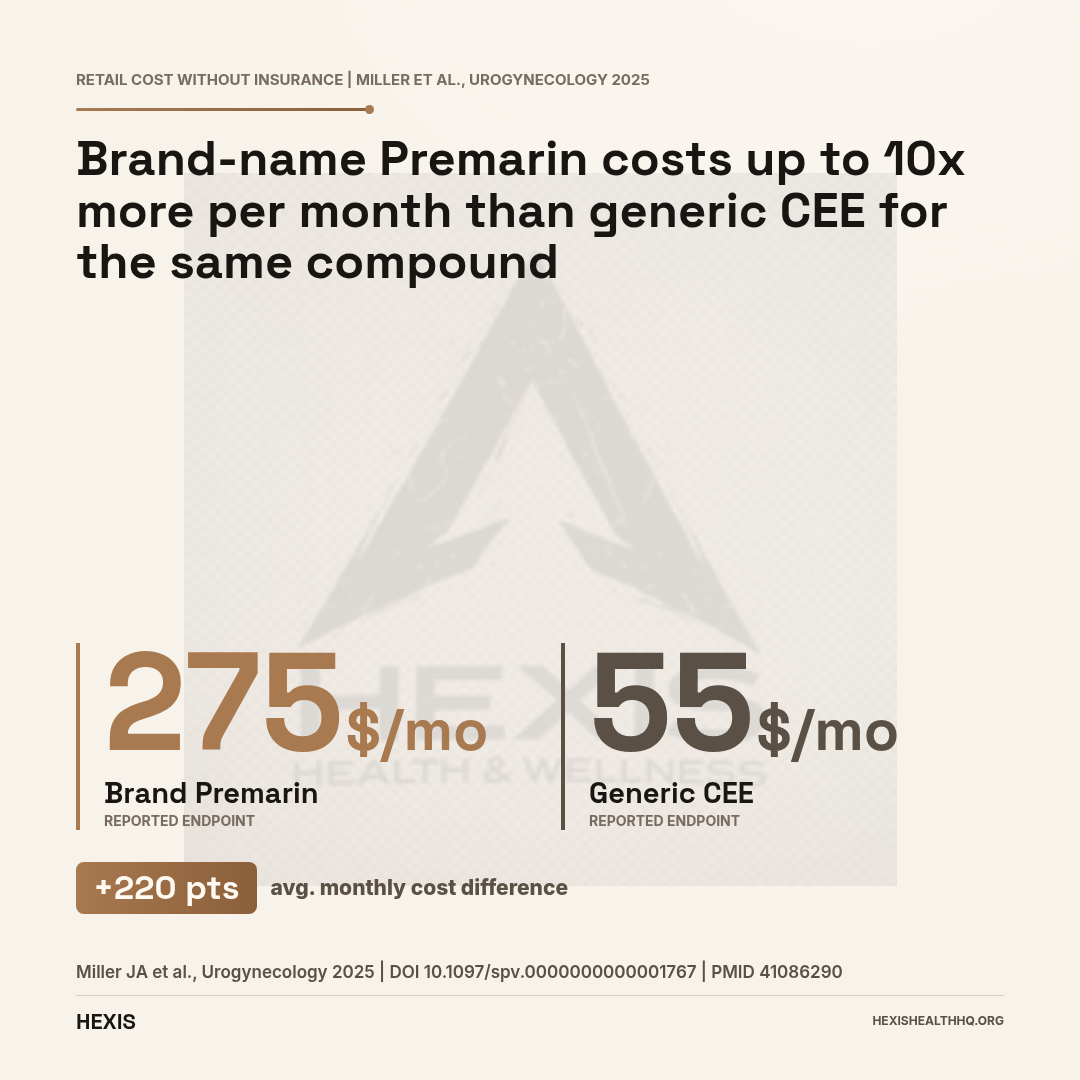
Premarin tablets cost approximately $200–$350/month at retail without insurance. With insurance coverage, copays vary widely — many insurance plans cover CEE under standard pharmacy benefits since it's FDA-approved and has decades of generic history. The Pfizer patient assistance program (Premarin PAP) offers free or reduced-cost medication for qualifying patients.
Generic CEE is available at significantly lower cost — typically $30–$80/month at retail pharmacies and even less with GoodRx or similar discount programs.
Vaginal Premarin cream is typically more expensive ($200+ retail without insurance) but is often separately covered for GSM indications.
Trends in vaginal estrogen prescribing and cost have shifted meaningfully since 2020, with growing availability of lower-cost generic formulations reducing the access barrier for many patients (Miller et al., 2025).
If you're navigating Premarin or other HRT options and want a lab-driven approach to finding the right formulation and dose, HEXIS starts with a full hormone panel — not a guess. Schedule a consultation to talk through your options with a provider who actually understands the differences between these formulations.
Premarin vs. Transdermal Estradiol — Key Differences
Both treat menopausal symptoms, but they differ in molecule, route, and risk profile
| Premarin (oral CEE) | Transdermal Estradiol | |
|---|---|---|
| Molecule | 10+ equine estrogen compounds | 17β-estradiol (identical to human) |
| Route | Oral tablet / vaginal cream | Patch, gel, spray, or oral tablet |
| Liver first-pass | Yes (oral forms) | Bypassed (transdermal) |
| VTE risk | Elevated (oral forms) | Substantially lower (transdermal) |
| Breast tissue data | CEE/MPA: higher proliferation signals | E2/MP: lower proliferation signals |
| Evidence base | WHI, HERS, KEEPS (large RCTs) | Growing; KEEPS, ELITE trial data |
| Cost (generic) | $30–$80/month | Widely available generically |
Source: Stanczyk et al., 2025; Archer & Oger, 2012; Lalitkumar et al., 2023; Graham et al., 2022
How Does Premarin Compare to Other HRT Options?
Premarin is not the only estrogen option. Here's where it fits relative to the main alternatives:
Premarin vs. Duavee (CEE + bazedoxifene) — Duavee combines CEE with bazedoxifene, a SERM that protects the uterus without the need for a separate progestogen. This is a legitimate option for women who can't tolerate progestogens, though the clinical evidence base is smaller than for CEE + progestin combinations (Umland et al., 2016).
Premarin vs. transdermal estradiol — covered above. The route of administration difference matters for VTE risk; the molecular difference matters for pharmacological effects. Neither is uniformly superior for all patients.
Premarin vs. vaginal estradiol (local-only) — for women whose primary concern is GSM rather than systemic menopausal symptoms, very low-dose vaginal estradiol (Vagifem 10 mcg, Imvexxy) delivers local estrogenic effects with minimal systemic absorption. The head-to-head comparison between 17β-estradiol vaginal tablets and CEE vaginal cream showed both were effective for vaginal atrophy, with slightly better pH normalization noted for the estradiol preparation (Rioux et al., 2000).
The comparison that matters for your situation depends on your symptoms, your risk profile, and what you're trying to achieve. These are not interchangeable products despite all being labeled "hormone therapy."
The Bottom Line
Premarin is a legitimate, FDA-approved, well-studied medication that reliably treats menopausal symptoms, prevents bone loss, and — depending on timing and individual profile — may carry cardiovascular benefits in younger postmenopausal women. It is also more pharmacologically complex than a single-molecule estrogen, carries real VTE and stroke risks (particularly oral forms), and the available evidence suggests its breast tissue profile differs from estradiol-plus-micronized-progesterone combinations.
The 2002 WHI findings that caused a mass exodus from HRT were real — but they applied to a specific combination in a specific population. A decade of follow-up research and newer trials like KEEPS have meaningfully refined that picture.
If you're a woman navigating menopause and trying to figure out whether Premarin is the right choice for you — or whether a different estrogen formulation makes more sense — the answer requires looking at your individual situation: your age, time since menopause, symptom severity, cardiovascular risk factors, whether you have a uterus, and what progestogen (if any) you'd pair with the estrogen.
At HEXIS, we do this with labs and a real clinical conversation. Not a one-size-fits-all prescription. Book a consultation to start.
Frequently Asked Questions
What is Premarin made from?
Premarin is made from conjugated equine estrogens (CEE) — a mixture of estrogen compounds extracted from the urine of pregnant mares. It contains at least ten different estrogenic substances, including equilin and equilenin, which are horse-specific estrogens not produced by the human body. This is the key molecular difference from bioidentical estradiol.
Is Premarin the same as bioidentical estrogen?
No. Premarin contains equine-derived estrogen compounds that are not identical to human estrogens. Bioidentical estradiol (17β-estradiol) is chemically identical to the estrogen your ovaries produce. They both bind estrogen receptors and treat menopausal symptoms, but they have different pharmacological profiles, different routes of metabolism, and different risk characteristics.
What did the Women's Health Initiative find about Premarin?
The WHI had two arms. CEE plus progestin (not Premarin alone) raised breast cancer, clot, stroke, and heart disease risk in older postmenopausal women. The CEE-alone arm — in women without a uterus — found no breast cancer increase and a potentially protective cardiovascular effect in younger women. The overall lesson is that timing, age, and whether a progestogen is added are all critical variables.
Does Premarin increase the risk of blood clots?
Oral CEE does increase VTE (clotting) risk through its effect on liver-derived clotting factors — this is well-documented and is a known risk of oral estrogen in general. Transdermal estrogen bypasses the liver and carries a substantially lower VTE risk. Women with a history of clotting disorders should discuss route of administration carefully with their provider.
Can you take Premarin without a progestogen?
Women who have had a hysterectomy can take CEE alone — this is actually the recommended approach, since unopposed estrogen in women with a uterus raises endometrial cancer risk. Women who still have a uterus need a progestogen (or a SERM like bazedoxifene) alongside any systemic estrogen.
Premarin: The Bottom Line
- 1
Premarin (CEE) is FDA-approved, well-studied, and effective for menopausal symptoms and bone protection — but it contains horse-specific estrogens not present in the human body, which gives it a different pharmacological profile than bioidentical estradiol.
- 2
The 2002 WHI scare applied to CEE+progestin in older women. The CEE-alone arm showed no breast cancer increase, and newer trials like KEEPS show timing matters — HRT started close to menopause carries a different risk profile than starting 10+ years later.
- 3
For most women today, the clinical conversation has shifted toward transdermal estradiol plus micronized progesterone because of lower VTE risk and more favorable breast tissue data — but Premarin remains a legitimate choice, especially when cost or established evidence base is the priority.