Low Testosterone Symptoms in Women: What the Research Actually Says
Low Testosterone Symptoms in Women: What the Research Actually Says
Testosterone is talked about almost exclusively as a male hormone. It isn't. Women produce it too — in their ovaries and adrenal glands — and low testosterone symptoms in women are real, measurable, and frequently dismissed. At HEXIS, we see this pattern constantly: a woman in her 40s comes in exhausted, with no sex drive and muscle she can't hold onto despite training, and every previous lab panel has come back "normal." The research gives us a clearer framework for what's actually happening.
The short answer: Low testosterone in women most commonly shows up as persistently low sexual desire (HSDD), fatigue, low mood, and reduced muscle mass. Normal total testosterone in premenopausal women runs approximately 15–70 ng/dL and declines roughly 50% by menopause. No FDA-approved testosterone product exists for women in the US, but the ISSWSH 2019 guideline supports transdermal testosterone for postmenopausal HSDD.
50.0% relative scale
decline in testosterone from peak (age 20s) to natural menopause — a gradual fall most women never get told about
What Does Testosterone Actually Do in Women?
Testosterone is not an afterthought in female physiology. It is the most abundant biologically active sex hormone in women — present at higher concentrations than estradiol across most of the reproductive lifespan (Rosato et al., 2024). Women produce it in two places: the ovaries and the adrenal glands. A smaller amount comes from precursor hormones like DHEA converted in peripheral tissues — fat, muscle, skin.
What does it do? Quite a bit. Testosterone drives sexual desire by acting on androgen receptors in the brain and genitourinary tract. It supports muscle protein synthesis and bone mineral density. It affects mood, energy, and cognitive clarity. And it influences clitoral and vaginal sensitivity through local receptor activity.
Production is not static. Testosterone levels peak in women during their 20s and then decline steadily — by approximately 50% by the time of natural menopause (Montero Bernaldez et al., 2026). This decline is gradual and does not drop sharply the way estrogen does at menopause, but the cumulative effect over decades is significant. Women who undergo surgical menopause (bilateral oophorectomy) experience a more abrupt decline because the ovaries account for roughly half of total testosterone production.
This is fundamentally different from male hypogonadism. In men, testosterone is the primary androgen with a narrow clinical normal range and well-established replacement thresholds. In women, the normal range is far lower, spans wider, and varies considerably across the menstrual cycle, age, and individual physiology. Conflating the two leads to misdiagnosis in both directions.
What Are the Symptoms of Low Testosterone in Women?
Low sexual desire is the symptom most clearly linked to low testosterone. It's rarely the only one. The full picture typically includes several overlapping complaints — and when they cluster together, androgen insufficiency is worth putting on the differential.
Reduced Sexual Desire and HSDD
Hypoactive Sexual Desire Disorder (HSDD) — now more precisely termed Female Sexual Interest and Arousal Disorder (FSIAD) in DSM-5 — is defined as persistently low or absent interest in sexual activity that causes personal distress. It affects approximately 10% of adult women (Clayton et al., 2018). Testosterone plays a central role in the neurobiology of sexual motivation, acting on dopaminergic reward pathways and androgen receptors in the hypothalamus.
Research into kisspeptin, a neuropeptide involved in reproductive hormone signaling, has illuminated how androgen-related pathways affect sexual brain processing. A 2022 JAMA Network Open trial found that kisspeptin administration in women with HSDD significantly increased sexual brain processing and self-reported desire scores compared to placebo (Thurston et al., 2022). This helps explain the mechanism: low androgenic tone can dampen the neural circuitry that drives sexual motivation before desire ever reaches conscious awareness.
Fatigue and Energy Decline
Persistent fatigue that doesn't resolve with sleep is one of the most consistently reported symptoms in women with low testosterone. It's not just tiredness — it's the kind where you sleep eight hours and still feel like you're running on empty. The mechanism involves androgen receptors in muscle tissue and the central nervous system. Testosterone supports mitochondrial function and red blood cell production. When androgens drop, that energy infrastructure weakens.
Mood Changes and Cognitive Symptoms
Irritability, low mood, and reduced motivation show up consistently in women with androgen insufficiency. These often precede — or get mixed in with — the estrogen-driven symptoms of perimenopause, so they get written off as stress or aging rather than something hormonal. Testosterone has direct effects on serotonin receptor sensitivity. That's likely what's driving the mood piece (Parrotta et al., 2026).
Muscle Loss and Bone Density
Androgens are anabolic. In women, testosterone supports muscle protein synthesis and helps maintain bone mineral density, particularly in trabecular bone. Women with surgically induced menopause — and therefore the sharpest decline in both estrogen and testosterone — show accelerated bone loss that standard estrogen replacement alone does not fully address (Kling, 2025). This is one reason some clinicians and guidelines now consider testosterone an adjunct to standard HRT, not a replacement for it.
What Are Normal Testosterone Levels in Women?
Normal total testosterone in premenopausal women runs approximately 15–70 ng/dL — a reference range that is substantially lower than in men and varies by lab, assay method, and age (Rosato et al., 2024). Free testosterone — the biologically active fraction — typically falls between 0.3 and 1.9 ng/dL. But three things make these numbers harder to act on than they look.
Three things complicate any single testosterone measurement:
Lab assays are inconsistent. Standard immunoassays, which most clinical labs use, are not sensitive enough to reliably measure the low concentrations in women. Mass spectrometry (LC-MS/MS) is considered the gold standard for female testosterone measurement but is not universally available (Uloko et al., 2022).
There is no agreed clinical threshold. Unlike male hypogonadism — where there are published cutoff values — no consensus threshold exists below which a woman is considered "deficient." The ISSWSH 2021 Clinical Practice Guideline explicitly states that testosterone testing should not be used to diagnose androgen insufficiency in women but can be used to monitor therapy once it is initiated (Parish et al., 2021).
Levels fluctuate. Testosterone in premenopausal women varies across the menstrual cycle, peaking around ovulation. Morning levels are typically higher. Age, stress, sleep, and body composition all affect results.
The clinical implication: a single testosterone number does not diagnose or rule out androgen insufficiency in women. Symptoms, context, and response to treatment matter more than a single lab value.
HSDD Treatment Options for Women
Evidence-based options — testosterone is off-label; flibanserin and bremelanotide are FDA-approved for premenopausal HSDD
| Transdermal Testosterone | Flibanserin (Addyi) | Bremelanotide (Vyleesi) | |
|---|---|---|---|
| FDA approved for women | No (off-label) | Yes — premenopausal | Yes — premenopausal |
| Mechanism | Androgen receptor activity | Serotonin / dopamine receptors | Melanocortin receptors |
| Route | Transdermal (gel/cream) | Daily oral tablet | Subcutaneous injection (on-demand) |
| Guideline support | ISSWSH 2021, BMS Consensus | FDA-approved indication | FDA-approved indication |
| Primary limitation | No US female product; monitoring required | Modest effect size (~0.5–1.0 SSE/month) | Modest effect size; nausea common |
Source: Parish et al., J Sex Med, 2021 | Barakeh et al., Ann Pharmacother, 2024 | Spielmans & Ellefson, J Sex Res, 2023
What Does the Evidence Say About Testosterone Therapy in Women?
Transdermal testosterone is the most evidence-supported hormonal option for postmenopausal women with HSDD, backed by a 2021 ISSWSH Clinical Practice Guideline, the BMS Global Consensus, and ICSM 2024 recommendations. The evidence is clearest for naturally and surgically menopausal women; data in premenopausal women is more limited.
ISSWSH Guideline: Postmenopausal HSDD
The International Society for the Study of Women's Sexual Health (ISSWSH) published its Clinical Practice Guideline in 2021 following a systematic evidence review. The conclusion: sufficient evidence exists to support transdermal testosterone for postmenopausal women with HSDD (Parish et al., 2021). The guideline specifies transdermal delivery (gels, creams, patches) at doses targeting the upper premenopausal normal range — not supraphysiologic levels.
The ADORE study and related testosterone patch trials in naturally menopausal women demonstrated improvements in satisfying sexual events and sexual desire scores versus placebo, with an acceptable safety profile at physiologic doses (Kling, 2025).
The British Menopause Society (BMS) reached similar conclusions in its global consensus statement, recommending testosterone as a second-line option after standard HRT for women with HSDD who have an inadequate response to estrogen alone.
The Fifth International Consultation on Sexual Medicine (ICSM 2024)
The 2026 publication of ICSM 2024 recommendations for HSDD evaluation and management reinforced the evidence for testosterone while also highlighting ongoing gaps (Rowen et al., 2026). The panel noted that high-quality RCT data are strongest for postmenopausal women; evidence in premenopausal women is more limited and less consistent.
FDA-Approved Alternatives for HSDD
Two non-androgen options are FDA-approved for HSDD in premenopausal women:
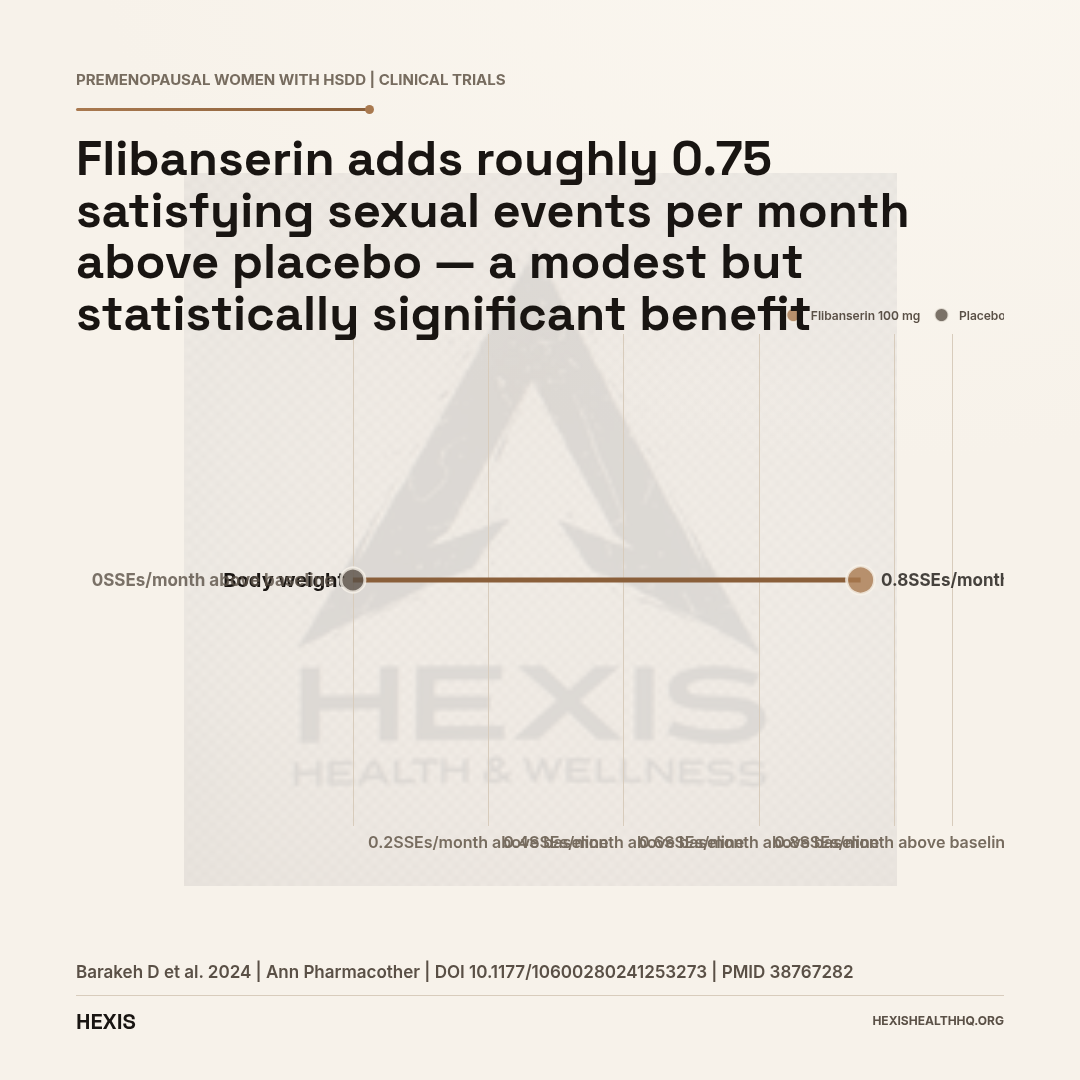
Flibanserin (Addyi) is a daily oral medication that works on serotonin and dopamine receptors. It received FDA approval in 2015 for premenopausal women with acquired, generalized HSDD. Effect sizes are modest — the drug increases satisfying sexual events by approximately 0.5–1.0 per month in clinical trials (Barakeh et al., 2024).
Bremelanotide (Vyleesi) is a subcutaneous injection taken on-demand before anticipated sexual activity. It activates melanocortin receptors, which influence sexual arousal pathways. Trial data show improvements in desire scores and reductions in distress, though clinical meaningfulness has been debated (Spielmans & Ellefson, 2023). It is approved for premenopausal women with acquired, generalized HSDD.
Neither drug is an androgen, and neither replaces the specific role of testosterone in women who have androgen insufficiency alongside menopausal transition.
Testosterone Gel: Real-World Data
A 2026 single-center study tracked serum testosterone concentrations in postmenopausal women using testosterone gel as part of standard HRT care. The data confirmed that physiologic dosing achieves concentrations within the premenopausal normal range without significant supraphysiologic spikes — which is the primary safety target for this therapy (Heald et al., 2026).
Supraphysiologic Doses Cause Virilization
Acne, increased facial and body hair, voice deepening, and clitoral enlargement are dose-dependent. These side effects are rare at physiologic doses (targeting the upper premenopausal normal range) but increase sharply when testosterone climbs toward male-range levels. HDL cholesterol also drops at high doses.
Pellet implants carry the highest risk of supraphysiologic levels and are outside standard guideline recommendations. Any testosterone therapy in women requires regular bloodwork to keep levels within the normal female range.
Source: Montero Bernaldez et al., Cureus, 2026 | Pinto da Costa Viana et al., Cureus, 2025
Is Testosterone Therapy Safe for Women?
At physiologic doses — those targeting the normal premenopausal range — the safety profile of transdermal testosterone in women is generally favorable. The most important concerns at supraphysiologic doses are:
- Virilization: acne, increased body or facial hair, voice deepening, and clitoral enlargement are dose-dependent side effects. They are rare at physiologic doses but become more common when levels significantly exceed the premenopausal range.
- Lipid effects: high-dose androgens can lower HDL cholesterol. This effect is less pronounced with transdermal delivery compared to oral androgens.
- Cardiovascular risk: long-term data are limited, but current trials at physiologic doses have not shown increased cardiovascular risk.
The safety concerns that make clinicians cautious stem largely from decades of use at male-range doses (10–20x the female physiologic range). Guidelines consistently emphasize monitoring testosterone levels after initiation and adjusting to maintain concentrations within normal female ranges (Montero Bernaldez et al., 2026).
Testosterone pellet implants, which deliver sustained release, carry a higher risk of supraphysiologic levels and are considered outside standard guideline recommendations until stronger safety data are available (Pinto da Costa Viana et al., 2025).
How Is Low Testosterone in Women Diagnosed and Treated?
Low testosterone in women is diagnosed clinically — starting with symptoms, not a single lab value. Because no validated cutoff exists for female testosterone deficiency, the ISSWSH process-of-care framework and the 5th ICSM recommendations both begin with a structured clinical interview, validated symptom questionnaires (such as the FSFI or FSDS-DAO), and systematic rule-out of other contributing factors — thyroid dysfunction, depression, relationship factors, medications that suppress androgen levels (like oral contraceptives or antidepressants).
Lab testing is used to establish a baseline before treatment and to monitor for supraphysiologic levels during therapy — not to make the diagnosis (Rowen et al., 2026). LC-MS/MS is the preferred assay when available.
Treatment options for women who have been clinically evaluated include:
- Transdermal testosterone gel or cream — the delivery method most supported by guidelines. Compounded formulations are commonly used in the US given the lack of an FDA-approved female product.
- Lifestyle optimization — resistance training, sleep, and weight management all affect androgen levels and androgen receptor sensitivity. These are adjuncts, not replacements for clinical treatment.
- Underlying cause management — if oral contraceptives are suppressing SHBG and reducing free testosterone, switching formulations may help. If the cause is surgical menopause, the approach differs from natural menopause.
If you are exploring testosterone therapy, the starting point is a full hormone panel — not a prescription. Understanding your baseline levels and ruling out other hormonal contributors takes a clinical workup, not guesswork. Women going through the menopausal transition may also want to read about HRT options for women before their first visit. Schedule a consultation at HEXIS to start with a proper lab panel.
Frequently Asked Questions
Can a woman have low testosterone even before menopause?
Yes. Testosterone declines gradually from peak levels in the 20s, so premenopausal women in their 30s and 40s can have measurably lower levels than they did a decade earlier. Women on combined oral contraceptives may have particularly low free testosterone because estrogen raises SHBG, which binds and inactivates testosterone. Surgical menopause at any age causes a sharp drop.
Does low testosterone cause weight gain in women?
The relationship is indirect. Testosterone supports lean muscle mass, and muscle tissue burns more calories at rest than fat. When androgens decline and muscle mass falls, basal metabolic rate drops — which can contribute to gradual fat gain even without changes in diet. Visceral fat also has higher aromatase activity, which further accelerates the conversion of remaining testosterone to estrogen (Rosato et al., 2024).
Is DHEA the same as testosterone therapy for women?
No. DHEA (dehydroepiandrosterone) is a precursor hormone that the body can convert into testosterone or estrogen in peripheral tissues. DHEA supplementation raises testosterone to a modest degree, but the conversion is inconsistent and uncontrolled. Prasterone (Intrarosa), a vaginal DHEA product, is FDA-approved for dyspareunia in postmenopausal women and works locally rather than systemically. It is not equivalent to systemic testosterone therapy for HSDD.
What are the risks if testosterone goes too high in women?
Supraphysiologic testosterone in women causes dose-dependent virilization — acne, increased facial or body hair, voice changes, clitoral enlargement, and disrupted menstrual cycles. Cardiovascular risk — specifically HDL cholesterol reduction — also increases at male-range doses. This is why guidelines consistently emphasize monitoring and targeting the upper premenopausal normal range, not male reference ranges (Montero Bernaldez et al., 2026). Regular bloodwork is essential during treatment.
“The treatment gap is real, and it frustrates a lot of clinicians and patients. No testosterone product is FDA-approved specifically for women in the US.”
What's Actually Available for Women With Low Testosterone?
The treatment gap is real, and it frustrates a lot of clinicians and patients. No testosterone product is FDA-approved specifically for women in the US. That means clinicians rely on off-label prescribing of male formulations at much lower doses, or on compounded products. Both are legal and widely practiced — but dosing is less standardized and requires more careful monitoring than it would with a purpose-built product.
The research pipeline is active. A 2026 review in Nature Reviews Urology summarized the current and emerging pharmacotherapy options for female sexual dysfunction, noting increasing evidence for testosterone alongside newer investigational agents targeting central desire pathways (Reisman et al., 2026). Kisspeptin-based therapies are among the most promising emerging options — a 2022 JAMA trial demonstrated significant improvements in sexual brain processing in women with HSDD (Thurston et al., 2022).
For women looking to explore their options now, the most evidence-supported path is: clinical evaluation with symptom assessment, a full hormone panel using sensitive assays, and — if appropriate — a trial of transdermal testosterone under physician supervision with regular monitoring. The HEXIS HRT page provides more context on how hormone evaluation works and what a full panel includes.
If you've already read about testosterone therapy basics and want to understand the female-specific picture more fully, this article covers the science. The next step is a clinical conversation with a provider who has actually looked at your labs.
Low Testosterone in Women: The Bottom Line
- 1
Testosterone is not a male-only hormone — women produce it in their ovaries and adrenal glands, and levels decline by roughly 50% by menopause. When it drops enough to cause symptoms (low libido, fatigue, mood changes, muscle loss), that's clinically relevant.
- 2
No FDA-approved testosterone product exists for women in the US, but the ISSWSH 2019 guideline and BMS Global Consensus both support transdermal testosterone for postmenopausal women with HSDD — off-label, at physiologic doses, with monitoring.
- 3
Diagnosis starts with symptoms and a structured clinical evaluation — not a single lab value. A full hormone panel establishes your baseline; treatment, if appropriate, is then monitored with regular bloodwork to stay within the normal female range.