Before & After TRT: What to Expect and When
Before & After TRT: What to Expect and When
Most men who start testosterone replacement therapy have the same question: how long until I actually feel something? It depends on what you're hoping to change — some things TRT does well, and others it doesn't fix at all. Here's what the largest clinical trial to date actually found, timeline and all.
The short answer: Most men notice improved libido and energy within 3–6 weeks. Body composition shifts take 3–6 months. Bone density changes take up to two years. But TRT does not improve erectile function on its own — and it won't fix cognition or sleep quality, per the TRAVERSE trial (n=5,204).
What Happens in the First 6 Weeks on TRT?
TRT's earliest effects are hormonal and subjective — you'll feel differences before you see them, typically in libido and energy, and those changes begin at weeks 3–6 in most men.
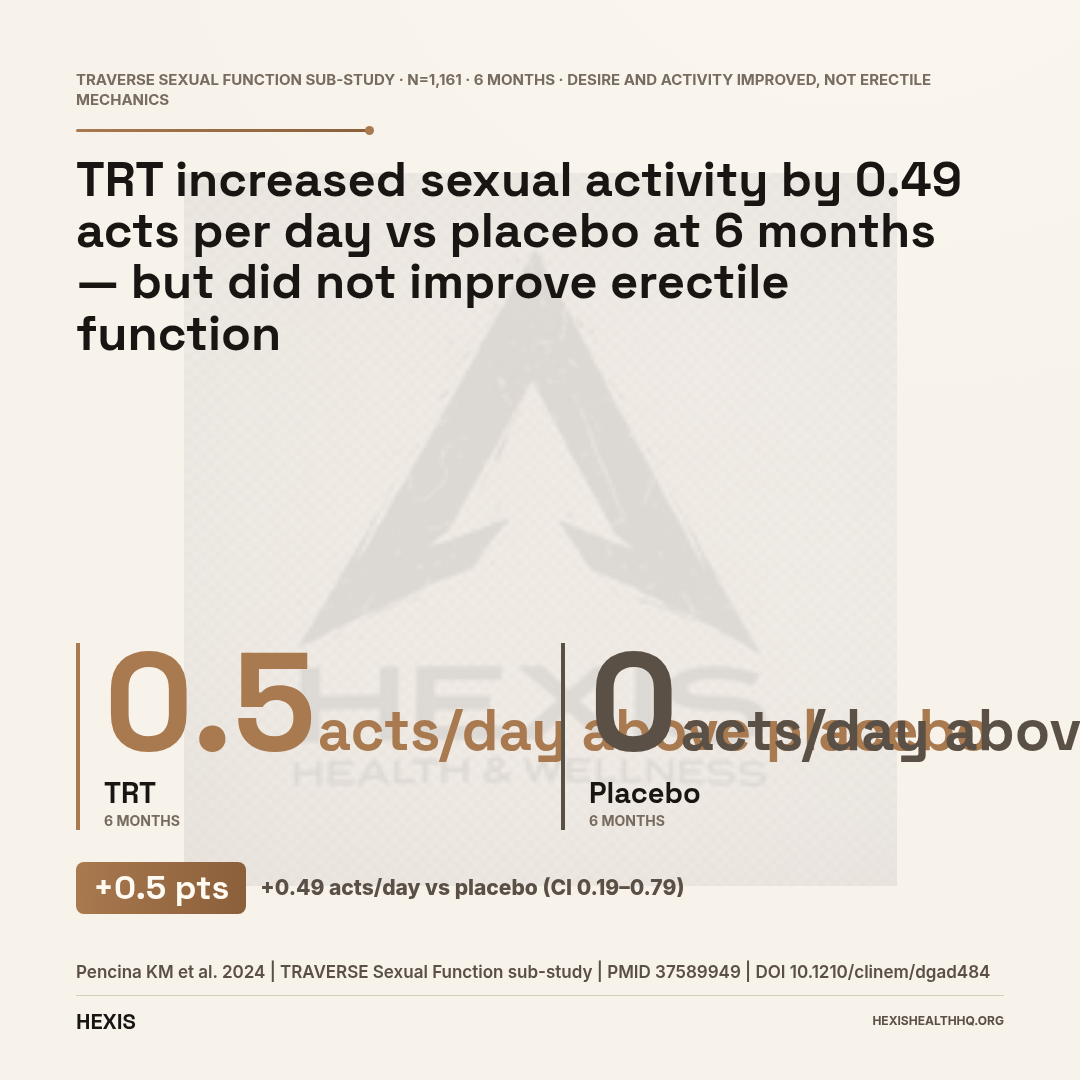
Sexual desire is usually the first thing men notice. In the TRAVERSE Sexual Function sub-study — which enrolled 1,161 men with low libido as a primary symptom — TRT significantly increased both sexual desire and sexual activity compared to placebo (Pencina et al., 2024). The difference versus placebo was 0.49 acts per day at 6 months and 0.47 acts per day at 12 months.
That's real. But here's what the same study also found, and what most TRT marketing never mentions: erectile function did not improve with TRT in TRAVERSE (Pencina et al., 2024). If erectile dysfunction is your main concern, testosterone alone is not the answer. Erections depend on vascular health, nerve function, and psychology — not just hormone levels.
Energy and mood start shifting around weeks 3–12, according to narrative review consensus among endocrinology guidelines (Barbonetti et al., 2020). Sleep quality and cognition, however, don't reliably improve with TRT — the TRAVERSE depression sub-study found TRT provided modest benefit on mood in hypogonadal men, but had no demonstrated effect on cognitive function or sleep (Bhasin et al., 2024).
About half of hypogonadal men have significant depressive symptoms. The TRAVERSE trial found that 50.8% of men enrolled had clinically meaningful depressive symptoms at baseline, and TRT did provide modest mood improvement in that group (Bhasin et al., 2024). Modest means real but not dramatic — don't expect antidepressant-level changes from testosterone alone.
How Does TRT Change Body Composition?
TRT improves body composition — more muscle mass, less visceral fat — but the timeline is 3–6 months, not 6 weeks, based on narrative review consensus from clinical endocrinology guidelines (Tsametis & Isidori, 2018).
You won't look different at six weeks. The hormonal shift happens faster than the tissue adapts.
Testosterone directly stimulates protein synthesis in muscle and reduces fat accumulation, particularly visceral fat. A 2025 study from the LITROS trial looked at testosterone combined with lifestyle therapy in older obese men with hypogonadism and found improvements in skeletal muscle glycolytic enzyme activity — meaning testosterone was helping muscle use fuel more effectively (Viola et al., 2025).
TRT is not a replacement for effort. Men who combine TRT with resistance training and dietary discipline see substantially better body composition results than those who don't. The hormone creates the physiological conditions; you still have to do the work.
There's one more piece of the picture here: excess body fat converts testosterone into estrogen via an enzyme called aromatase. So men who are significantly overweight often have low testosterone partly because of the fat itself — and losing fat can raise testosterone levels independent of TRT (Tsutsumi & Tsuchiya, 2025). This is why some providers address weight first before prescribing testosterone.
What Does TRT Do for Bone Density?
Bone density is the slowest-moving outcome on TRT — and the most underappreciated.
Bones remodel slowly. Meaningful increases in bone mineral density after TRT begin around 6 months and continue for up to 24 months, per narrative review consensus from the European Academy of Andrology guidelines (Corona et al., 2020). These are not single-trial findings — they represent expert consensus from longitudinal registry data and review-level evidence.
This matters most for men with classical hypogonadism — conditions like Klinefelter syndrome or Kallmann syndrome, where testosterone deficiency is severe and long-standing. A 2026 study found that men with Klinefelter syndrome have significantly altered body composition by DXA even with treatment, highlighting that bone and muscle outcomes depend heavily on the underlying cause of hypogonadism (Buoso et al., 2026).
For men with late-onset or age-related testosterone decline, the bone benefit is real but more modest. The timeline is long enough that most men don't notice it at all during treatment — it shows up in DEXA scans, not in how you feel day-to-day.
Monitor Your Hematocrit
Polycythemia — elevated red blood cell concentration — is the most common lab abnormality on TRT. Guidelines flag hematocrit above 54% as the threshold for dose reduction or temporary discontinuation.
Source: Chin-Yee et al., 2017 (PMID 28150363)
Is TRT Safe for the Heart and Prostate?
These are the two questions every man should ask before starting, and they deserve straight answers.
Cardiovascular safety: The TRAVERSE trial specifically enrolled men with high cardiovascular risk — they had pre-existing heart disease or multiple risk factors — and TRT did not increase major adverse cardiovascular events compared to placebo. This was the headline finding that helped resolve years of conflicting observational data reviewed across the TRT and cardiac literature (Goodale et al., 2017). TRT is not risk-free for every man, but the "TRT causes heart attacks" narrative from earlier studies doesn't hold up under rigorous trial conditions.
Prostate safety: The TRAVERSE prostate sub-study found no significant increase in high-grade prostate cancer (Gleason score 4+3 or higher) in TRT-treated men compared to placebo over the trial period (Bhasin et al., 2023). Prostate-specific antigen (PSA) levels do rise modestly on TRT, which is monitored at follow-up visits. The data does not support avoiding TRT out of prostate cancer fear in appropriately screened men.
Hematocrit: The most common lab abnormality on TRT is polycythemia — an increase in red blood cell concentration. Monitoring guidelines flag a hematocrit above 54% as the threshold for dose reduction or temporary discontinuation (Chin-Yee et al., 2017). This is routine monitoring, not a rare emergency, but it's why labs at 3 and 6 months matter.
Fertility: TRT suppresses the hormonal signals that drive sperm production. Men who want biological children should not start TRT without a serious conversation about alternatives — including clomiphene or HCG, which can preserve fertility in some cases (Ide et al., 2020). This is not a gray area.
What TRT Does vs. What It Doesn't
Source: TRAVERSE trial (Pencina et al., 2024; Bhasin et al., 2024); Corona et al., 2020
What TRT Does NOT Fix
TRT is FDA-approved for classical hypogonadism — primary or secondary — in adult males (Corona et al., 2020). It is not approved for age-related testosterone decline alone. Many men have testosterone in the low-normal range that is causing real symptoms, but the clinical picture is nuanced and requires lab confirmation, not assumptions.
Per the TRAVERSE trial, TRT does not improve:
- Erectile function (Pencina et al., 2024)
- Cognitive performance (Bhasin et al., 2024)
- Sleep quality (Bhasin et al., 2024)
These are the three things men most commonly assume TRT will fix. When a man reports that TRT "didn't work," it's often because he was expecting it to resolve one of these — and it's not designed to.
Mood and energy improvement are real but modest. Sexual desire improvement is real and supported by trial data. Body composition and bone density take time, require effort, and depend heavily on the underlying cause of deficiency.
How Long Do You Stay on TRT?
TRT is typically an ongoing treatment, not a finite course.
Testosterone replacement restores levels while you're on it. When you stop, levels return to baseline — which is why men stop feeling the benefits after discontinuation (Rastrelli et al., 2019). This isn't addiction; it's the nature of hormonal replacement.
Duration decisions depend on the individual's diagnosis, response, and monitoring data. Men with primary hypogonadism (testicular failure) often stay on TRT indefinitely. Men with secondary hypogonadism (pituitary or hypothalamic cause) may have other options explored first, including alternatives that stimulate endogenous production rather than replacing exogenous testosterone (Ide et al., 2020).
The monitoring cadence typically looks like: baseline labs, then 3-month check, then 6-month, then annually once stable. Labs include total testosterone, free testosterone, hematocrit, PSA (if applicable), and LH/FSH (Livingston et al., 2017). Your provider adjusts protocol based on those numbers — it's not set-and-forget.
Frequently Asked Questions
How long does TRT take to work?
Sexual desire typically improves within 3–6 weeks. Energy and mood shift at 3–12 weeks, per narrative review consensus. Body composition changes become visible at 3–6 months. Bone density improvements can take 6–24 months. The timeline depends on which outcome you're measuring.
Does TRT help with erectile dysfunction?
The TRAVERSE trial specifically tested this in men with hypogonadism and found that TRT did not improve erectile function compared to placebo (Pencina et al., 2024). TRT improves sexual desire and activity — not the mechanical function of erections. If erectile dysfunction is the primary concern, a different evaluation is needed.
Does TRT improve mood and energy?
Modestly, yes. The TRAVERSE depression sub-study found that TRT provided measurable mood improvement in hypogonadal men with depressive symptoms — 50.8% of whom had significant symptoms at baseline (Bhasin et al., 2024). Energy improvement is noted in clinical reviews but tends to be more pronounced in men with genuinely low testosterone, not low-normal levels.
What are the risks of TRT I should actually worry about?
Polycythemia (elevated hematocrit above 54%) is the most common lab concern and is caught with routine monitoring (Chin-Yee et al., 2017). Prostate safety was confirmed in the TRAVERSE prostate sub-study — no significant increase in high-grade prostate cancer (Bhasin et al., 2023). Fertility suppression is real and irreversible without stopping treatment. Cardiovascular risk was not elevated vs. placebo in the TRAVERSE main trial.
Can I start TRT if I want to have children?
No — not without a detailed conversation about alternatives first. TRT suppresses spermatogenesis, and this effect can persist for months after stopping. Men who want biological children should explore fertility-preserving options like clomiphene or HCG with their provider before starting testosterone (Ide et al., 2020).
What a Real TRT Protocol Looks Like at HEXIS
HEXIS Health is a licensed medical clinic — our providers see men at every point on the testosterone spectrum, from genuinely deficient to low-normal with real symptoms, and the evaluation process is the same: labs first, protocol second. Starting TRT without bloodwork is like calibrating a scale without a baseline weight. Every protocol begins with a full hormone panel — total testosterone, free testosterone, LH, FSH, SHBG, estradiol, hematocrit — before anything is prescribed.
If you qualify, your provider will discuss delivery method (gel, injection, pellet, or transdermal patch), frequency, and dose based on your numbers and lifestyle. Follow-up labs at 3 and 6 months are standard — not optional — because hematocrit and PSA need monitoring, and dose adjustments are normal early on.
If your levels are low-normal and your symptoms are real, there's a conversation worth having. If your levels are genuinely low, there's a protocol that can help. Either way, it starts with data — not guesswork.
Understand what low testosterone actually looks like before deciding if TRT is worth exploring for you.
See how TRT compares to other hormonal approaches if you're weighing your options.
If you're also concerned about the cardiovascular angle, read how testosterone affects the heart — the TRAVERSE data is explained there in full.
Schedule a consultation — labs first, protocol second.
- 1
Libido and energy typically shift within 3–6 weeks — body composition takes 3–6 months, bone density up to 24 months.
- 2
TRT improves sexual desire and activity. It does NOT improve erectile function, cognition, or sleep (TRAVERSE, n=5,204).
- 3
50.8% of hypogonadal men in TRAVERSE had depressive symptoms — TRT provided modest but real mood improvement.
- 4
Hematocrit above 54% triggers dose adjustment — standard monitoring catches this early.
- 5
TRT suppresses sperm production. Men wanting biological children should discuss alternatives first.