Can Low Testosterone Cause Hair Loss? What the Science Actually Shows
Can Low Testosterone Cause Hair Loss?
Men starting testosterone therapy sometimes ask whether TRT will make their hair loss worse. Occasionally someone comes in believing low testosterone is causing their thinning hairline. Both are reasonable concerns — and both trace back to the same misunderstanding about how hair loss actually works. Low testosterone doesn't cause the kind of hair loss most men worry about. Male-pattern baldness is driven by a different mechanism entirely — one where having more testosterone can actually speed things up.
The short answer: Male-pattern baldness (androgenetic alopecia) is driven by genetic sensitivity to DHT — a testosterone byproduct — not by low testosterone levels. Men with hair loss often have higher circulating testosterone than men without it. Low testosterone rarely causes scalp hair loss in men; in some cases, treating low T with testosterone therapy can actually accelerate hair thinning in genetically susceptible individuals.
The Actual Driver of Male-Pattern Baldness
Most hair loss conversations start in the wrong place. Testosterone isn't the problem. DHT is.
Testosterone is converted to dihydrotestosterone (DHT) by an enzyme called 5-alpha-reductase, which sits inside the dermal papilla — the tiny cluster of cells at the base of each hair follicle. Once formed, DHT binds to the androgen receptor in that follicle with roughly five times the affinity that testosterone does (Trüeb, 2002). That tight binding is what triggers the cascade that shrinks hair follicles over time.
What makes this process specific to some follicles and not others is genetics. Follicles on the crown and temples of genetically predisposed men and women have elevated DHT levels and increased androgen receptor expression compared to follicles on the back of the scalp (Trüeb, 2002). This is why male-pattern baldness follows such a predictable pattern — the Hamilton-Norwood progression on the crown and temples, not uniform thinning across the whole head.
The progressive result: DHT shortens the hair's active growth phase (anagen), lengthens the resting phase (telogen), and the follicle gradually miniaturizes from a thick terminal hair down to a fine vellus hair. Eventually it stops producing visible hair at all (Chen et al., 2025).
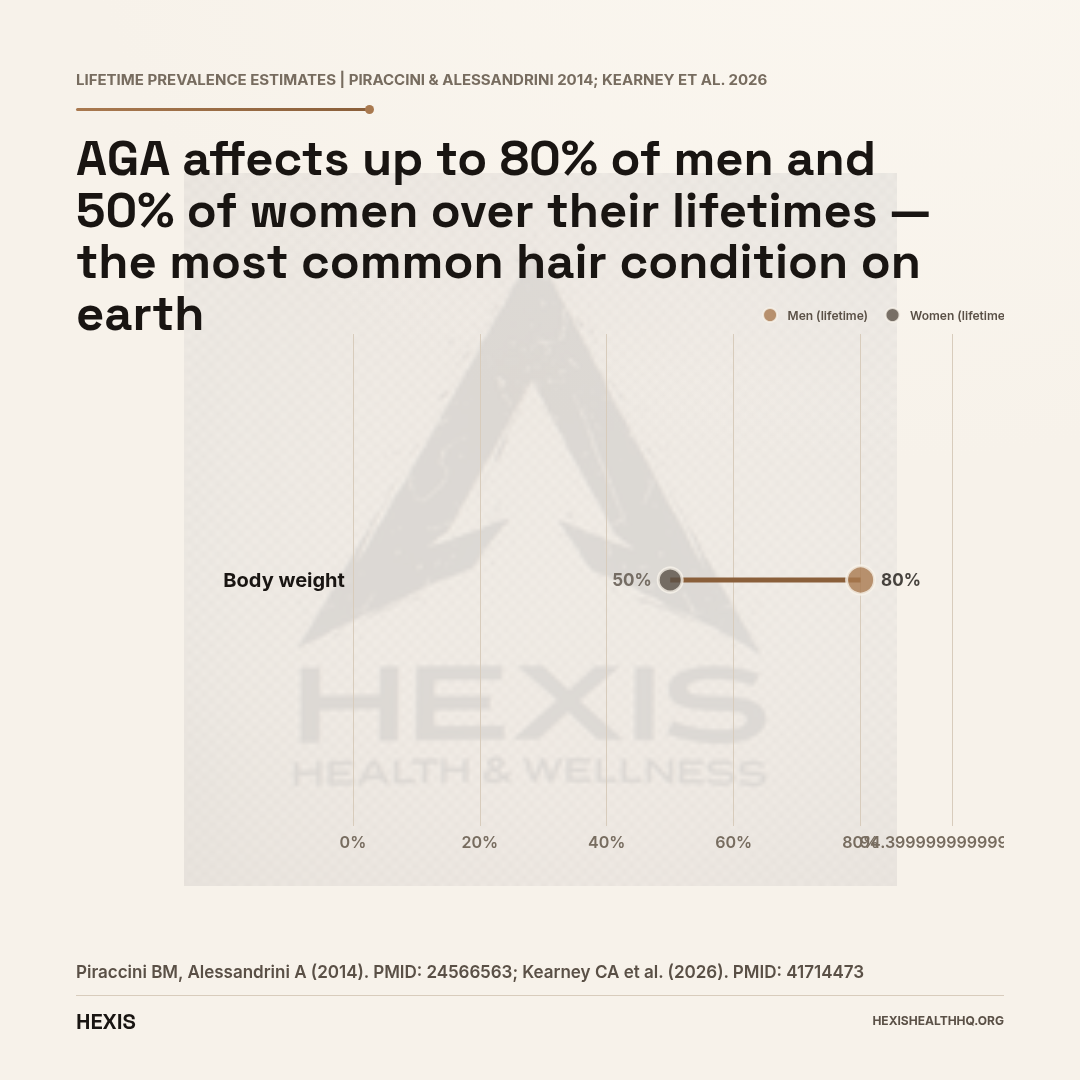
This is androgenetic alopecia (AGA). It affects up to 80% of men and nearly 50% of women over their lifetimes (Piraccini & Alessandrini, 2014; Kearney et al., 2026). By age 50, between 40% and 50% of Canadians are affected (Landells et al., 2025). It is the most common form of hair loss on the planet, and its root cause is not how much testosterone you have — it's how sensitive your follicles are to DHT.
Do Men With Hair Loss Have Low Testosterone?
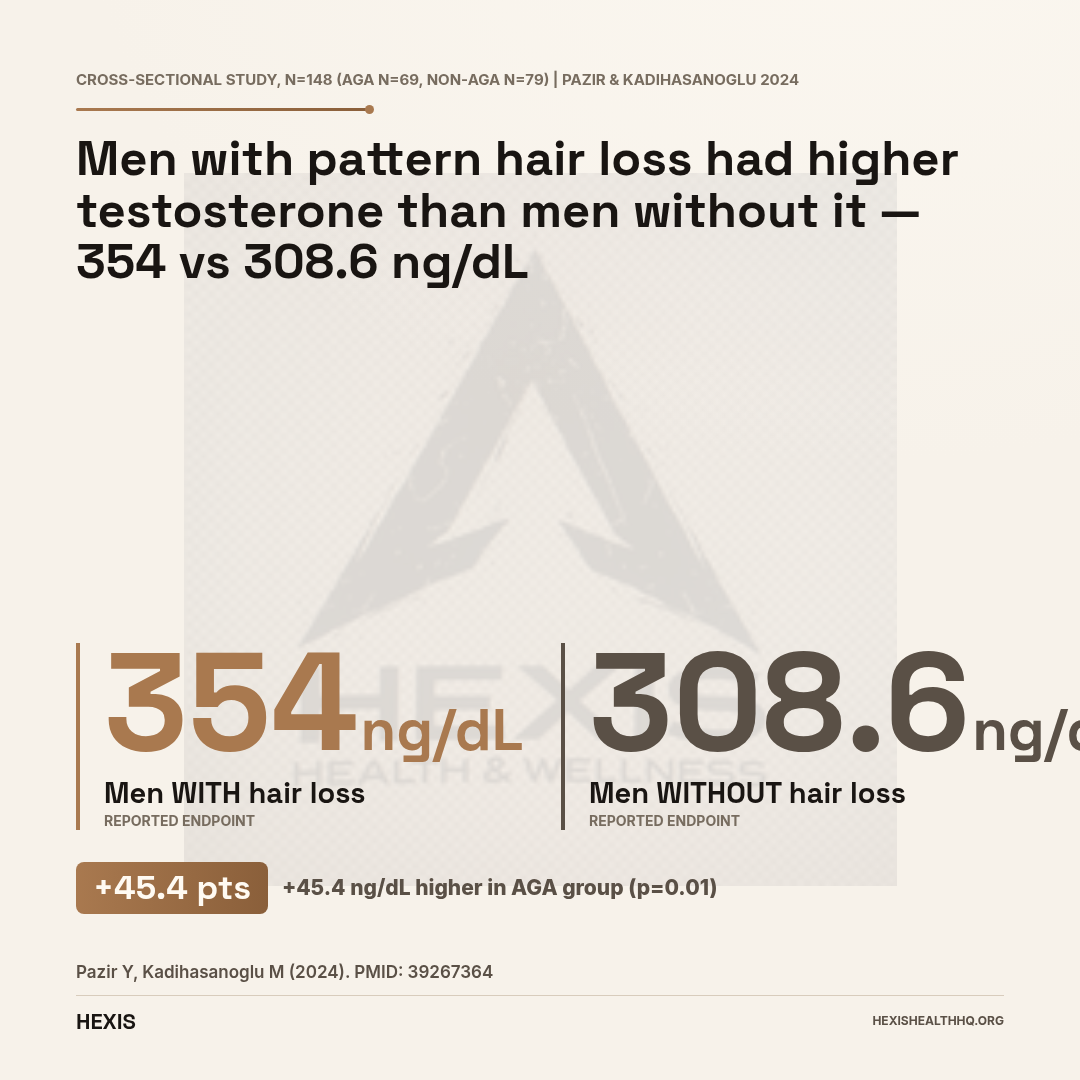
Men with androgenetic alopecia tend to have higher serum testosterone than men without it — the opposite of what most people expect. A 2024 study measuring testosterone in men with and without AGA found the AGA group averaged 354 ng/dL versus 308.6 ng/dL in the non-AGA group, a statistically significant difference (p = 0.01) (Pazir & Kadihasanoglu, 2024).
Men with more visible hair loss had higher testosterone. Not lower.
This makes biological sense once you understand the mechanism. AGA isn't about testosterone being too low — it's about what happens to testosterone downstream in a genetically susceptible follicle. You can have perfectly adequate testosterone and still lose hair rapidly if your scalp follicles are highly sensitive to DHT. Conversely, you can have moderately low testosterone and keep a full head of hair if you don't carry the susceptibility genes.
The androgen receptor gene sits on the X chromosome, which is why the maternal grandfather pattern (your mother's dad was bald) is often cited as the most predictive single family history factor — though the full genetic architecture is polygenic and involves variants across multiple chromosomes (Liu et al., 2025).
Low testosterone, on its own, is not a meaningful risk factor for androgenetic alopecia.
Can Testosterone Replacement Therapy Accelerate Hair Loss?
TRT can worsen hair loss. That's not a reason to avoid it — but it is a reason to plan around it.
TRT raises circulating testosterone. In genetically predisposed men, more circulating testosterone means more substrate available for 5-alpha-reductase to convert to DHT in scalp follicles. The result: accelerated follicular miniaturization in men who already carry the AGA genes (Tang et al., 2023).
A 2023 systematic review of gender-affirming hormone therapy found that testosterone treatment in transgender men could induce or accelerate androgenetic alopecia, providing direct evidence that raising testosterone levels contributes to AGA progression in susceptible individuals (Tang et al., 2023).
The risk isn't universal. Men with no family history of hair loss and no baseline AGA pattern are unlikely to see significant changes. But men with Hamilton-Norwood stage III or higher at baseline, or a strong family history, face a real risk of accelerated hair thinning when testosterone levels rise substantially.
This doesn't mean TRT is the wrong choice for men with clinically low testosterone. It means the conversation about TRT should include this tradeoff — and in many cases, the solution is targeted, not avoidance. Finasteride and dutasteride exist precisely for this reason.
If you're thinking about starting testosterone therapy, this is a conversation worth having with your provider before you begin.
“63% of androgen-deficient women with hair thinning reported hair regrowth after starting testosterone therapy.”
The Women's Paradox: Low T and Hair Loss Work Differently
In androgen-deficient women, low testosterone can contribute to hair thinning — and restoring it with therapy can reverse that thinning. This is the opposite of what happens in men with androgenetic alopecia, where adding testosterone accelerates hair loss rather than preventing it.
Among women, androgenetic alopecia presents as diffuse thinning — particularly across the central part — rather than the frontal recession seen in men. The same DHT mechanism applies, but it's less dominant, and estrogen's protective effects on hair follicles complicate the picture significantly (Grymowicz et al., 2020).
The numbers from a 285-woman study of androgen-deficient patients put it plainly: 27% (76 women) reported hair thinning before starting subcutaneous testosterone implants. Among those 76 women, 63% (48 women) reported hair regrowth after starting testosterone therapy (Glaser et al., 2012).
The difference comes down to context. Women with androgen deficiency lack the hormonal signaling that follicles need to complete normal growth cycles. That deficiency itself drives thinning. Restore adequate androgens and the follicles respond.
Men with AGA have the opposite problem: their follicles are too sensitive to androgens. Adding more fuel to that fire accelerates the damage.
Same hormone. Different mechanism. Different outcome. This is why "testosterone causes hair loss" and "testosterone doesn't cause hair loss" can both be correct — depending entirely on who you're talking about.
Women experiencing unexplained hair thinning may want to explore this alongside other hormone-related symptoms. See our overview of testosterone therapy for women for more context.
AGA Treatment Options: How They Compare
| Option | Mechanism | FDA Status | Efficacy (2025 NMA) |
|---|---|---|---|
Source: Gupta et al., 2025 (NMA); Gupta & Talukder, 2022. PMID: 40586152, 35238144
What Actually Treats Pattern Hair Loss?
The most effective treatments for androgenetic alopecia work by blocking the enzyme that converts testosterone to DHT — not by changing testosterone levels. Finasteride and dutasteride are 5-alpha-reductase inhibitors; they reduce DHT at the follicle level, which is where the damage actually happens.
Finasteride (1 mg/day, oral) selectively inhibits type 2 5-alpha-reductase, the primary isoform in hair follicles. Dutasteride (0.5 mg/day, oral) inhibits both type 1 and type 2. Both work by reducing the amount of DHT available to bind androgen receptors in scalp follicles.
A 2025 network meta-analysis comparing these agents found dutasteride 0.5 mg/day to be the most effective option for male-pattern hair loss. Among FDA-approved treatments, topical minoxidil 5% was the most effective topical option, while oral finasteride 1 mg/day was the most effective oral FDA-approved choice (Gupta et al., 2025).
A direct comparison of topical versus oral finasteride showed the two formulations are roughly equivalent in efficacy. At 24 weeks, topical finasteride 0.25% spray produced a mean improvement of 20.2 hairs/cm², compared to 21.1 hairs/cm² for oral finasteride 1 mg — a clinically negligible difference (Gupta & Talukder, 2022). The topical route matters for a different reason: significantly lower systemic absorption reduces the exposure linked to sexual side effects.
On the safety question: sexual adverse effects — reduced libido, erectile changes — are documented with oral finasteride and appear at rates higher than placebo in trial populations (Valdez-Zertuche et al., 2025). Post-finasteride syndrome, a claimed persistent sexual dysfunction after stopping the medication, remains controversial and lacks a confirmed biological mechanism in the current literature (Bourne et al., 2026). For men who start TRT and want to protect their hairline, finasteride is the most evidence-backed tool. For men on TRT who see accelerated shedding, having that conversation with a provider is the right move — not stopping TRT cold.
Men managing both low testosterone and pattern hair loss can read more about the treatment options in our article on low testosterone symptoms.
Other Causes of Hair Loss Worth Ruling Out
Three conditions are commonly mistaken for androgenetic alopecia and require different treatment entirely: telogen effluvium (stress-triggered shedding), alopecia areata (immune-mediated attack on follicles), and thyroid or nutritional deficiency-driven hair loss. Assuming genetics without a workup can delay the right treatment by months.
Telogen effluvium — sudden diffuse shedding triggered by illness, major surgery, rapid weight loss (including GLP-1 therapy-associated weight loss), or extreme stress — is temporary and usually resolves without treatment. Alopecia areata involves immune-mediated follicle attack and responds to different interventions entirely, including JAK inhibitors like baricitinib (Ferrara, 2026). Thyroid dysfunction, iron deficiency, and nutritional gaps can all drive shedding that looks like AGA but isn't.
If your hair loss started recently and rapidly, or if it doesn't follow the typical male or female pattern distribution, that's reason to get a proper workup rather than assuming genetics.
Diffuse thinning in women, in particular, has a broader differential diagnosis. Low ferritin, hypothyroidism, and hormonal shifts around perimenopause are all common contributors that deserve evaluation alongside any androgen assessment. Learn more about low testosterone symptoms in women and how they can overlap with hair-related concerns.
Frequently Asked Questions
Does low testosterone cause hair loss?
In most men, no. Male-pattern baldness is driven by genetic sensitivity to DHT — a testosterone byproduct — not by low testosterone levels. Men with androgenetic alopecia actually tend to have higher circulating testosterone than men without it (Pazir & Kadihasanoglu, 2024). Low T is not a recognized driver of androgenetic alopecia.
Will testosterone replacement therapy make me go bald?
It can accelerate hair loss if you're genetically predisposed. TRT raises circulating testosterone, which provides more substrate for conversion to DHT in scalp follicles. A 2023 systematic review found testosterone therapy can induce or accelerate AGA in susceptible individuals (Tang et al., 2023). If you have a family history of early hair loss, discuss finasteride with your provider before or at the time of starting TRT.
What is DHT and why does it cause hair loss?
DHT (dihydrotestosterone) is converted from testosterone by the enzyme 5-alpha-reductase inside hair follicles. DHT binds the androgen receptor with roughly five times the affinity of testosterone (Trüeb, 2002). In genetically predisposed follicles, this binding shortens the growth phase, miniaturizes the follicle over time, and eventually stops hair production. Finasteride and dutasteride work by blocking this conversion.
Can finasteride prevent hair loss from TRT?
For men who are starting or already on TRT and are seeing hair thinning, finasteride is the most evidence-backed protective option. By reducing scalp DHT levels, finasteride addresses the downstream mechanism that TRT can amplify. The 2025 network meta-analysis confirmed finasteride 1 mg/day as the most effective FDA-approved oral option for male-pattern hair loss (Gupta et al., 2025).
Why am I losing hair even though my testosterone is normal?
Because testosterone level isn't what drives androgenetic alopecia. The driver is how sensitive your follicles are to DHT, which is genetically determined. You can have completely normal testosterone and still lose hair rapidly — and the upstream research confirms that most men with AGA have normal or elevated testosterone (Pazir & Kadihasanoglu, 2024). The fix isn't raising or lowering testosterone; it's reducing DHT at the follicle level.
Working With a Provider Who Understands Both
Hair loss and hormone levels intersect in ways that aren't obvious from a standard lab panel. If you're managing low testosterone, starting TRT, or trying to understand why you're losing hair despite normal labs, the conversation needs to cover DHT sensitivity, family history, and whether a 5-alpha-reductase inhibitor belongs in your protocol.
At HEXIS, we start with labs — not assumptions. Your provider looks at the full picture before making recommendations, including whether TRT-related DHT exposure is a meaningful risk for your specific situation.
Schedule a consultation to have that conversation with a physician who gets it.
- 1
Low testosterone does not cause male-pattern baldness. AGA is driven by DHT sensitivity in genetically predisposed follicles — not by circulating testosterone levels.
- 2
Men with AGA tend to have higher testosterone than men without it (354 vs 308.6 ng/dL, p=0.01).
- 3
TRT can accelerate hair loss in susceptible men by raising DHT substrate in the scalp — plan ahead with your provider.
- 4
In androgen-deficient women, testosterone therapy can actually improve hair (63% regrowth in one study).
- 5
The targeted treatment for AGA is DHT reduction via finasteride or dutasteride — not testosterone management.