How to Increase Testosterone Naturally: What the Evidence Actually Shows
How to Increase Testosterone Naturally
Most articles about natural testosterone boosts promise you'll double your levels by Friday. This one won't do that.
The short answer: Lifestyle changes — sleep, fat loss, correcting vitamin D or zinc deficiency, and managing chronic stress — can meaningfully restore testosterone in men whose levels are being suppressed by a correctable problem. They do not push men with already-normal levels into a supraphysiological range. That distinction matters more than most content on this topic will tell you.
For most men, these interventions work by restoring testosterone toward normal, not by lifting it past the natural ceiling. If your levels are low because of poor sleep, excess body fat, zinc deficiency, or chronic stress, those are real, fixable problems. Fix them and your testosterone will likely reflect that. If your levels are already normal, there's less headroom — and less evidence that any lifestyle intervention will meaningfully change things.
What follows is what the science actually says, what it does not say, and which levers actually move the needle.
The Honest Truth About Natural Testosterone Optimization
Most lifestyle interventions for testosterone work by removing a suppressor — not by manufacturing more hormone than your body would normally make. Obesity, sleep deprivation, micronutrient deficiency, and chronic stress each independently suppress testosterone. Remove the suppressor and testosterone tends to recover. That is the mechanism, and it explains why these interventions don't turn a 500 ng/dL man into an 800 ng/dL man.
For men with genuinely low levels, the lifestyle gains can be clinically meaningful. For men already in a healthy range, the interventions below still support long-term hormonal health — they just are unlikely to produce large measurable T increases on a blood panel.
That framing matters because it changes what success looks like. Get your levels tested first. Understand your baseline. Then work the levers that are most likely broken for you. If you have not done that yet, understanding what causes low testosterone in men is a useful starting point.
How Does Sleep Affect Testosterone Levels?
Sleep is where testosterone research delivers its clearest practical message.
In a landmark study published in JAMA, researchers had healthy young men sleep only 5 hours per night for one week. After just 7 days of that restriction, their daytime testosterone levels had dropped substantially — roughly 10–15% based on secondary literature reporting of the findings (Leproult & Van Cauter, 2011). The full data are behind a paywall, but the directional finding has been replicated: insufficient sleep reliably suppresses testosterone.
This matters because most adults think 6-hour nights are fine. They are not, at least not for testosterone. The majority of daily testosterone secretion happens during sleep, concentrated in the early morning hours. Cut the sleep window and you cut the peak.
Seven to nine hours per night is the evidence-backed target. Going from 5 or 6 hours to a consistent 8 hours is likely one of the largest, lowest-cost testosterone interventions available to most men.
Sleep quality matters too, not just duration. Obstructive sleep apnea is a well-established cause of low testosterone in men — because it fragments the very sleep stages where testosterone is produced. A clinical review found that sleep apnea and testosterone deficiency are closely linked, with OSA treatment often improving hormonal status (Burschtin, 2016). If you snore heavily or wake unrefreshed despite long nights, that is worth evaluating separately.
Does Losing Weight Actually Raise Testosterone?
Yes — in overweight and obese men, losing body fat consistently raises testosterone, because excess fat is actively suppressing testosterone production through a well-documented enzymatic pathway.
Fat tissue, especially visceral adipose tissue, contains an enzyme called aromatase. Aromatase converts testosterone into estradiol. More fat means more aromatase activity, which means more testosterone being converted to estrogen. That excess estrogen then feeds back to suppress the hypothalamic-pituitary axis, which signals the testes to produce less testosterone in the first place. A 2015 review confirmed that obesity drives testosterone suppression through exactly this aromatase-mediated cycle, and that weight loss consistently reverses it in affected men (Kelly et al., 2015).
Losing body fat breaks that cycle. The evidence is clear: a 2022 systematic review and meta-analysis found that calorie restriction in overweight and obese men reliably raised testosterone concentrations, with the magnitude of increase tracking the degree of fat loss achieved (Smith et al., 2022).
This is why the biggest testosterone improvements from lifestyle change show up in men with obesity or metabolic syndrome. If your BMI is 30+ and your testosterone is low, losing 15–20% of your body weight may produce a more meaningful testosterone increase than any supplement on the market. For lean men who are already metabolically healthy, there is less aromatase activity to begin with — and less headroom for this mechanism to work.
“Exercise training had a negligible effect on resting total testosterone concentration — a standardized mean difference of 0.00 (95% CI: -0.20 to 0.20). Zero. Null effect.”
Does Exercise Raise Testosterone?
Exercise and testosterone is an area where popular advice gets ahead of the evidence. The real picture is more honest.
Acute testosterone spikes are real. Heavy resistance training and high-intensity exercise reliably produce short-term testosterone elevations in the hours following a workout. Those spikes are physiologically real and may contribute to muscle adaptation and recovery.
But resting testosterone is a different story. A 2021 systematic review and meta-analysis examined 11 randomized controlled trials involving 421 eugonadal, insufficiently active men across 16 intervention groups. The finding: exercise training had a negligible effect on resting total testosterone concentration — a standardized mean difference of 0.00 (95% CI: −0.20 to 0.20) (Potter et al., 2021). Zero. Null effect. Across aerobic, resistance, and combined training modalities.
Exercise is genuinely important for hormonal health, body composition, insulin sensitivity, and cardiovascular function. Those benefits are real and well-documented. But if someone is selling you an exercise program specifically for its testosterone-boosting effect, the meta-analysis says that claim is overstated.
The exception may be in overweight or previously sedentary men, where exercise contributes to fat loss — and fat loss, as described above, can raise testosterone. In that case, exercise is doing its testosterone work through body composition, not through some direct hormonal mechanism.
The practical takeaway: lift weights and do cardio because they are good for you in a dozen well-documented ways. Just do not expect to see your testosterone panel transform from exercise alone. If your resting testosterone is low, look at sleep, body fat, and micronutrients first.
Vitamin D Supplementation: Deficient vs. Replete Men
| Vitamin D Deficient Men | Men With Adequate Levels | |
|---|---|---|
Should You Take Vitamin D or Zinc for Testosterone?
Two micronutrients have genuine RCT evidence connecting them to testosterone — vitamin D and zinc. Both have the same important caveat: the evidence applies to men who are deficient. For men who already have adequate levels, supplementation does not appear to boost testosterone above normal.
Vitamin D
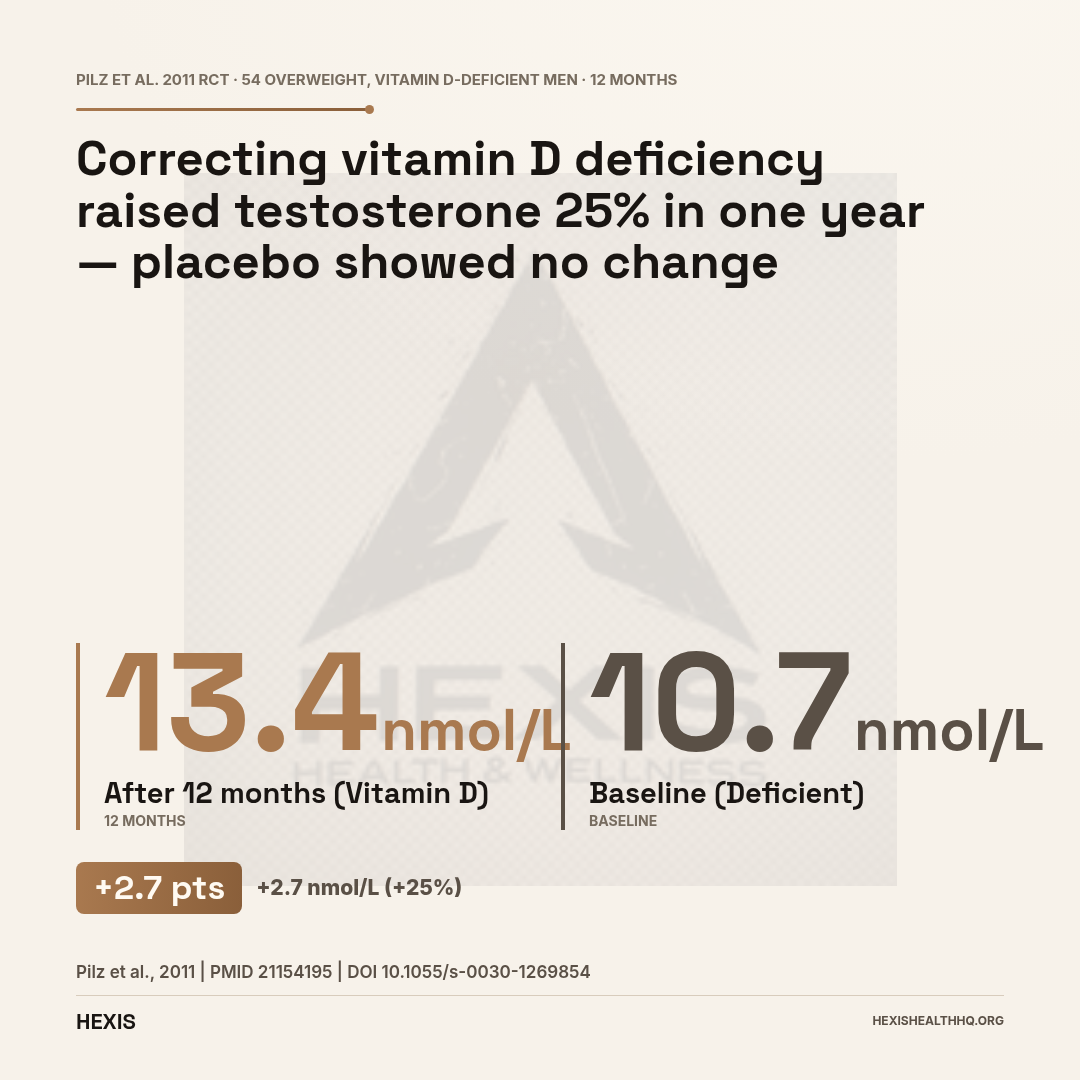
In a randomized controlled trial, 54 overweight men received either 3,332 IU of vitamin D per day or placebo for one year. At baseline, the men in the vitamin D group (who were vitamin D deficient) had total testosterone of 10.7 nmol/L. After 12 months, that rose to 13.4 nmol/L (p < 0.001), while the placebo group showed no significant change (Pilz et al., 2011).
That is a meaningful increase — roughly 25% — but it was in men who were both vitamin D deficient and overweight. That is not the average reader of this article. If you have normal vitamin D levels, adding a D3 supplement will not produce that kind of change.
Getting tested is the actionable step here. Vitamin D deficiency is common — estimates suggest 40% of American adults have insufficient levels. If yours are low, correcting them is worth doing regardless of testosterone, and the hormonal benefit may come along with it.
Zinc
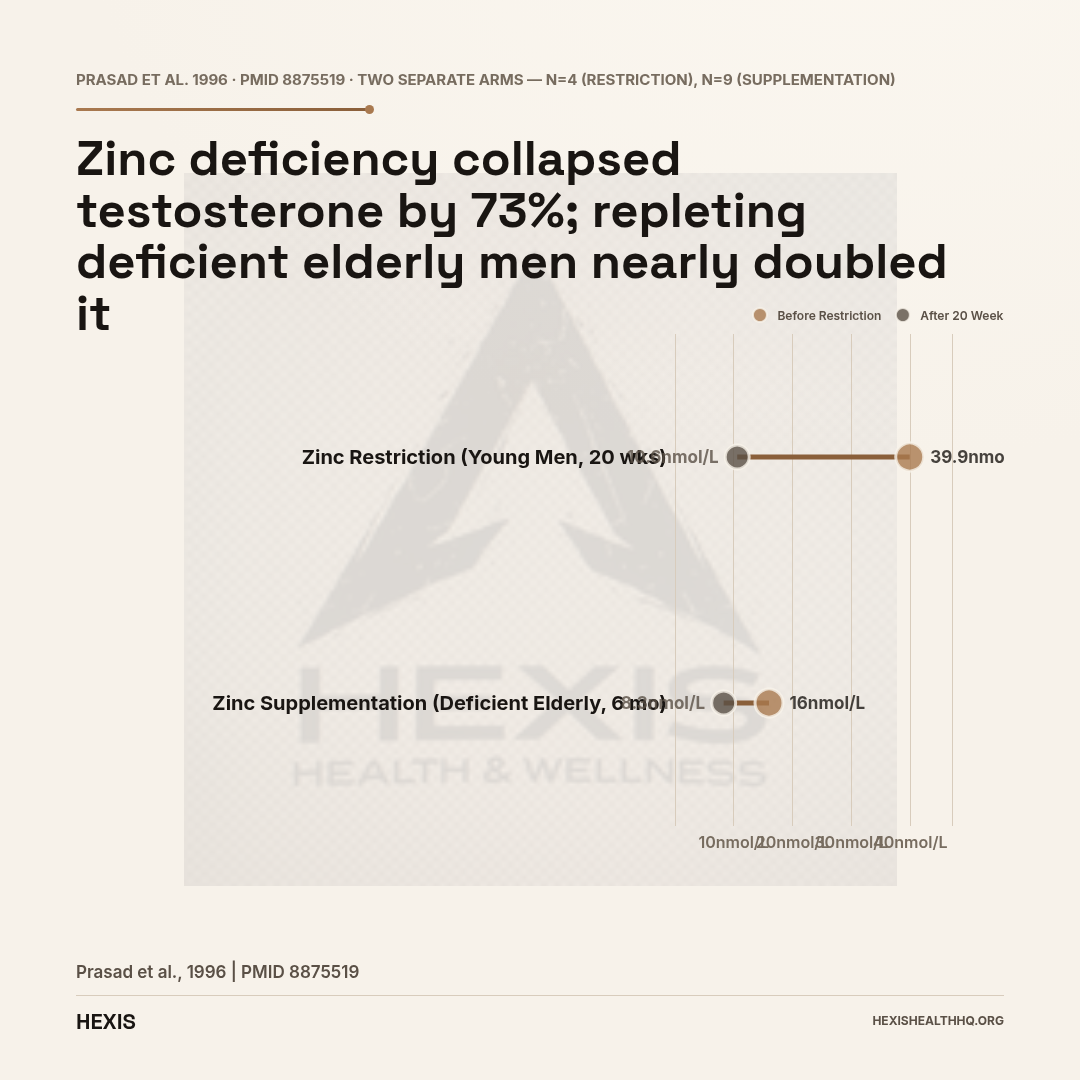
Zinc restriction experiments provide unusually clear evidence of the mineral's role. In a controlled dietary study, zinc restriction in young men over 20 weeks caused serum testosterone to fall from 39.9 nmol/L to 10.6 nmol/L (p = 0.005). In a separate arm of the same study, zinc supplementation in marginally zinc-deficient elderly men raised testosterone from 8.3 nmol/L to 16.0 nmol/L over 6 months (p = 0.02) (Prasad et al., 1996).
Both effects are dramatic — but the sample sizes were small (n=4 and n=9 respectively), and the key word is "deficient." Zinc depletion suppresses testosterone. Zinc repletion in deficient men restores it. Zinc supplementation in men who already have adequate zinc does not produce the same effect.
Red meat, shellfish (especially oysters), and legumes are good dietary zinc sources. If you eat a varied diet, you are likely meeting your needs. A basic blood panel can check zinc status directly.
For a deeper look at supplement evidence — including ashwagandha, fenugreek, D-aspartic acid, and others — see our guide to best supplements for testosterone.
Does Alcohol Lower Testosterone?
Yes, but the size of the effect depends heavily on how much and how often you drink. Chronic heavy alcohol use suppresses testosterone through two mechanisms: direct damage to Leydig cells in the testes (the cells that produce testosterone) and disruption of the hypothalamic-pituitary-gonadal axis, which reduces the LH signal that triggers testosterone production. A 2023 review confirmed that these effects are dose-dependent, with the clearest signal against chronic heavy drinking rather than moderate or occasional use (Smith et al., 2023).
A couple of drinks per week is not the same as daily heavy use. The distinction matters because many men conflate the two when evaluating alcohol's impact on their hormonal health.
If alcohol is a significant part of your routine, reducing it is a reasonable step for testosterone and for a dozen other health reasons. If you drink occasionally, the testosterone impact is unlikely to be large.
Stress and Cortisol: The Overlooked Suppressor
Chronic stress lowers testosterone — and the mechanism is direct. Elevated cortisol inhibits testosterone production at both the central signaling level and at the testes themselves. The hypothalamic-pituitary-adrenal (HPA) axis and the hypothalamic-pituitary-gonadal (HPG) axis share regulatory territory, and when one is chronically activated, the other pays the price.
A 1983 study demonstrated this directly: acute cortisol elevation produced a rapid decrease in circulating testosterone in men (Cumming et al., 1983).
Chronic stress — work pressure, poor sleep (yes, these compound each other), overtraining, relationship conflict — keeps cortisol chronically elevated. That is a meaningful long-term testosterone suppressor for many men.
Adequate sleep, managing training load, and addressing chronic stressors where possible are the main levers. "Reduce your stress" is not specific advice. But chronically elevated cortisol is actively working against your hormonal health — that much the data make clear.
Overtraining is a specific and underappreciated version of this. More exercise is not always better. Training volume that exceeds your recovery capacity drives cortisol up and can suppress testosterone. The goal is training that challenges without depleting.
The Evidence Hierarchy for Supplements
Ashwagandha is the exception with RCT support (+96.2 ng/dL vs +18.0 ng/dL placebo, p=0.004 — Wankhede et al., 2015). Fenugreek has mixed results. D-aspartic acid has not held up in follow-up trials. Tribulus terrestris has not demonstrated significant T increases in athletes across multiple RCTs. Lifestyle changes — sleep, fat loss, deficiency correction — outrank all of them.
Source: Wankhede et al., 2015
What About Testosterone Booster Supplements?
A full review of supplement evidence is beyond the scope of this lifestyle article — we cover it in depth in our testosterone booster guide. The short version:
Ashwagandha (Withania somnifera) has the strongest OTC evidence among non-vitamin/mineral supplements. In an 8-week randomized controlled trial of 57 young men engaged in resistance training, the ashwagandha group saw testosterone increase by 96.2 ng/dL versus 18.0 ng/dL in the placebo group (p = 0.004) (Wankhede et al., 2015). That is a real signal in a real RCT. Important caveats: both groups were doing resistance training, the population was young men, and the effect has not been uniformly replicated across all contexts.
Fenugreek has mixed evidence — some trials show modest effects, others do not.
D-aspartic acid had early promising results that later trials have not consistently confirmed.
Tribulus terrestris has been studied in athletes and has not demonstrated significant testosterone increases in multiple RCTs.
Bottom line: supplements are unlikely to be the primary driver of meaningful testosterone change. Getting sleep, body composition, and micronutrient status right will almost certainly matter more.
When Lifestyle Is Not Enough
Lifestyle changes cannot fix every cause of low testosterone. Hypogonadism has structural causes — primary testicular failure, pituitary dysfunction, and genetic conditions like Klinefelter syndrome (affecting roughly 1 in 500–600 males) — that sleep, fat loss, and micronutrient correction will not resolve. For these men, behavior change is not the missing variable.
If you have worked the levers above — consistent sleep, weight management, regular exercise, correcting deficiencies, limiting alcohol, managing stress — and you still feel symptomatic, that is important clinical information worth bringing to a physician. Some men's testosterone declines with age in ways that are real, not correctable through behavior, and that affect quality of life in meaningful ways.
Getting tested is not a failure. Testosterone replacement therapy (TRT) exists because some men genuinely need it. TRT is a clinical intervention that should be supervised by a physician, with regular monitoring, not a gym experiment. If you want to explore it, Schedule a consultation with a HEXIS provider who will start with your actual numbers — not assumptions.
Frequently Asked Questions
Can you actually raise testosterone naturally without TRT?
Yes, but with realistic expectations. Lifestyle changes — especially sleep optimization, weight loss in overweight men, and correcting micronutrient deficiencies — can meaningfully restore testosterone that is being suppressed by a correctable problem. They are unlikely to push a man with already-normal levels into a supraphysiological range. Get tested first so you know what you are working with.
How much does sleep affect testosterone levels?
More than most people expect. Research published in JAMA showed that restricting sleep to 5 hours per night for one week produced roughly a 10–15% drop in daytime testosterone levels in young healthy men (Leproult & Van Cauter, 2011). Most testosterone secretion happens during sleep. Consistently getting 7–9 hours is one of the most accessible interventions available.
Does losing weight increase testosterone?
In overweight or obese men, yes — often substantially. Fat tissue contains aromatase, which converts testosterone to estrogen. More fat means more conversion and more suppression of the hormonal axis that drives testosterone production. Losing fat removes that suppressor. The effect is most pronounced in men with significant adiposity (Kelly et al., 2015), less so in men who are already lean.
Should I take vitamin D for testosterone if I am not deficient?
Probably not for that purpose. The RCT evidence showing testosterone increases from vitamin D (Pilz et al., 2011) was in deficient men. In men with adequate vitamin D levels, supplementation does not appear to produce the same hormonal benefit. Get your levels checked — if you are deficient, correcting that is worthwhile for multiple reasons including potential testosterone support.
What Actually Moves the Needle
- 1
Sleep 7-9 hours: single largest modifiable factor; 1 week of 5-hour nights drops T 10-15%
- 2
Lose body fat if overweight: aromatase in visceral fat converts T to estrogen — fat loss breaks that cycle
- 3
Check vitamin D and zinc: both have RCT evidence, but only if you are deficient
- 4
Limit chronic heavy alcohol: dose-dependent T suppression via Leydig cell damage and LH disruption
- 5
Manage cortisol: chronic stress chronically suppresses testosterone via HPA-HPG axis competition
- 6
Exercise for health, not T panels: resting T is unaffected by training in eugonadal men (SMD 0.00)