Low Testosterone Levels & Normal Range by Age (What Counts as Low)
Low Testosterone Levels & Normal Range by Age (What Counts as Low)
Your doctor ran labs, glanced at the range printed on the report, said "you're normal," and moved on. But nobody explained what "normal" actually means — or where on that range your number sits. If you've been feeling off for months and the labs keep coming back "fine," here's what the evidence actually says about normal testosterone levels by age — and where the real clinical threshold for low sits.
The short answer: In healthy nonobese men aged 19–39, the normal total testosterone range is 264–916 ng/dL (Travison et al., 2017). The clinical working threshold for low testosterone is generally below 300 ng/dL on two fasting morning draws — but a diagnosis of hypogonadism requires symptoms alongside that number, not just the lab result alone (Bhasin et al., 2018).
What Is the Normal Testosterone Range?
The most widely cited reference range comes from a 2017 study that pulled data from 9,054 men across four major cohort studies in the US and Europe — the Framingham Heart Study, the European Male Aging Study, the Osteoporotic Fractures in Men study, and the Male Sibling Study of Osteoporosis (Travison et al., 2017). The goal was to create one harmonized standard that labs across countries could actually agree on.
In healthy nonobese men aged 19–39, the harmonized percentile values for total testosterone are:
| Percentile | Total Testosterone |
|---|---|
| 2.5th (lower limit of normal) | 264 ng/dL |
| 5th | 303 ng/dL |
| 50th (median) | 531 ng/dL |
| 95th | 852 ng/dL |
| 97.5th (upper limit of normal) | 916 ng/dL |
What that table tells you: a man at the median sits around 531 ng/dL. A man at 303 ng/dL is in the bottom 5%. A man at 264 ng/dL is at the 2.5th percentile — meaning 97.5% of healthy young men have higher testosterone than he does.
That 264 ng/dL number is important. It's the lower limit of normal in the harmonized reference range, and it's the floor that the Endocrine Society and the American Urological Association built their diagnostic guidelines around (Bhasin et al., 2018).
The range is also established in healthy, nonobese men. If you have obesity, your numbers will likely be lower — adipose tissue converts testosterone into estrogen through a process called aromatization, which means the reference range may not perfectly reflect what's going on in your body.
Two Thresholds — Two Different Meanings
| Threshold | What It Is | Used For |
|---|---|---|
What Testosterone Level Is Considered Low?
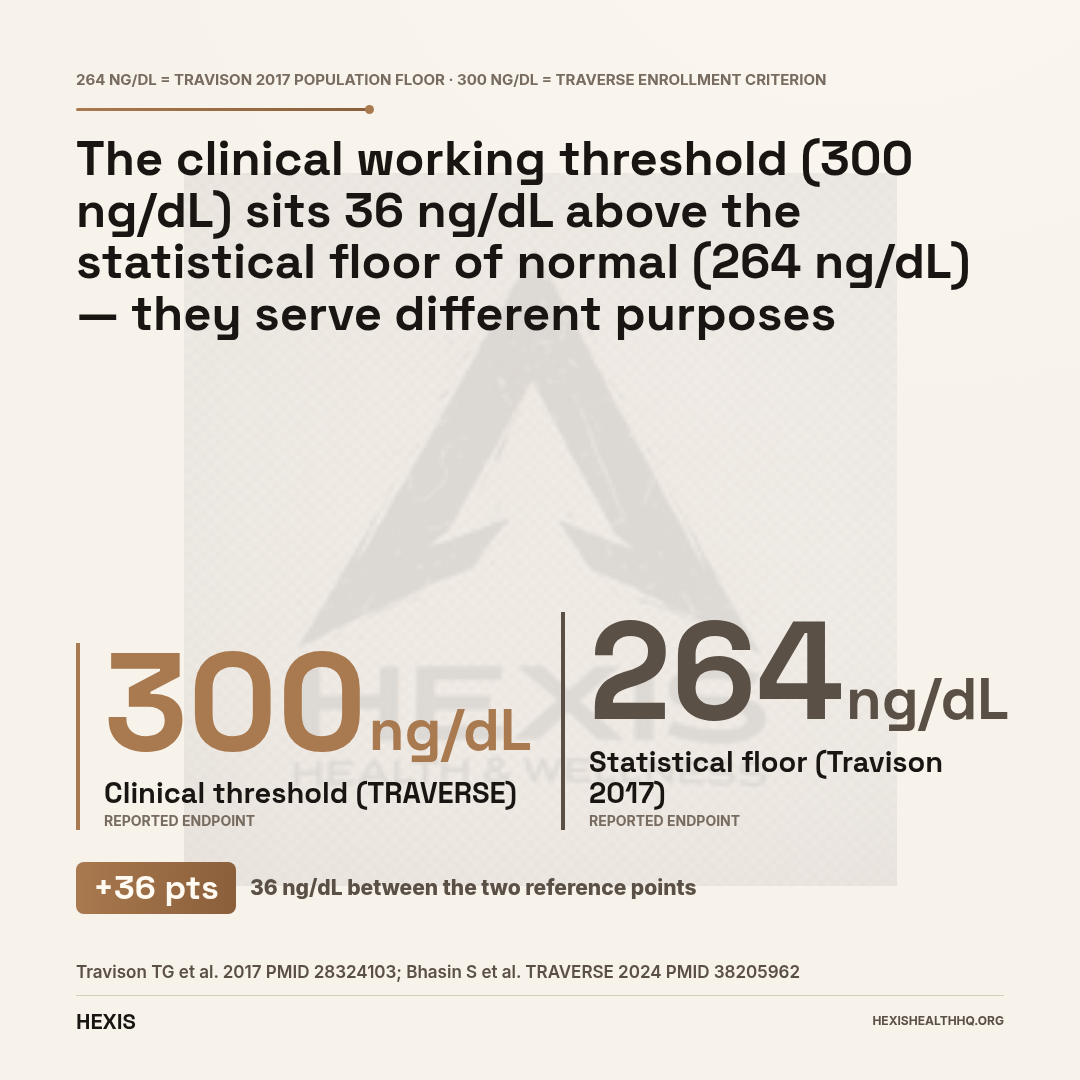
This is where a lot of confusion lives. There are two numbers that get thrown around — 264 ng/dL and 300 ng/dL — and they mean different things.
264 ng/dL is the 2.5th percentile of the harmonized reference distribution in healthy young men (Travison et al., 2017). It's where the statistical lower limit of normal sits.
300 ng/dL is the clinical enrollment cutoff used in the TRAVERSE trial — the largest randomized controlled trial of testosterone replacement therapy ever conducted, with 5,246 participants. To enroll, men needed two fasting testosterone measurements below 300 ng/dL along with confirmed symptoms (Bhasin et al., 2024).
The Endocrine Society's 2018 Clinical Practice Guideline doesn't name a single cutoff number. It says clinicians should diagnose hypogonadism only in men with "unequivocally and consistently low serum testosterone concentrations" combined with symptoms of androgen deficiency — and it recommends confirming with two fasting morning draws (Bhasin et al., 2018). That "unequivocally low" language is doing real work: a single borderline result isn't a diagnosis.
So when people ask "is 300 ng/dL low testosterone," the honest answer is: it depends on context. A number below 300 ng/dL on two separate morning draws, in a man with real symptoms, is a reasonable trigger for a clinical conversation. A number of 301 ng/dL in a man who feels completely fine is not a diagnosis.
How Does Testosterone Change With Age?
Testosterone declines gradually from around age 35 — not dramatically at 40 or 50 — with the most significant drop occurring after age 80 (Handelsman et al., 2015).
The Handelsman et al. (2015) study behind that finding is the largest age-spanning testosterone dataset in the published literature — 10,904 men aged 35–100 from three Australian cities, tracking testosterone, DHT, and estradiol across the lifespan.
The "approximately 1% per year" decline figure you'll see cited in many summaries comes from older longitudinal studies, and it's frequently referenced in clinical review literature as a rough approximation. What the data more precisely shows is that the rate is not constant — the decline from age 35 to 65 is modest, while the acceleration after 80 is more dramatic (Handelsman et al., 2015). Citing a flat 1% annual figure implies a precision the data doesn't fully support.
Total testosterone declines with age, but so does sex hormone binding globulin (SHBG) — and SHBG is a complicating factor that gets missed in basic bloodwork.
Total Testosterone vs. Free Testosterone: Why It Matters
Free testosterone is the biologically active fraction of total testosterone — the roughly 1–3% not bound to proteins like SHBG or albumin, and the only portion your cells can actually use. Total testosterone measures everything in your blood; free testosterone measures what's available.
The problem: SHBG tends to rise as men age. An older man can have a total testosterone number that sits squarely in the "normal" range while his free testosterone is significantly lower than it should be — because more of his total is bound up and unavailable (Barone et al., 2022).
This matters most in men with obesity, liver disease, thyroid dysfunction, or advancing age — all conditions that shift SHBG levels.
Reference intervals for free testosterone were established in a 2023 study using equilibrium dialysis, the gold-standard measurement method, combined with CDC-certified LC-MS/MS assay (Jasuja et al., 2023). In healthy nonobese adult men, the normal range runs from 66 to 309 pg/mL. For men aged 19–39 specifically, the range is tighter and higher: the 2.5th percentile is 120 pg/mL, the median is 190 pg/mL, and the 97.5th percentile is 368 pg/mL (Jasuja et al., 2023).
Free testosterone testing is most useful when total testosterone is borderline, when SHBG is known to be elevated, or when symptoms persist despite a "normal" total T result. The Endocrine Society guideline recommends calculating or measuring free testosterone in men with suspected hypogonadism who have total testosterone levels near the lower limit of the normal range (Bhasin et al., 2018).
If your doctor only checked total testosterone, that's often the starting point — but it's not always the complete picture.
Why Lab Methodology Matters More Than People Realize
Not all testosterone assays are the same. Immunoassay-based tests — the kind most commercial labs run — can vary significantly between manufacturers, and some consistently read lower or higher than the actual value. Mass spectrometry (LC-MS/MS) is more accurate and is the method used in more rigorous reference range studies (Damgaard-Olesen et al., 2016), but most routine labs don't use it.
This is exactly why the Travison et al. (2017) study was needed in the first place: the four cohort studies were harmonized using standardized CDC reference materials to create a common baseline. Without that harmonization step, the 264 ng/dL lower limit wouldn't be meaningful across different testing platforms.
The practical takeaway: if you're borderline on one lab's assay, retesting on a more accurate platform — or ensuring the lab uses a standardized method — can change where your number actually sits relative to the reference range (Livingston et al., 2017).
This is also why the Endocrine Society guideline emphasizes using "an accurate and reliable assay" and confirming with two fasting morning measurements rather than acting on a single result (Bhasin et al., 2018).
Fatigue, low libido, brain fog, and mood changes are all consistent with low testosterone — but they have dozens of other causes. The Endocrine Society guideline requires both consistently low testosterone levels confirmed on two fasting morning draws AND symptoms of androgen deficiency before a diagnosis is made.
Source: Bhasin et al., 2018. J Clin Endocrinol Metab.
What Are the Symptoms of Low Testosterone?
Low testosterone is a clinical diagnosis. The lab number alone doesn't make the diagnosis — and neither do the symptoms alone. Both are required.
The symptoms most consistently linked to androgen deficiency:
- Reduced libido and sexual function
- Decreased energy and persistent fatigue
- Mood changes, including depression and irritability
- Reduced muscle mass and increased body fat
- Poor concentration or brain fog
- Decreased bone density (often silent until fracture)
The challenge is that most of these symptoms are nonspecific. Fatigue, weight gain, and low mood have dozens of causes. The Endocrine Society guideline explicitly notes that clinicians should evaluate for other treatable causes before attributing symptoms to low testosterone (Bhasin et al., 2018).
If you have symptoms and borderline labs, that's a conversation worth having with a provider who actually looks at your full panel — not just whether the number clears the lab's printed cutoff.
What Testosterone Level Is Normal at 40, 50, or 60?
No single age-specific cutoff exists in current guidelines — clinicians apply the same harmonized reference range (264–916 ng/dL for men 19–39) across adult men and adjust interpretation based on free testosterone, SHBG, and symptoms rather than age alone (Bhasin et al., 2018). The Travison et al. (2017) data tables do break the range down by age cohort, but those decade-specific medians are not widely used to set treatment thresholds.
What Handelsman et al. (2015) adds is the population-level trajectory: testosterone begins a gradual decline from age 35, and the decline accelerates meaningfully after 80. Between those ages, the shift is real but modest for most men in the absence of disease or significant obesity.
What this means practically: a 50-year-old man with a total testosterone of 400 ng/dL may have a number that was 550 ng/dL at 30. Both are within normal range on a cross-sectional reference. But free testosterone is likely lower at 50 because SHBG has risen — and that's the piece that often explains persistent symptoms in men whose total T looks "fine."
The clinical approach is to look at total T, free T, SHBG, and symptom burden together (Bhasin et al., 2018).
For internal context on why this matters for treatment decisions, see our article on how to treat low testosterone and our breakdown of low testosterone symptoms — the symptom picture shapes the clinical decision as much as the number itself.
How Is Low Testosterone Diagnosed?
The diagnostic protocol, per the Endocrine Society 2018 Clinical Practice Guideline, is straightforward in principle and more nuanced in practice (Bhasin et al., 2018):
- Symptoms first. A man needs to have signs and symptoms consistent with androgen deficiency. A low number in the absence of symptoms is not an indication for treatment.
- Two fasting morning draws. Testosterone peaks in the morning and is suppressed by food. A single afternoon draw in a fed state can produce a falsely low result. The guideline requires two separate fasting morning measurements.
- Unequivocally low levels. Not just "below the middle of the range." The Endocrine Society uses language like "unequivocally and consistently low" — which in practice means well below 300 ng/dL, often with the second draw confirming the first.
- Rule out secondary causes. Sleep apnea, opioid use, obesity, type 2 diabetes, and pituitary dysfunction can all lower testosterone independently. These need to be evaluated before treatment (Livingston et al., 2017).
The TRAVERSE trial, which enrolled men with confirmed testosterone below 300 ng/dL on two fasting draws, is the largest evidence base for what happens when men meeting that threshold are treated with TRT (Bhasin et al., 2024). The trial ran 5,246 men and found no increase in major cardiovascular events compared to placebo — which addressed a significant concern that had surrounded TRT for years.
The 300 ng/dL TRAVERSE cutoff is a research enrollment criterion, not a hard clinical rule. The Endocrine Society's 264 ng/dL lower limit of the harmonized normal range is the population-based floor — below that, a man is statistically outside the normal distribution. Between 264 and 300 ng/dL, clinical judgment and symptoms drive the decision.
“A drop from 700 to 320 ng/dL puts a man in 'normal range' by the reference table — but it represents a more than 50% reduction in his individual baseline, and his body notices that.”
Can You Have Low Testosterone Symptoms With a Normal Lab Result?
Yes — and the most common mechanism is elevated SHBG suppressing free testosterone while total testosterone remains in the reference range. If total testosterone is 350 ng/dL but SHBG is significantly elevated — which happens with age, liver dysfunction, thyroid imbalance, and some medications — the biologically available free fraction can be genuinely low even though the total number looks borderline normal (Barone et al., 2022).
Some men also have testosterone levels that were significantly higher earlier in life. A drop from 700 to 320 ng/dL puts a man in "normal range" by the reference table — but it represents a more than 50% reduction in his individual baseline, and his body notices that.
Current guidelines don't have a formal framework for treating men in this situation, and the Endocrine Society is explicit that a diagnosis of hypogonadism requires both symptoms and consistently low levels. But the conversation is worth having, and a provider who looks at free T, SHBG, and the clinical picture together is better positioned to interpret what the numbers mean for a specific person.
For a deeper look at how testing and treatment decisions connect, see our overview of low testosterone treatment options.
Does Testosterone Really Decline 1% Per Year After 30?
This claim appears widely in clinical summaries and patient education materials. It originates from longitudinal aging studies that tracked testosterone over time in aging men.
What those studies actually show is a gradual decline beginning around age 35 that is real but nonlinear (Handelsman et al., 2015). The rate varies substantially between individuals and is influenced heavily by body composition, sleep quality, underlying health conditions, and genetics. A flat "1% per year" implies a consistency that the population-level data doesn't support — some men at 60 have testosterone numbers typical of men at 35, while others are significantly below the reference range.
The important practical point: age alone is not a diagnosis. A 55-year-old man with testosterone at 480 ng/dL and no symptoms doesn't need treatment. A 38-year-old with testosterone at 240 ng/dL and clear androgen deficiency symptoms does.
Frequently Asked Questions
What testosterone level is considered low for a man?
Below 264 ng/dL puts a man at the 2.5th percentile of the harmonized reference range — statistically below normal in healthy young men (Travison et al., 2017). In clinical practice, the working threshold is typically below 300 ng/dL on two fasting morning draws combined with symptoms of androgen deficiency (Bhasin et al., 2024). A single borderline result without symptoms is not a diagnosis.
What is a normal testosterone level for a 50-year-old man?
Current guidelines use a population-based reference range (264–916 ng/dL for healthy men aged 19–39) rather than strict age-specific cutoffs. Testosterone does decline gradually from age 35 onward, but a 50-year-old man with a total testosterone above 300 ng/dL and no symptoms is generally within a clinically acceptable range. Free testosterone and SHBG become more important to evaluate as men age (Handelsman et al., 2015).
Why does the Endocrine Society not give a single cutoff number for low testosterone?
Because the diagnostic process isn't just about the number. The Endocrine Society's 2018 guideline requires both consistently low testosterone levels AND symptoms of androgen deficiency to make a diagnosis (Bhasin et al., 2018). This prevents overtreating men with borderline numbers who feel completely fine — and recognizes that a number that's low for one man may not be low for another given individual variation.
What is the difference between total and free testosterone?
Total testosterone measures everything in your blood — both the bound and unbound fractions. Free testosterone measures only the biologically active portion not bound to SHBG or albumin, roughly 1–3% of total. In healthy nonobese adult men, free testosterone runs 66–309 pg/mL, with the median in young men around 190 pg/mL (Jasuja et al., 2023). Men with elevated SHBG can have normal total T but low free T — which is why both values matter.
Do I need to test for low testosterone in the morning?
Yes, and fasting. Testosterone follows a diurnal rhythm — it's highest in the early morning and falls through the day. An afternoon draw can look 20–30% lower than an accurate morning value. The Endocrine Society guideline requires two separate fasting morning measurements before a diagnosis is made (Bhasin et al., 2018). If your doctor drew blood at 3 PM after lunch, ask to retest.
When to Talk to a Provider
If you've been experiencing fatigue, low libido, mood changes, or difficulty maintaining muscle — and your regular labs have come back "normal" without anyone looking at the actual numbers — it's worth getting a full hormone panel that includes total testosterone, free testosterone, SHBG, and LH.
A number in "normal range" doesn't mean your levels are optimal for you. And a number below 300 ng/dL on a single afternoon draw isn't a diagnosis either. What matters is the full picture: two fasting morning draws, free T, SHBG, and how those numbers connect to what you're actually experiencing.
If you want to explore this with a provider who starts with bloodwork and not guesswork, schedule a consultation with HEXIS Health. We look at the full panel and build the protocol around your actual numbers — not the printed range on a lab report.
The Bottom Line
- 1
Normal total testosterone in healthy men aged 19–39 is 264–916 ng/dL — the median is 531 ng/dL.
- 2
Below 264 ng/dL is statistically below normal. Below 300 ng/dL on two fasting morning draws is the clinical working threshold — but symptoms are required for a diagnosis.
- 3
Free testosterone (normal: 66–309 pg/mL) matters more than total T when SHBG is elevated, which becomes more common with age.
- 4
A single afternoon blood draw is not a diagnosis. Two fasting morning draws are required by Endocrine Society guidelines.
- 5
Age-related decline is real but nonlinear. Numbers are only part of the picture — symptom burden shapes the clinical decision.