Online TRT: Get Testosterone Therapy Online — What You Actually Need to Know
Online TRT: Get Testosterone Therapy Online — What You Actually Need to Know
Online TRT has exploded in popularity — and with it, a flood of clinics ranging from genuinely excellent to outright dangerous. The physicians at HEXIS regularly see patients who were prescribed testosterone through questionnaire-only platforms, without a single lab value reviewed and no monitoring plan in place. Getting testosterone therapy online is legal and medically sound when it is done correctly. But "done correctly" means something specific: a licensed physician, a real video consultation, bloodwork reviewed before any prescription is written, and a DEA-registered prescriber working through a licensed pharmacy. This article breaks down exactly what that looks like, what the law actually requires, and how to tell the difference between a clinic worth trusting and one to avoid.
The short answer: Legitimate online TRT requires two confirmed low testosterone readings (below 300 ng/dL), symptoms of hypogonadism, a video consultation with a DEA-registered physician, lab work reviewed before prescribing, and dispensing through a licensed pharmacy. Testosterone is a Schedule III controlled substance — the Ryan Haight Act governs how it can be prescribed online, and legitimate clinics comply with it fully.
Is Online TRT Legal?
Online TRT is legal in the United States when the prescribing physician follows federal law — specifically the Ryan Haight Online Pharmacy Consumer Protection Act of 2008 (21 U.S.C. §829(e)).
Testosterone is classified as a Schedule III controlled substance under the Controlled Substances Act (21 U.S.C. §812), the same category as anabolic steroids generally. That classification — put in place by the Anabolic Steroid Control Acts of 1990 and 2004 — means testosterone has accepted medical uses but carries moderate potential for abuse. Schedule III drugs require a valid prescription from a licensed practitioner with DEA registration.
The Ryan Haight Act specifically addresses controlled substances prescribed online. Under normal circumstances, prescribing a Schedule III substance via the internet requires a prior in-person evaluation by the prescribing physician (Dubin et al., 2022). During the COVID-19 public health emergency (2020–2025), the DEA granted blanket telemedicine waivers allowing Schedule III prescribing via video consultation without a prior in-person visit. As of 2025, the DEA has continued temporary extensions of those waivers while the agency finalizes a new Telemedicine Prescribing Registration (TPR) framework. The practical effect: online TRT clinics using video consultation and full lab review are currently operating within a DEA-sanctioned pathway, but the final rules are still pending (Dubin et al., 2022).
What this means for you: a clinic that prescribes testosterone through a legitimate video visit, with bloodwork reviewed first and dispensing through a licensed pharmacy, is operating legally. A platform that mails you testosterone based on a questionnaire alone — without a synchronous video call and lab review — is not.
What Qualifies You for TRT?
Testosterone therapy is FDA-approved for men with hypogonadism — a medical condition, not just a feeling of being tired. The diagnosis requires both a lab finding AND symptoms together, not one or the other.
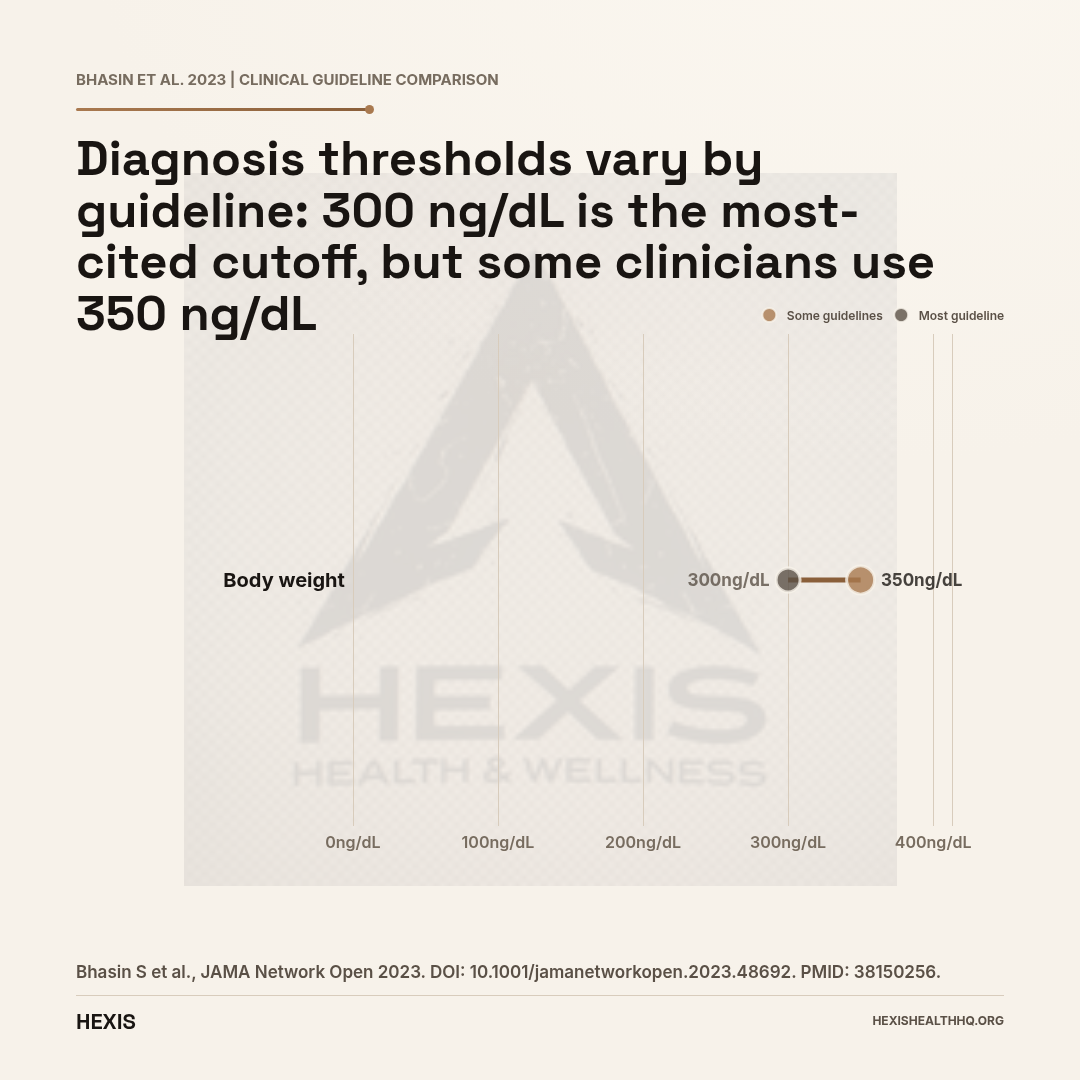
The lab threshold: two separate morning blood draws showing total testosterone below 300 ng/dL, taken at least two weeks apart (Bhasin et al., 2023). Some guidelines use 350 ng/dL as the lower boundary, but 300 ng/dL is the most widely cited clinical threshold. The draws must be in the morning because testosterone follows a diurnal rhythm — levels drop significantly throughout the day, so an afternoon reading is not diagnostic (Livingston et al., 2017).
The symptom picture matters just as much. Qualifying symptoms include low libido, erectile dysfunction, persistent fatigue, depression, loss of muscle mass despite training, increased body fat, and reduced bone density (Bhasin et al., 2023). If your testosterone is low but you have none of these symptoms, treatment may not be indicated. If you have all the symptoms but your lab values are normal, something else is going on and a good physician will investigate.
The required pre-treatment labs are not limited to testosterone alone. A complete workup includes luteinizing hormone (LH), follicle-stimulating hormone (FSH), sex hormone-binding globulin (SHBG), complete blood count (CBC), hematocrit, and PSA for men over 40 (Dubin et al., 2022). LH and FSH help distinguish primary hypogonadism (testicular failure) from secondary hypogonadism (signaling failure from the pituitary), which matters because the treatment options differ (Corona et al., 2020).
How Does an Online TRT Clinic Actually Work?
A legitimate online TRT clinic follows the same clinical process as an in-person endocrinologist — the difference is the delivery method, not the standard of care. At HEXIS, every patient who starts testosterone therapy goes through this process before a single prescription is written: labs first, physician review second, prescription third.
At a properly run clinic, the process starts before any prescription is written. You order a blood panel — either through the clinic's lab partner or your own doctor. Once results are available, you have a synchronous video consultation with a licensed physician (not a questionnaire, not a chat bot).
The physician reviews your lab values, discusses your symptoms, and — if you meet diagnostic criteria — writes a prescription. That prescription goes to a state-licensed compounding or retail pharmacy, which ships directly to you. Follow-up labs are typically ordered at three to six months, then annually once levels stabilize (Chin-Yee et al., 2017).
The video visit is not optional — it's the legal hinge point. Under the current DEA telemedicine extension, a real-time audio-video consultation with a DEA-registered physician is what separates a valid telemedicine prescription from an illegal online sale of a controlled substance (Dubin et al., 2022).
For men who previously had to schedule repeat in-person clinic visits specifically for injections or lab draws, the telehealth model eliminates a real access barrier. Research on COVID-era TRT access documented that many patients reported difficulty maintaining their therapy specifically because their clinic required in-person visits for every injection dose — a barrier telehealth removes (Dubin et al., 2022).
FDA-Approved Testosterone Formulations
| Form | Route | Frequency | Telehealth-Friendly |
|---|---|---|---|
What Are the FDA-Approved Forms of Testosterone?
Legitimate online TRT clinics prescribe FDA-approved testosterone formulations. These are not gray-market compounds — they are the same drugs your urologist or endocrinologist would write for you in person.
The approved forms include:
- Testosterone cypionate injection (Depo-Testosterone) — the most commonly prescribed form through online clinics; administered via intramuscular or subcutaneous injection, typically weekly
- Testosterone enanthate — similar to cypionate, injected weekly or biweekly
- Testosterone gel (AndroGel, Testim) — applied to skin daily; effective but carries transfer risk to partners and children
- Transdermal patch (Androderm) — applied nightly
- Testosterone pellets (Testopel) — subcutaneous pellets inserted in-office every 3–6 months; less commonly available through pure telehealth models
- Nasal gel (Natesto) — applied intranasally three times daily; preserves spermatogenesis better than injections in some data, owing to its shorter androgen peak (Barbonetti et al., 2020)
- Oral testosterone undecanoate (Jatenzo) — approved in 2019; taken with food to reduce cardiovascular risk
Injectable cypionate or enanthate is the most common choice through online platforms because it is cost-effective, has well-characterized pharmacokinetics, and can be self-administered at home once trained. If fertility preservation is a priority, your physician may discuss alternatives to standard injection protocols, since exogenous testosterone suppresses LH and FSH and significantly reduces sperm production (Barbonetti et al., 2020).
What Does the TRAVERSE Trial Tell Us About TRT Safety?
The TRAVERSE trial (NCT03518034, n=5,204) is the largest randomized controlled trial of testosterone replacement therapy ever conducted. It enrolled men aged 45–80 with hypogonadism and preexisting cardiovascular disease or elevated cardiovascular risk, and followed them for up to five years. This trial is the reason we can now discuss TRT safety with more confidence than was possible five years ago.
On cardiovascular outcomes: the TRAVERSE program found that TRT did not increase the rate of major adverse cardiovascular events compared to placebo, resolving years of uncertainty that followed a contested 2010 trial. This was a meaningful finding. For years, some physicians avoided prescribing TRT to men with cardiac history based on limited and conflicting evidence. TRAVERSE enrolled the highest-risk group specifically to answer this question directly in a large, well-powered study (Bhasin et al., 2023).
On prostate safety: TRAVERSE found no statistically significant increase in high-grade prostate cancer rates in men receiving testosterone compared to those receiving placebo (Bhasin et al., 2023). There was a modest increase in some lower-grade prostate events (benign prostatic hyperplasia progression, elevated PSA), which is why PSA monitoring remains part of the standard protocol — but the feared link between TRT and prostate cancer was not supported in this trial.
On depression: In men with hypogonadism and depressive symptoms at baseline, TRT produced meaningful improvement in depressive syndrome scores compared to placebo in TRAVERSE (Bhasin et al., 2024). This is not a trivial point — fatigue, loss of motivation, and low mood are among the most common presenting complaints in men with low testosterone, and the data now supports that treating the underlying hormonal deficiency can improve those symptoms.
That said, TRAVERSE enrolled men with elevated cardiovascular risk — it was not a general-population study. The findings are most directly applicable to men in that risk category. For younger, lower-risk men, the trial's safety signals are still reassuring, but clinical judgment about individual risk remains important.
Most Common TRT Risk: Elevated Hematocrit (Polycythemia)
TRT stimulates red blood cell production. If hematocrit rises above approximately 52–54%, blood viscosity increases — raising the risk of clots, stroke, and cardiovascular events. Hematocrit monitoring is mandatory at every follow-up. A clinic that skips it is skipping the most critical safety check.
Source: Chin-Yee et al., 2017. Transfusion. PMID 28150363.
What Are the Real Risks of TRT — Including From Online Clinics?
TRT carries real risks. Any online clinic that doesn't discuss them honestly is a red flag.
Polycythemia (elevated hematocrit) is the most common adverse effect of testosterone therapy. TRT stimulates red blood cell production, raising hematocrit. At high levels, this increases blood viscosity and the risk of blood clots, stroke, and cardiovascular events (Chin-Yee et al., 2017). Hematocrit monitoring is mandatory at every follow-up — if it rises above roughly 52–54%, the dose is reduced or therapy is paused. Some men on TRT are asked to donate blood periodically to manage elevated hematocrit, though blood banks have varying policies on accepting blood from men on hormonal therapy (Chin-Yee et al., 2017).
Fertility suppression is near-universal with standard injectable TRT. Exogenous testosterone signals the pituitary to shut down LH and FSH production, which drives spermatogenesis. This is reversible in most cases once TRT is stopped, but recovery varies in timing. If you are considering parenthood in the near term, this is a critical conversation to have with your physician before starting.
Estradiol elevation is common and often manageable. Testosterone aromatizes to estrogen, so elevated estradiol (leading to breast tissue sensitivity or mood changes) can occur — particularly at higher doses. Monitoring estradiol as part of follow-up labs allows dose or protocol adjustment.
Sleep apnea may worsen on TRT, particularly in men who are overweight. This is worth discussing if you have symptoms.
Skin and transfer risks apply specifically to topical formulations — gels and patches can transfer active compound to partners or children through skin contact.
A 2020 study examining direct-to-consumer internet platforms found that questionnaire-only prescribing platforms missed clinically significant comorbidities — including conditions that would have changed the treatment decision entirely (Dubin et al., 2022). That is the structural problem with platforms that skip the real clinical evaluation: they are not finding out what they do not know.
The Red Flags of a Questionable Online TRT Clinic
Some online TRT clinics are excellent. Others will mail you testosterone based on a five-minute questionnaire and call it a day. Here is how to tell them apart.
Legitimate clinics do all of these:
- Require a real-time video consultation with a licensed physician (not a nurse practitioner via asynchronous text)
- Order and review bloodwork before writing any prescription
- Have a DEA-registered prescriber who holds valid state licensure
- Dispense through a state-licensed compounding or retail pharmacy
- Schedule follow-up labs at 3–6 months and at 12 months
- Discuss contraindications — including polycythemia risk, fertility, prostate baseline
Clinics to avoid look like this:
- "Answer a few questions and get testosterone shipped this week" — no lab requirement
- No synchronous video visit with a physician
- Prescribing through an international or unlicensed pharmacy
- No mention of monitoring or follow-up
- Pricing that bundles testosterone with performance-enhancement framing rather than clinical framing
The single clearest test: does the clinic require bloodwork before the first prescription, and is there a licensed physician conducting a live video call to review it? If both are yes, the clinic is operating within the legal and clinical standard. If either is no, move on.
A 2026 content analysis found that a significant portion of online information about male hypogonadism was discordant with established clinical guidelines — overstating benefits, understating diagnostic criteria, or omitting the monitoring requirements (Grant et al., 2026). That gap between what the internet says and what the evidence supports is exactly what you are navigating when you search "online TRT."
How Long Until TRT Works?
Most men on TRT notice improvements in libido and energy within 3–6 weeks, with fuller effects on body composition and erectile function emerging by 3–6 months, and bone density changes detectable at 12–24 months. The timeline varies by outcome and by individual response — here is the pattern the clinical data shows:
- Energy and mood: Early improvements often noted within 3–6 weeks
- Libido: Typically improves within 3–6 weeks at therapeutic levels (Pencina et al., 2024)
- Erectile function: Improvement typically seen by 3 months; full response may take 6 months
- Body composition (muscle/fat): Measurable changes in 3–6 months; meaningful body recomposition requires 6–12+ months (Pencina et al., 2024)
- Bone density: Changes measurable at 12–24 months with DEXA scanning
The TRAVERSE sub-study on sexual function found that men on TRT showed significant improvements in sexual desire, erectile function, and hypogonadal symptom scores compared to placebo at 3 months, with continued improvement through 12 months (Pencina et al., 2024). Earlier meta-analyses of TRT's effect on sexual symptoms showed consistent improvements in libido and erectile function in hypogonadal men (Rastrelli et al., 2019). This is why the 3–6 month follow-up lab visit matters — that is also when you assess clinical response, not just bloodwork.
You won't feel a dramatic change in the first two weeks. By six weeks, if levels have reached therapeutic range, you should notice something. If you don't, the dose or formulation may need adjustment — which is why the follow-up visit matters as much as the initial one.
Monitoring: What Your Labs Should Look Like on TRT
Ongoing monitoring is what separates a physician-managed TRT protocol from a prescription-and-forget service. A legitimate online clinic orders these labs at your 3–6 month follow-up and annually thereafter:
- Total testosterone — targeting the therapeutic range (typically 400–700 ng/dL, sometimes higher depending on the protocol and your physician's judgment)
- Estradiol — to catch excess aromatization
- Hematocrit and CBC — the most critical safety marker; dose reduction is indicated if hematocrit exceeds threshold (Chin-Yee et al., 2017)
- PSA (men over 40) — baseline and follow-up to screen for prostate changes
- Blood pressure and lipids — TRT can affect both
If a clinic never orders follow-up labs or makes it hard to discuss your results with a physician, that's a problem regardless of how convenient the ordering process is.
Athletes, Competition, and WADA
Competitive athletes face a separate layer here: testosterone is prohibited at all times under the World Anti-Doping Agency's Prohibited List (Category S1: Anabolic Agents). That means in-competition and out-of-competition both. If you hold a therapeutic use exemption (TUE) through your national anti-doping organization for a confirmed diagnosis of hypogonadism, testosterone is permitted within the terms of that exemption. Without a TUE, TRT disqualifies you from WADA-governed competition — regardless of whether the prescription is legitimate. This is not unique to online TRT; it applies to any testosterone prescription.
What HEXIS Does Differently
If you are thinking about exploring testosterone therapy, the right starting point is not guessing — it is your lab values. HEXIS providers review your complete hormone panel, not just a single testosterone number, and build a protocol around what your physiology actually shows.
The process starts with bloodwork. No prescription is written without it. Your physician is available for a real video visit, not an algorithm. Monitoring is built into the protocol — not added as an afterthought.
For more on what the clinical evidence says about TRT's effects, read our article on how to treat low testosterone. If you are trying to understand your baseline before considering TRT, our article on low testosterone symptoms walks through the diagnostic picture. For an overview of the full evidence on hormone therapy options, see our testosterone therapy guide.
Schedule a consultation to review your labs with a HEXIS physician.
Frequently Asked Questions
Is online TRT legitimate and legal?
Yes, online TRT is legitimate and legal when the prescribing physician holds valid DEA Schedule III registration, conducts a real-time video consultation, and reviews lab work before prescribing. Testosterone is a Schedule III controlled substance — federal law (the Ryan Haight Act) governs online prescribing of it. Platforms operating through video consult and licensed pharmacies comply with current DEA telemedicine extensions. Questionnaire-only platforms without video visits do not.
What testosterone level qualifies me for TRT?
The clinical threshold is total testosterone below 300 ng/dL on two separate morning blood draws taken at least two weeks apart, combined with symptoms of hypogonadism such as low libido, fatigue, or loss of muscle mass (Bhasin et al., 2023). The lab finding alone is not sufficient — diagnosis requires both the blood level and the symptom picture. Some physicians use 350 ng/dL as a threshold, especially in symptomatic men.
Do I need an in-person exam to get testosterone online?
Under the current DEA telemedicine framework, a prior in-person exam is not required if the prescribing physician conducts a real-time video consultation and reviews your bloodwork (Dubin et al., 2022). This framework, extended from COVID-era DEA waivers, allows Schedule III controlled substances to be prescribed via telehealth without prior in-person evaluation. The final DEA Telemedicine Prescribing Registration rule is pending as of 2025, but the video-visit pathway remains active.
What are the risks of getting TRT from an online clinic?
The medical risks of TRT itself include polycythemia (elevated hematocrit), fertility suppression, elevated estradiol, possible sleep apnea worsening, and skin transfer with topicals (Chin-Yee et al., 2017). The additional risk of an online clinic specifically is inadequate evaluation — platforms that skip lab review or use questionnaire-only intake miss comorbidities that would change the clinical picture (Dubin et al., 2022). These risks are managed by choosing a clinic that requires real bloodwork, a video physician visit, and scheduled follow-up monitoring.
How do online TRT clinics monitor your health?
A legitimate online TRT clinic orders follow-up labs at 3–6 months after initiating therapy, then annually once levels stabilize (Chin-Yee et al., 2017). Key markers include total testosterone (to confirm therapeutic levels), hematocrit (polycythemia risk), estradiol, PSA (for men over 40), and CBC. If hematocrit rises above safe threshold, dose adjustment or therapy interruption is indicated. Ongoing physician access for questions and dose adjustments between labs is a mark of a well-run clinic.
- 1
Testosterone is a Schedule III controlled substance — online prescribing is legal only with a real video consultation, lab review, and a DEA-registered physician.
- 2
Diagnosis requires total testosterone below 300 ng/dL on TWO morning draws, plus symptoms. One low reading is not enough.
- 3
The TRAVERSE trial (n=5,204) found no increase in major cardiovascular events or high-grade prostate cancer on TRT vs placebo.
- 4
Polycythemia (elevated hematocrit) is the most common risk — any legitimate clinic monitors it at 3–6 months and annually.
- 5
Questionnaire-only platforms that skip lab review and video visits are not operating legally — and they miss significant comorbidities.