How to Test Your Testosterone Levels: The Correct Protocol
How to Test Your Testosterone Levels
Most men who get a testosterone test done wrong never know it. They show up at whatever time their doctor had available, eat breakfast beforehand, and get a number back that could be 10-15% lower than their actual morning peak — then that one result shapes whatever conversation follows. If it comes back borderline, a diagnosis hangs on a measurement that should never have been taken that way in the first place.
Testing testosterone correctly matters, and the protocol is more specific than most labs communicate. This guide covers exactly how to test your testosterone levels — when to draw, whether to fast, what measurements to order, what assay method your lab should use, and why one result is never enough to make a diagnosis.
Reviewed by the HEXIS Health Medical Team — licensed physicians specializing in hormone optimization and men's health.
The short answer: Get a morning blood draw (8–10 AM), fast overnight for 12 hours, order total testosterone first, and if results are borderline or SHBG is abnormal, add free testosterone and SHBG. The Endocrine Society requires two separate morning measurements on different days before any hypogonadism diagnosis is confirmed (Bhasin et al., 2018).
Total Testosterone by Blood Draw Time Window
Mean ng/dL — earlier draws capture the circadian peak
| Draw Time Window | Mean Total Testosterone (ng/dL) |
|---|---|
| 8–11 AM | 411.7 |
| 11 AM–2 PM | 396.5 |
| 2–5 PM | 344.3 |
| 5–8 PM | 334.4 |
Source: Crawford et al., Current Medical Research and Opinion, 2015 (PMID 26360789)
Why Testosterone Testing Timing Matters More Than Most Doctors Explain
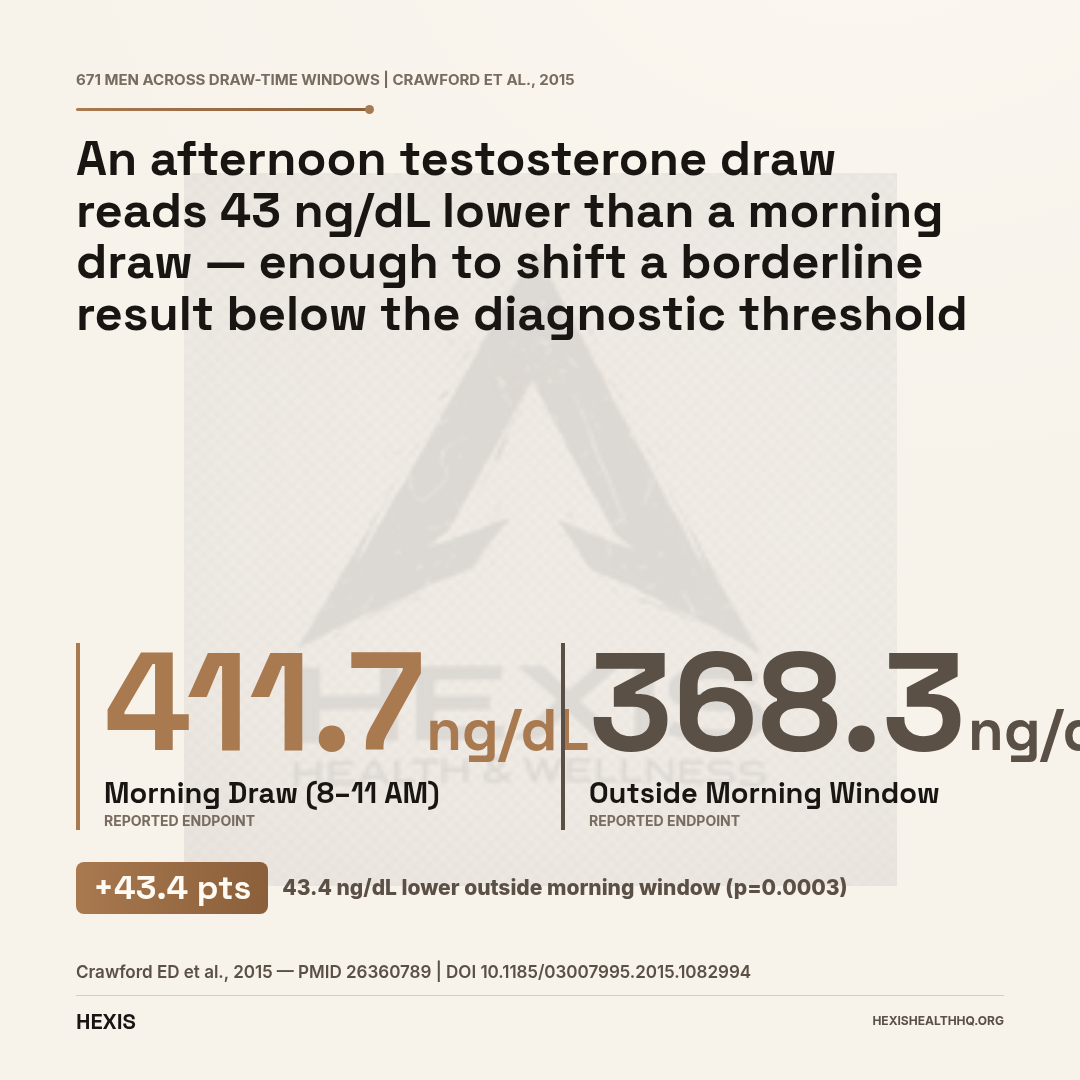
Testosterone isn't flat throughout the day. It follows a circadian rhythm — peaking in the early morning and declining as the day goes on. This isn't a small difference. In a study of 671 men across different time windows, those tested between 8 and 11 AM had a mean testosterone of 411.7 ng/dL. Outside that morning window, the mean dropped to 368.3 ng/dL — a statistically significant difference (p=0.0003) (Crawford et al., 2015).
By mid-afternoon, values fall further. The same data shows 2–5 PM draws averaging 344.3 ng/dL, and 5–8 PM draws averaging 334.4 ng/dL (Crawford et al., 2015). That's a difference of roughly 77 ng/dL between an optimal morning draw and an evening one.
For a man whose actual level sits at 310 ng/dL in the morning, an afternoon draw could read 260 ng/dL — potentially below the diagnostic threshold for hypogonadism. Conversely, someone borderline low could appear normal if tested too early in a particularly strong morning window.
The standard recommendation from the Endocrine Society is to draw between 7 and 10 AM, with 8–10 AM being the preferred window (Bhasin et al., 2018). Some guidelines note that men over 65 tend to have a blunted diurnal rhythm, so for older men an afternoon draw is more acceptable — but for younger men, morning timing is non-negotiable.
Do You Need to Fast Before a Testosterone Test?
Yes — and the reason is more specific than most labs explain.
The Endocrine Society guideline specifically recommends a fasting morning draw (Bhasin et al., 2018). Food — particularly carbohydrate-heavy meals — can transiently suppress testosterone through insulin's effects on sex hormone-binding globulin (SHBG) and luteinizing hormone (LH). The suppression isn't massive, but in the context of a borderline result, it's enough to shift a reading below or above a diagnostic cutoff.
Twelve hours of overnight fasting before the draw is standard. That typically means nothing after dinner, water is fine, and the draw happens before breakfast.
For a test you're using to establish your baseline or to confirm a diagnosis, the fasting detail matters more than most patients realize. If you've already had breakfast and the lab will run your test anyway, it's worth noting that on the report — or rescheduling if the result may be borderline.
Total Testosterone vs Free Testosterone: What to Order First
Start with total testosterone. This is always the first measurement, and in most men, it tells you enough to either rule out a problem or direct the next steps.
Total testosterone measures all the testosterone in your blood: the portion bound to SHBG (about 44-45%), the portion loosely bound to albumin (about 54%), and the small free fraction (roughly 1-3%). The SHBG-bound portion is biologically inactive — it can't enter cells and act. The free fraction and albumin-bound portion together make up what's called bioavailable testosterone.
Free testosterone is the fraction with direct cellular access. When SHBG is abnormal — elevated in older age, thyroid disease, liver disease, or anticonvulsants, or suppressed in obesity, insulin resistance, hypothyroidism, or anabolic steroid use — total testosterone can misrepresent what your body is actually getting. A man with very high SHBG might have a "normal" total T but low free T and real symptoms. A man with low SHBG might have a "low" total T and feel completely fine.
The Endocrine Society recommends adding free testosterone when total testosterone is borderline (typically 200–400 ng/dL) or when SHBG is suspected to be abnormal (Bhasin et al., 2018). If you have obesity, are older, or have a condition that affects SHBG, free T is often worth including from the start.
For age-stratified reference tables on what those numbers mean for your specific age, see our detailed breakdown in testosterone levels by age.
"Free Testosterone Direct" Kits Are Often Inaccurate
Analog immunoassay kits labeled 'free testosterone direct' use antibody competition methods that do not accurately measure the unbound fraction. Results can read substantially higher or lower than the actual free testosterone level. Equilibrium dialysis and the Vermeulen calculated method are the reliable alternatives.
If your lab report lists 'free testosterone' with no method specified, ask whether it used direct immunoassay — and if so, request a calculated free-T result instead.
Source: Jasuja et al., Andrology, 2023 (PMID 36251328)
How Free Testosterone Is Measured — and Why the Method Matters
Three methods exist for measuring free testosterone, and only two are clinically reliable — but many lab reports don't specify which one they used.
The gold standard for measuring free testosterone is equilibrium dialysis — a method that directly separates and measures the unbound fraction. It's accurate, it's what research studies use, and it's expensive. Most routine labs don't offer it.
The Vermeulen formula is the widely used alternative: it calculates free testosterone from total testosterone, SHBG, and albumin (assumed constant at 4.3 g/dL). It's the practical clinical standard and is what most labs use when you order "calculated free testosterone." The formula has been validated and produces reliable estimates when total T and SHBG are measured accurately.
There is a third option: analog immunoassay free testosterone kits, often labeled "free testosterone direct" on lab reports. These are inaccurate. They use antibody competition methods that don't actually measure the free fraction reliably, and results from analog assays are known to be unreliable — they frequently read higher or lower than the actual free fraction. If your lab report says "free testosterone" and uses a direct immunoassay method (not equilibrium dialysis or a calculated/Vermeulen method), treat that number skeptically — it may not reflect reality (Jasuja et al., 2023).
A survey of 124 clinical laboratories across 27 countries found that the majority use the Vermeulen formula for calculated free testosterone, which is appropriate — but the underlying SHBG assay variability affects the accuracy of those calculations (Narinx et al., 2025). In practice, consistency matters: if you're tracking free testosterone over time, use the same lab and the same method each time.
the harmonized lower limit of normal for men ages 19–39 — below this is unequivocally low (Travison et al., 2017, n=9,054)
What "Normal" Actually Means: The Harmonized Reference Range
Here's a number worth committing to memory: 264 ng/dL.
That's the 2.5th percentile cutoff for total testosterone in healthy, non-obese men aged 19–39, based on a harmonized analysis of four major cohort studies (n=9,054) in the United States and Europe (Travison et al., 2017). Below 264 ng/dL is unequivocally low. This is the diagnostic threshold most evidence-based guidelines point to.
The full distribution from that study:
- 2.5th percentile: 264 ng/dL (the lower normal limit)
- 5th percentile: 303 ng/dL
- 50th percentile (median): 531 ng/dL
- 95th percentile: 852 ng/dL
- 97.5th percentile: 916 ng/dL
If your result comes back at 280 ng/dL, you're below the 5th percentile for young adult men. If it comes back at 400 ng/dL, you're well within normal range but below the median. Context matters — that's why this is a conversation to have with a provider who's seen many results, not just a lab printout.
The borderline zone is roughly 264–400 ng/dL. In this range, total testosterone alone is insufficient for a diagnosis. Free testosterone adds critical context, especially if you have symptoms of hypogonadism.
For free testosterone, the reference intervals established using equilibrium dialysis and CDC-certified LC-MS/MS methodology show a normal range of 66–309 pg/mL across all adult men, with the 2.5th to 97.5th percentile range for men aged 19–39 running 120–368 pg/mL (Jasuja et al., 2023).
If you're wondering whether your numbers are actually low — not just "low-normal" — the article on low testosterone symptoms covers what those lab numbers look like alongside the clinical picture.
“Two separate fasting morning measurements on different days are required before a diagnosis of hypogonadism is confirmed. One low result is not enough.”
The Two-Measurement Rule: Why One Low Result Is Never a Diagnosis
The Endocrine Society requires two separate fasting morning measurements on different days before hypogonadism is diagnosed — one low result, no matter how low, is never sufficient on its own (Bhasin et al., 2018).
This is the rule that most primary care settings skip. The 2018 Clinical Practice Guideline is explicit, and the same requirement appeared in the 2010 guideline before it (Bhasin et al., 2010). It has been consistent for over 15 years.
Why? Testosterone has natural intraindividual variability. A bad night's sleep, an acute illness, high psychological stress, or even a different draw time can push a result below the threshold on one day and back within range on another. Basing a diagnosis — and a treatment decision — on a single data point runs a real risk of over-diagnosing or under-diagnosing.
If you got one borderline result and your doctor wanted to start treatment without a second measurement, that's worth pushing back on.
For a result clearly below 264 ng/dL and accompanied by consistent symptoms, the second measurement often confirms what the first one showed. But you still need it documented.
LC-MS/MS vs Immunoassay for Testosterone Testing
The method your lab uses affects how accurate your result is — especially at low concentrations
| LC-MS/MS (Mass Spec) | Immunoassay (Most Labs) | |
|---|---|---|
| Accuracy vs NIST standard | Reference method | 79.2–149.2% recovery |
| Low-concentration performance | Reliable | Degrades significantly |
| Functional sensitivity range | <0.1 nmol/L | 0.14–3.49 nmol/L |
| CDC standardized | Yes | No |
| Used in harmonized reference ranges | Yes (Travison 2017) | No |
| Lab availability | ~25% of labs | ~75% of labs |
Source: La'ulu et al., Clinical Biochemistry, 2018 (PMID 29763574); Narinx et al., Clin Chem Lab Med, 2025 (PMID 40068942)
How Lab Assay Method Affects Your Result
Not all testosterone measurements are equal. The method your lab uses significantly affects the accuracy of the result, particularly at lower concentrations.
LC-MS/MS (liquid chromatography–tandem mass spectrometry) is the reference method. It was standardized through the CDC's hormone harmonization program, which is why the Travison reference ranges are considered trustworthy — they were built on CDC-standardized LC-MS/MS (Travison et al., 2017). This method is accurate across the full range of concentrations, including low values where accuracy matters most.
Most clinical labs use immunoassays — automated antibody-based methods. These are faster and cheaper than LC-MS/MS, but their accuracy at low concentrations is a known problem. A direct evaluation of five automated immunoassays found total coefficient of variation up to 9.0% across 5-day imprecision testing — and when accuracy was assessed against the NIST reference standard (SRM 971), recovery ranged from 79.2% to 149.2% depending on the assay and sample type (La'ulu et al., 2018). In other words, some assays reported a value 50% higher than the actual concentration. At low concentrations, this error can mean the difference between a result that reads 220 ng/dL and one that reads 150 ng/dL from the same blood sample.
The practical gap between assays is also significant. The functional sensitivity (the lowest concentration the assay can measure with a coefficient of variation at or below 20%) varied from 0.14 nmol/L for the Abbott ARCHITECT to 3.49 nmol/L for the Siemens IMMULITE (La'ulu et al., 2018). For a man with a testosterone level in the low-normal range, the assay used can meaningfully change the number.
A survey of 124 clinical laboratories across 27 countries found that fewer than half of labs recommend a morning fasting draw, and only about one in four use mass spectrometry for testosterone measurement (Narinx et al., 2025). The majority still rely on immunoassays with no consistent pre-analytical guidance.
What this means practically: if you're in a borderline range, ask whether your lab uses LC-MS/MS or immunoassay. Request testing through a CLIA-certified lab with CDC-standardized methodology when possible. Quest Diagnostics and LabCorp both offer LC-MS/MS-based total testosterone panels. Knowing this doesn't require being a lab scientist — it requires asking one specific question when you order the test.
For more detail on what causes testosterone levels to drop, see the overview on causes of low testosterone.
What to Test Alongside Testosterone
A complete low-testosterone workup requires more than just testosterone — LH, FSH, prolactin, estradiol, SHBG, and a basic metabolic panel all serve distinct diagnostic purposes that total testosterone alone cannot answer (Bhasin et al., 2018).
Total testosterone tells you what the level is. It doesn't tell you why. For a first workup, the Endocrine Society recommends starting with total testosterone and — if results are low or borderline — adding these:
LH and FSH — These pituitary hormones regulate testosterone production in the testes. If total testosterone is low and LH is high, the problem is in the testes themselves (primary hypogonadism — think age-related testicular failure, Klinefelter syndrome, prior testicular injury). If testosterone is low and LH is low or normal, the problem is upstream — in the hypothalamus or pituitary (secondary hypogonadism — think obesity, pituitary tumor, opioid use, sleep apnea). This distinction changes the workup and treatment.
Prolactin — Elevated prolactin can suppress LH and FSH, lowering testosterone. A pituitary adenoma (prolactinoma) is one of the more common secondary causes of low T in men. If LH is low, prolactin should be checked.
Estradiol — Testosterone aromatizes (converts) into estradiol in fat tissue. Men with obesity or very high testosterone (from exogenous sources) can have elevated estradiol, which creates its own symptom picture. Baseline estradiol is useful when starting any treatment that affects the testosterone-to-estradiol balance.
SHBG — Already discussed above, but worth ordering alongside total T in men who are obese, older, or have thyroid or liver conditions that might push SHBG abnormally high or low.
CBC and metabolic panel — Routine baseline. Hematocrit matters before TRT because testosterone increases red blood cell production. Liver function matters because the liver metabolizes some testosterone formulations.
This is not a "run everything" approach — it's a logical workup that localizes the problem and rules out reversible causes before any treatment decisions are made.
What About At-Home Testosterone Tests?
At-home testosterone test kits — saliva-based or dried blood spot methods — are not accurate enough for a hypogonadism diagnosis. Their coefficient of variation is higher and their accuracy lower than venipuncture testing at a CLIA-certified lab, particularly at the low concentrations where precision matters most.
They're widely available and the question comes up constantly. The practical answer: use them for rough trending — a general sense of direction — but not for a clinical decision. The same lab method accuracy gap documented in immunoassay research (La'ulu et al., 2018) applies even more severely to saliva and dried blood spot kits, which add sample collection variability on top of assay variability.
For a detailed comparison of at-home test kit options and how to interpret those results, the at-home testosterone test guide covers the specific products and their performance characteristics.
If you're considering testosterone therapy, any decision needs to be based on certified lab results, not a fingertip sample.
Frequently Asked Questions
What time should I get my testosterone blood test?
The optimal window is 8–10 AM. Testosterone peaks in the early morning and declines throughout the day — men tested at 8–11 AM averaged 411.7 ng/dL versus 368.3 ng/dL outside that window (Crawford et al., 2015). Earlier in that morning window is generally better. For older men (65+), the diurnal rhythm is blunted, so an afternoon draw may be acceptable — but for younger men, morning timing is the standard.
Do I need to fast before a testosterone test?
The Endocrine Society recommends an overnight fast (approximately 12 hours) before a testosterone blood draw (Bhasin et al., 2018). A carbohydrate-heavy meal can transiently affect SHBG and LH, which can shift the testosterone reading. Fasting isn't strictly required for every lab, but it improves consistency and removes a confounding variable — particularly if the result may be borderline.
What is a normal testosterone level for men?
Based on harmonized data from 9,054 healthy, non-obese men ages 19–39, the normal range runs from 264 ng/dL (2.5th percentile) to 916 ng/dL (97.5th percentile), with a median of 531 ng/dL (Travison et al., 2017). Below 264 ng/dL is unequivocally low. The 264–400 ng/dL range is borderline — symptoms and free testosterone both need to be factored in.
Why do I need two testosterone tests?
One measurement isn't enough because testosterone varies naturally from day to day and within a single day. The Endocrine Society requires two separate fasting morning measurements on different days before confirming a hypogonadism diagnosis (Bhasin et al., 2018). Stress, illness, sleep deprivation, and draw timing all introduce variability. A single result — especially in the borderline range — should always be confirmed before treatment is considered.
What is free testosterone and do I need to test it?
Free testosterone is the roughly 1–3% of total testosterone that is unbound and biologically active. It matters most when SHBG is abnormal — high SHBG (common in older men, thyroid disease, liver disease) can make total testosterone appear normal while the active fraction is actually low. If your total T is borderline or you have symptoms despite "normal" total T, add free testosterone and SHBG to your panel. The reference range for free testosterone using equilibrium dialysis is 66–309 pg/mL for adult men overall, or 120–368 pg/mL for men aged 19–39 (Jasuja et al., 2023).
What Comes After the Test
A blood draw is the start of the conversation, not the end of it. Two morning results, a full panel that includes LH, FSH, and SHBG, a result from a CLIA-certified lab — that's the foundation for a clinical conversation that means something.
At HEXIS Health, we start every testosterone evaluation with labs. Not a questionnaire, not a symptom checklist that fast-tracks you to a prescription. We look at the full panel — total T, free T, SHBG, LH, FSH, estradiol, CBC, and metabolic markers — and build the protocol around what the numbers actually show. If the numbers are borderline, we confirm before we move. If they're clearly low and you have symptoms, we have a real conversation about what your options are.
If you're ready to get tested the right way and understand what your results mean, schedule a consultation and we'll start with the bloodwork.
This article is for educational purposes and does not constitute medical advice. Testosterone testing and interpretation should be done in consultation with a licensed healthcare provider.
How to Test Your Testosterone Levels: The Bottom Line
- 1
Draw timing and fasting are non-negotiable — 8–10 AM, 12 hours fasted. An afternoon result can read 15–20% lower than your actual morning peak, enough to shift a borderline result in either direction.
- 2
One result is never a diagnosis — the Endocrine Society requires two separate fasting morning measurements on different days before hypogonadism is confirmed. If your doctor ordered treatment after one borderline result, push back.
- 3
Ask your lab which method they use — roughly 75% of labs use immunoassay, not LC-MS/MS. If your result is borderline, request a CDC-standardized LC-MS/MS panel (Quest and LabCorp both offer it) and add free testosterone plus SHBG to the order.